
Yes. Wisconsin generally allows adults to carry knives openly or concealed, regardless of blade length, but restrictions can apply for people prohibited from possessing firearms, for knives carried on school premises, and in certain government buildings where local rules may ban knives. While that sounds simple, the details of Wisconsin knife laws still matter, especially when police are involved or prior convictions exist.
If you are unsure how the law applies to you or you are already facing criminal charges, speaking with one of our criminal defense attorneys at Kim & LaVoy S.C. can help protect your rights and your future.
Carry a Knife in Wisconsin: What Changed Under State Law
For years, knife laws in Wisconsin were confusing and restrictive, especially around concealed carry. That changed when Governor Scott Walker signed the 2015 Assembly Bill 142 into law in February 2016. [Source]
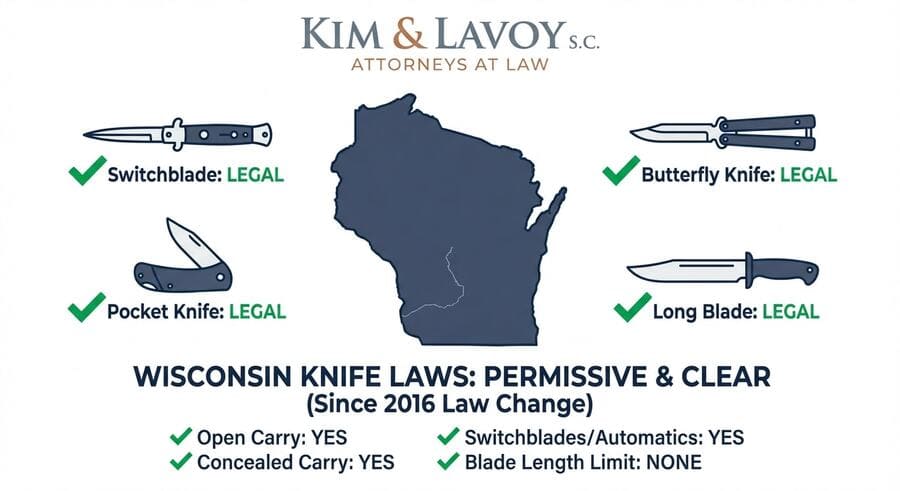
This new state statute removed nearly all restrictions on carrying a concealed knife. It also repealed the old law that criminalized switchblades, now commonly called automatic knives. Today, not all knives are restricted, and in most situations, people can legally carry knives of any blade length or type.
In practical terms, this means:
- You may carry a knife openly carried or concealed
- There are no knife blade length limits under state law
- Automatic knives and butterfly knives are no longer banned
- Pocket knife, kitchen knife, and other knives are generally lawful
For most people, carrying a concealed knife is no longer illegal simply because it is concealed.
However, there are important exceptions that still lead to serious criminal charges.
Concealed Knife and Concealed Carry: When It Becomes a Crime
While Wisconsin’s concealed carry law no longer restricts knives for most people, it does not apply to everyone.
If you are prohibited from possessing a firearm under Wisconsin law, you may also be banned from carrying a concealed knife that qualifies as a dangerous weapon. [Source]
Under Wisconsin statutes, a person prohibited from possessing a firearm who goes armed with a concealed knife that is a dangerous weapon can be charged with a Class A misdemeanor.
This means:
- Carrying a concealed knife can still be illegal in certain cases
- Carrying a concealed weapon charge may apply to knives
- Penalties can include up to 9 months in jail, fines up to $10,000, or both
This is where many people unknowingly get into trouble.
Someone who assumes concealed carry is always legal may suddenly be facing life-changing consequences.
Dangerous Weapon Under Wisconsin Law
Wisconsin law uses a broad statutory definition for what counts as a dangerous weapon.
A dangerous weapon is any device designed or used in a way capable of producing death or great bodily harm.
That can include:
- Pocket knife
- Kitchen knife
- Automatic knives
- Butterfly knives
- Certain knives with larger blades
- Other knives or other devices capable of producing death
In the wrong hands or under the wrong circumstances, nearly any blade can be viewed as capable of producing death or great bodily harm.
This matters most when someone is accused of being armed with a concealed, dangerous weapon.
From Our Managing Partner
Wisconsin’s knife laws are far more permissive than most people realize, but the exceptions are where serious charges happen. What looks legal on the surface can quickly become a criminal case if someone is prohibited from possessing weapons or the situation escalates.

Criminal or Malicious Intent Still Matters
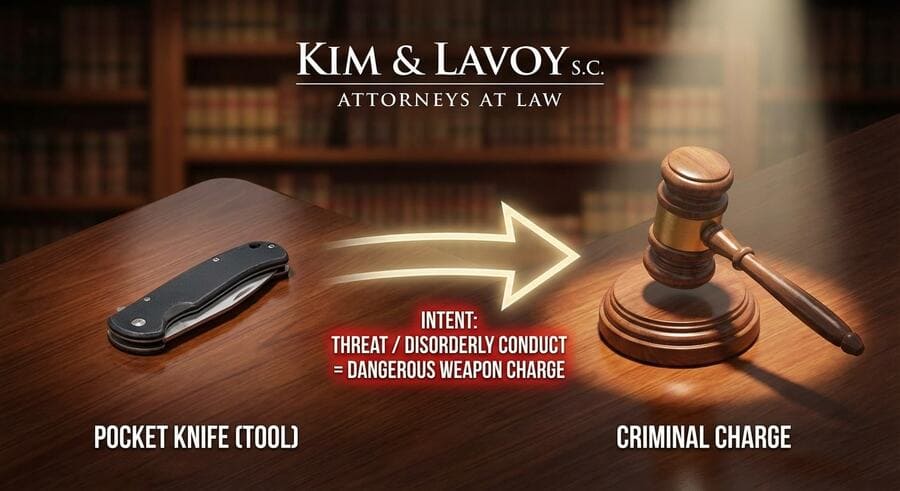
Even though most people may legally carry knives, how a knife is used or why it is present can still result in charges.
Police often focus on criminal or malicious intent when deciding whether a knife becomes part of a weapons case.
Situations that raise concern include:
- Carrying a knife during disorderly conduct
- Displaying a blade in a threatening way
- Using a knife in a confrontation
- Bringing knives into heated disputes
A knife that is usually “just a tool” can suddenly be treated as a dangerous weapon with malicious intent.
This is how many people end up charged with endangering safety or other weapons offenses. If you are facing questions from law enforcement about a knife or weapons charge, call us for a free consultation at (414) 257-2100.
Blade Length and Knife Blade Length Limits in Wisconsin
One of the most common myths is that Wisconsin has a legal blade-length limit. There isn’t.
Wisconsin law does not set knife blade length limits at the state level. No specific blade size automatically makes a knife illegal.
However, blade length can still influence how law enforcement officers view a situation. Larger blades are more likely to be seen as capable of producing death or great bodily harm, which may impact charging decisions.
So while blade length does not determine legality by itself, it still plays a role in real-world encounters.
Carry Knives Openly Carried vs Carrying a Concealed Knife
Due to changes in state law, openly carrying knives and carrying concealed knives are generally legal for most people in Wisconsin.
Open carrying a knife rarely raises issues unless it is used as a weapon or carried into restricted areas.
Carrying a concealed knife is lawful for most residents, but becomes illegal if:
- You are prohibited from possessing a firearm
- The knife qualifies as a dangerous weapon
- It is connected to criminal behavior
Understanding this distinction is critical to staying on the right side of the law.
Public Buildings, School Premises, and Restricted Locations
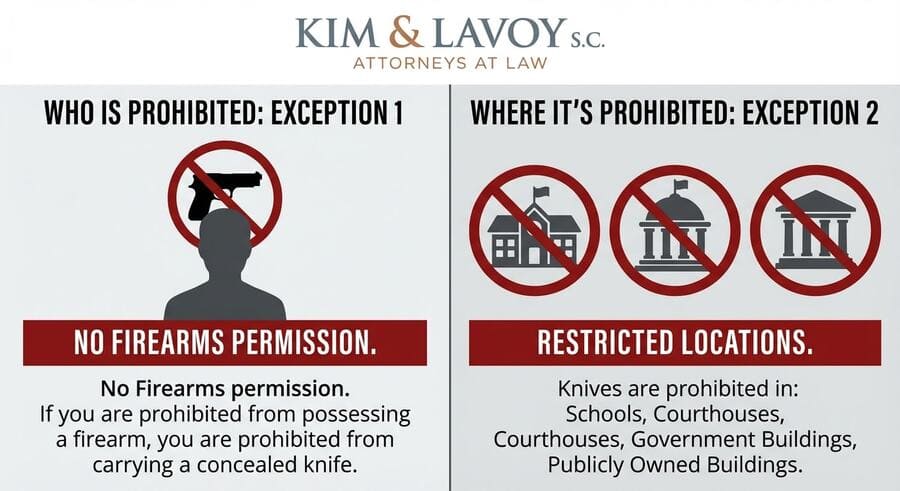
Even if you can legally carry a knife in Wisconsin, there are still places where knives are prohibited.
It is illegal to carry knives into:
- Certain governmental buildings (e.g., courthouses), where local ordinances may prohibit knives.
- Publicly owned building spaces
- Certain government facilities
- School premises
Violations near schools can be especially serious and may result in felony charges under Wisconsin law.
When it comes to restricted locations, the safest approach is to assume knives are not allowed.
Wisconsin Preemption Laws and Local Regulation
Wisconsin’s preemption laws now cover knives as well as firearms. [Source]
This means that no political subdivision, such as a city, village, or county, may enforce knife ordinances that are stricter than state law. Local regulation cannot control:
- Sale or purchase delay
- Ownership
- Possession
- Transportation
- Bearing knives
- Firearms or firearm components
- Reloader components
State law controls across Wisconsin. However, rules around government property and schools still apply statewide.
Who Is Prohibited From Carrying Knives
Certain individuals are prohibited from possessing weapons in Wisconsin.
Examples include:
- Convicted felons
- Anyone with a felony conviction involving weapons
- Individuals under restraining orders
- People are prohibited from possessing a firearm as a condition of parole or probation
If you fall into these categories, carrying a concealed knife that qualifies as a dangerous weapon may result in criminal charges. Even a small pocket knife can lead to serious legal consequences.
How Long Does a Concealed Knife Charge Stay on Your Record?

If you are charged with carrying a concealed knife illegally due to firearm prohibitions, that offense remain on your record for years / permanently unless expunged orpardoned. [Source]
Beyond possible jail time and fines, a permanent record can impact:
- Employment
- Housing
- Professional licensing
- Future legal situations
From Our Managing Partner
We see too many people assume a knife is ‘just a tool’ and end up facing life-changing consequences because of one misunderstanding. When weapons laws are involved, getting clear legal guidance early can protect your record and your future
Why Kim & LaVoy Should Be Your First Call
Knife laws may appear straightforward, but real-life cases are rarely simple. At Kim & LaVoy S.C, our team takes a calm, human-first approach while building strong legal strategies based on how Wisconsin courts actually handle weapons cases.
We focus on:
- Clear explanations instead of panic
- Protecting your record and future
- Strategic defense from the earliest stage
- Honest guidance about realistic outcomes
If you are facing criminal charges involving knives, concealed weapons, or weapons laws in Wisconsin, you want us on your side. If police are involved or charges are being discussed, call for a free consultation now at (414) 257-2100.
Summary
Is it legal to carry a knife in Wisconsin? Yes, most people may legally carry a knife in Wisconsin, openly or concealed, with no blade-length restrictions.
But carrying into publicly owned buildings, using a knife as a weapon, or carrying while prohibited from possessing firearms can quickly lead to serious criminal charges that stay on your record for life.
Do not rely on internet advice when your freedom is on the line.
Talk to a Criminal Defense Attorney Today
If you have questions about carrying a concealed knife, Wisconsin knife laws, or criminal charges involving weapons, contact our team for clear guidance and strong representation. The sooner you act, the more options you may have.
Frequently Asked Questions
Is carrying a knife in Wisconsin legal for self-defense?
Yes, most people can legally carry a knife in Wisconsin for self-defense, and the right to bear arms includes knives under state law. The one exception applies if you are prohibited from possessing a firearm due to a prior felony conviction or court order.
Does a prior felony conviction affect whether a person can carry a concealed knife?
Yes, if you have a prior felony conviction that prohibits you from possessing a firearm, Wisconsin law may also prohibit you from carrying a concealed knife that qualifies as a dangerous weapon. This is the one exception to Wisconsin’s otherwise broad concealed knife protections.
How have Wisconsin courts and the appellate court interpreted knife laws?
Wisconsin court cases, including appellate court decisions and appeals held over the years, have focused on how phrases defined in state statutes apply to real-life situations. These rulings show that intent, location, and whether a person applied the law correctly often determine the outcome.
Do knife laws apply the same way across Wisconsin, including areas like Green Bay?
Yes, Wisconsin knife laws apply statewide, including in Green Bay, because preemption laws prevent local governments from creating stricter rules. However, restricted areas like schools and publicly owned buildings still follow state law and can result in serious penalties.
Legal Disclaimer
The information provided in this article is for general informational purposes only and does not constitute legal advice. Every criminal case is unique, and the facts of your specific situation may result in different outcomes than those described here. Reading this content does not create an attorney-client relationship between you and Kim & LaVoy S.C. or any of its attorneys. Wisconsin law is complex and subject to change. For legal advice tailored to your individual circumstances, please contact Kim & LaVoy S.C. directly to schedule a consultation.