
What Is the Right to Remain Silent? | When & How to Invoke It
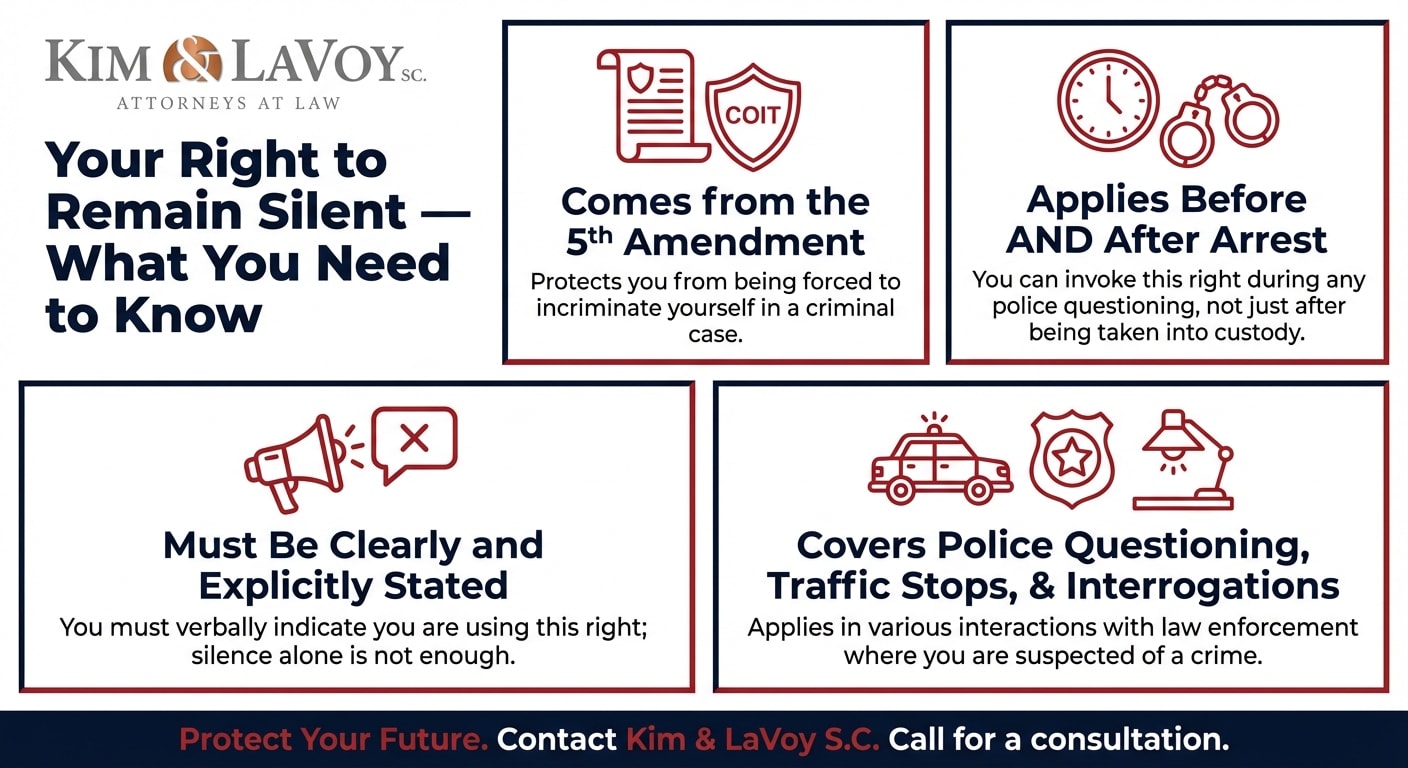
Do you have the right to remain silent in Wisconsin? Yes. But remember, you still have to follow police orders. Do not fight back. Say, “I am going to remain silent,” “I want a lawyer,” or “I am invoking my right to remain silent”. Then follow every lawful order they give you.
For many people, the moment law enforcement officers start asking questions can feel overwhelming. Your mind races; you want to explain yourself and calm the situation. Your first instinct is to talk your way out of this situation so you can go home. Seems simple enough. But what does it mean to have the right to remain silent, and how are you supposed to use that right?
The truth is that you have the right to remain silent in many situations.
As Julius Kim, Managing Partner at Kim & LaVoy S.C, explains,

“People think silence makes them look guilty. In reality, silence protects your ability to make decisions later when you understand the full picture.”
It is human nature to believe that talking will help, but in the middle of a criminal investigation, speaking without guidance can create consequences that follow you long after that moment ends. The truth is, many innocent people implicate themselves by over-explaining or embellishing details. Silence is not an indication of guilt. It’s an indication of intelligence and patience. There is no rush to talk; take your time.
The right to remain silent is a constitutional protection that allows criminal suspects to avoid self-incrimination during police questioning and throughout a criminal case. Understanding what the right to remain silent is, when you have the right to remain silent, and how to use your Miranda rights can help you protect your future rather than react under pressure.
At Kim & LaVoy S.C., we often meet people who have spoken with law enforcement officials, leaving them unsure of what they said or what will happen next. Our role is to slow the moment down, explain your Fifth Amendment rights, and help you move forward with clarity, legal counsel, and support. Contact us today for your free consultation and find out more about how we can help you navigate your case.
Call for a Free Consultation
(414) 257-2100
Key Takeaways
- Silence is not an admission of guilt, so use it!
- The right to remain silent protects you from compelled self-incrimination in a criminal case.
- Miranda rights require law enforcement officers to advise you of your constitutional rights during custodial interrogation.
- You can invoke the right to remain silent even before an arrest
- You must clearly state that you are invoking your Fifth Amendment privilege
- Remaining silent is often one of the most important early defense decisions
- An attorney present during police questioning helps protect the defendant’s rights
What to Say When You Want to Remain Silent
- “I am exercising my right to remain silent, and I want an attorney.”
- “I am going to remain silent, and I would like my lawyer.”
- “I do not want to talk.”
- “I will not answer any questions without my attorney present.”
- “I’m taking the 5th and 6th amendment. I will remain silent until after I speak with my attorney.”
What Is the Right to Remain Silent?
Many people hear the phrase “you have the right to remain silent” on television long before they experience it in real life. When it becomes personal, the meaning suddenly carries more weight.
The right to remain silent comes from the Fifth Amendment of the United States Constitution. This amendment protects individuals from self-incrimination and prevents the government from forcing a defendant’s confession during a criminal investigation. [Source]
The Supreme Court held in Miranda v. Arizona that law enforcement officers must advise a person arrested of their Miranda warnings before custodial police interrogation. [Source]
The Miranda warning includes the right to have an attorney present during questioning, and if the suspect cannot afford one, an attorney will be appointed. [Source]
The right to remain silent does not mean you cannot speak. It means you have the right to remain silent when answering police officer questions, which could result in incriminating evidence being used in legal proceedings or a criminal trial. [Source]
This Fifth Amendment protection applies whether you are at a police station, during police interrogations, or interacting with an investigating officer during a criminal case. The Supreme Court has held that the right to remain silent applies outside of criminal trials, including in civil depositions and grand jury proceedings.
Why This Right Matters More Than People Realize
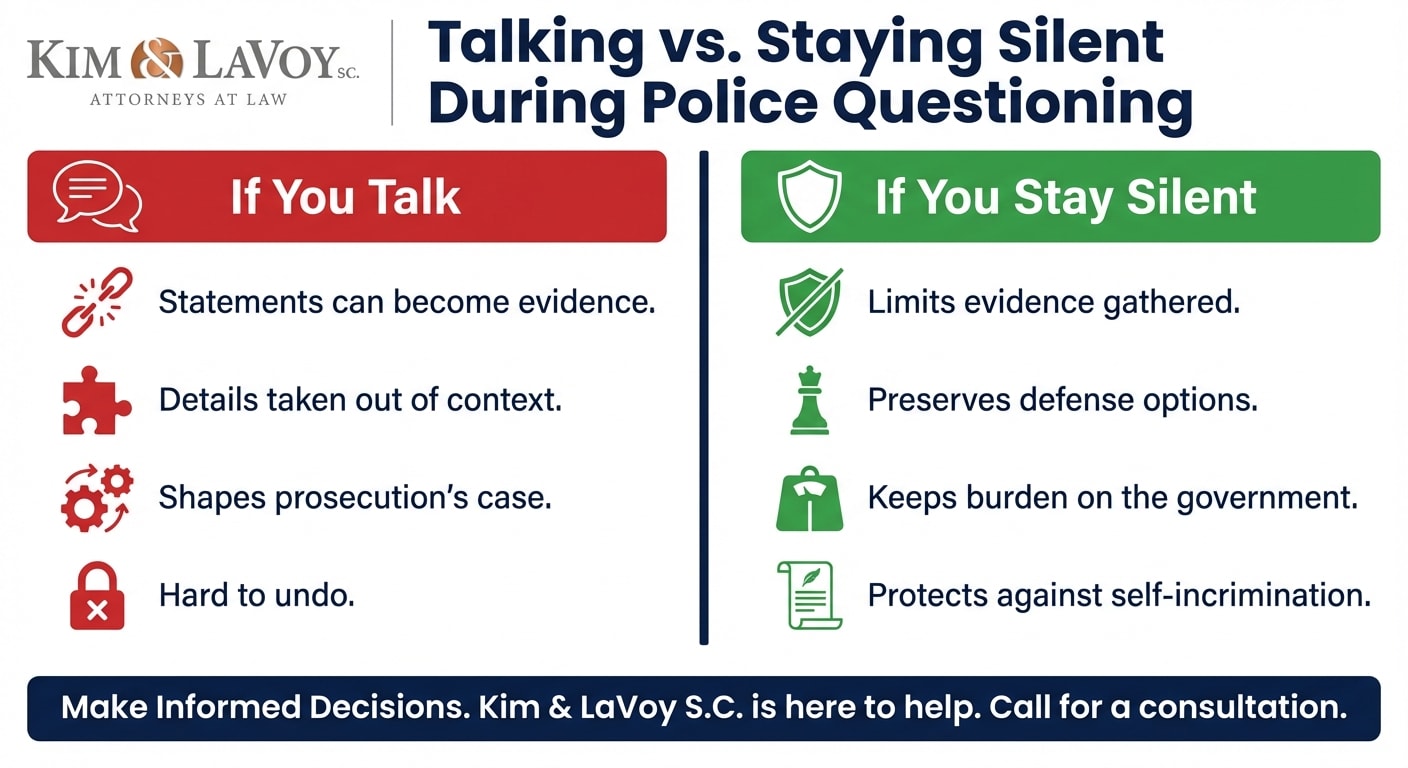
It is natural to want to cooperate with law enforcement officials. Many criminal suspects believe that explaining will clear things up. What often happens instead is that small details become substantive evidence.
The Supreme Court’s decision emphasized that statements made during custodial interrogation can shape the prosecution’s case, influence reasonable doubt, and affect the outcome of a criminal trial.
Evidence obtained through police questioning may be used even when a person did not intend to admit wrongdoing.
Mr. Kim often reminds clients,
“The system is built on information. The more information the government attempts to gather from you, the more important your amendment privilege becomes.”
The right to remain silent amendment exists to balance that power.
When to Invoke the Right to Remain Silent
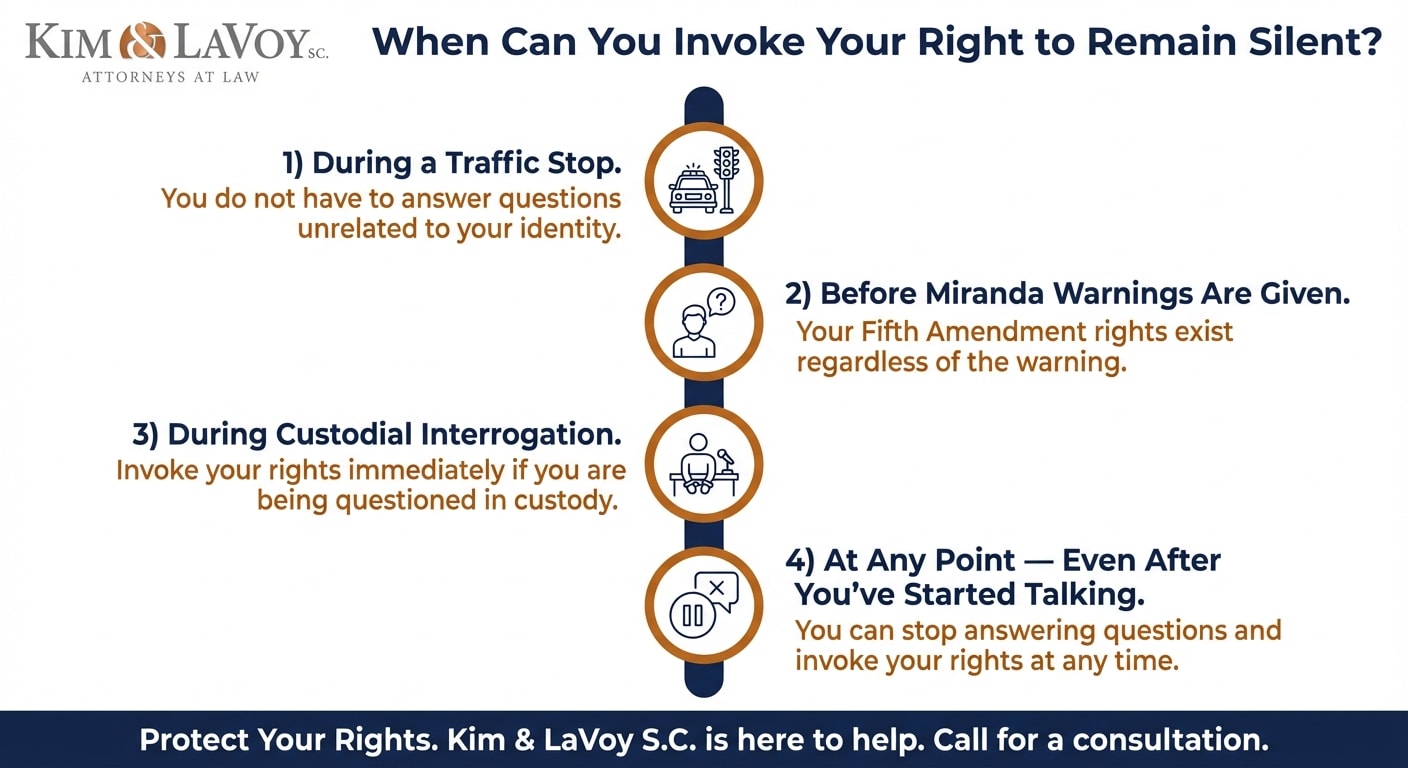
One of the most common misunderstandings is the belief that the right to remain silent only applies after a person is arrested and hears the Miranda rights. In reality, you have the right to remain silent at multiple stages.
During Interrogation
If police questioning begins and you feel suspected of a crime, you can invoke your Fifth Amendment claim immediately.
During a Traffic Stop
You must provide identification in many situations because Wisconsin can function like a stop-and-ID state in certain circumstances. However, you do not have to answer a police officer’s questions about activities that could relate to criminal charges. [Source]
Before or After Miranda Warnings
Miranda warnings reinforce your Fifth Amendment rights, but your Fifth Amendment privilege exists regardless of when they are given. A defendant decides when to invoke it.
At Any Time
Even if you initially answer police questions, you can stop at any time. Courts recognize that a defendant’s silence can begin at any point during custodial interrogation.
Mr. Kim explains it this way,
“You are allowed to pause. You are allowed to ask for help. The right to remain silent gives you that space.”
How to Properly Invoke It in Wisconsin
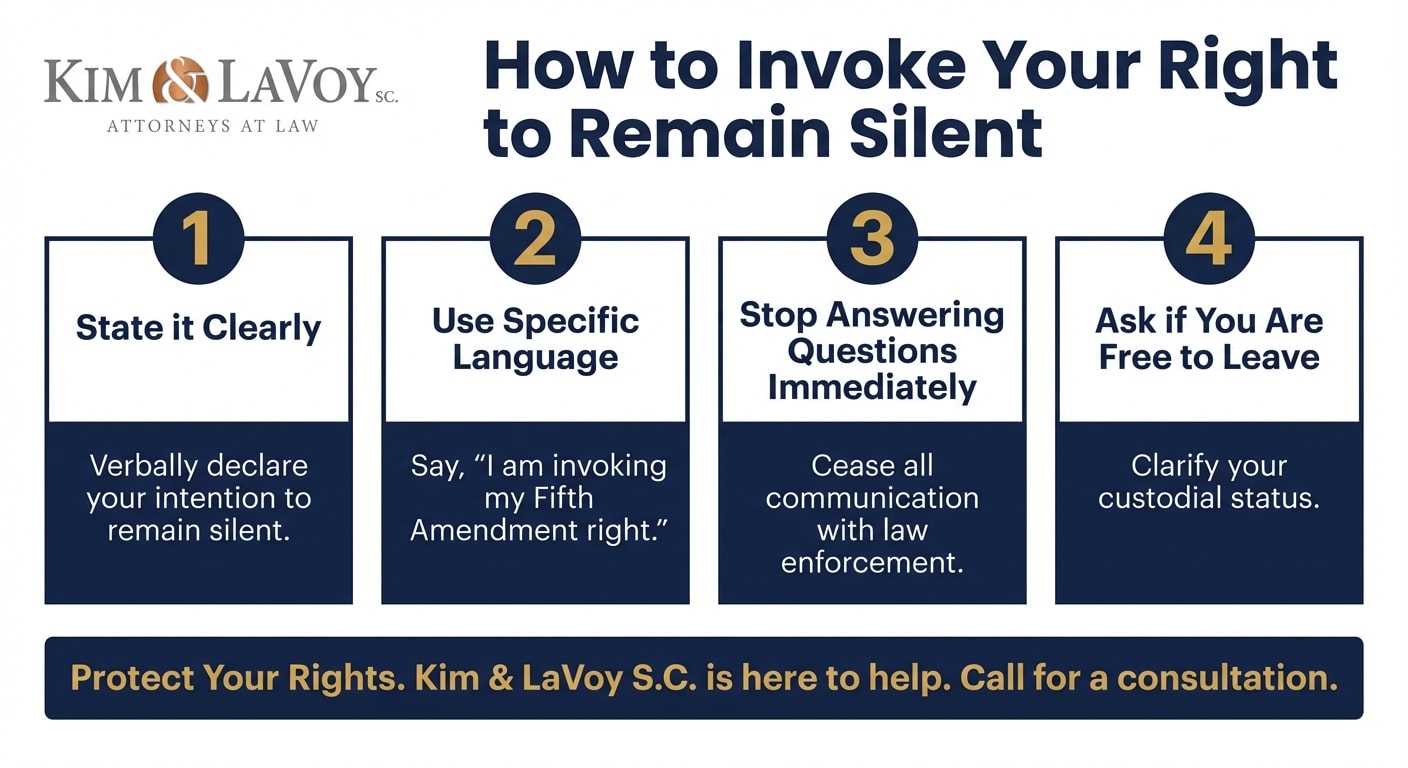
Many people assume silence alone is enough. The Supreme Court has noted that you must clearly state your intention.
Be Clear
You must say that you are invoking your Fifth Amendment rights. This creates a clear amendment claim.
Use Specific Language
Examples include:
- “I am going to remain silent.”
- “I am invoking my Fifth Amendment right to remain silent.”
- “I want an attorney present before answering questions.”
Stop Talking
Once invoked, continuing to answer police officer questions can undermine your Fifth Amendment protection.
Ask if You Are Free to Leave
If you are not free to leave, you are likely in police custody, and custodial interrogation rules apply.
These steps help prevent the improper collection of evidence and protect your constitutional rights throughout legal proceedings.
Important Considerations in Wisconsin
Understanding nuance can reduce risk during a criminal investigation.
Silence must be explicit. Courts evaluate whether statements were voluntary or coerced. Law enforcement personnel may continue the conversation, but your amendment privilege remains in effect.
The right to remain silent does not allow lying. Providing false information can create additional criminal charges and affect due process.
Mr. Kim often tells clients,
“Politeness and boundaries can exist together. You can be respectful and still protect yourself.”
This balance protects the defendant’s rights without escalating the situation.
How Kim & LaVoy Can Help
By the time many people call us, they worry they said too much. That fear is common, and it does not mean your case is over.
At Kim & LaVoy S.C., we analyze how police questioning occurred, whether Miranda rights were properly given, and whether such evidence should be challenged under Fifth Amendment grounds.
We examine custodial police interrogation, review the investigating officer’s conduct, and evaluate whether compelled self-incrimination occurred.
Our role is not only legal strategy but guidance.
Mr. Kim explains,
“Our job is to create clarity in moments that feel confusing. The earlier we are involved, the more options exist.”
Early representation can influence plea discussions, suppression motions, and the prosecution’s case as it develops before a criminal trial.
Why Silence In These Moments Feels So Hard
Many people struggle with the idea of silence because it feels uncomfortable. Silence can feel like conflict. It can feel like you are doing something wrong.
But the Fifth Amendment protects ordinary people during stressful moments. It recognizes that fear, confusion, and pressure affect decision-making.
The right to remain silent is not about hiding. It is about preserving your ability to defend yourself with full information and legal counsel present.
That is why invoking your Miranda rights is often the first meaningful step in your defense.
Conclusion
The right to remain silent is one of the most important constitutional rights available to criminal suspects. It protects against self-incrimination, shapes how evidence obtained can be used, and ensures that the burden remains on the government rather than on you. Whether you are facing police questioning, a criminal investigation, or preparing for legal proceedings, this protection can influence the direction of your criminal case.
If you or a loved one has been questioned by law enforcement officers and is unsure what to do next, speaking with one of our experienced criminal defense attorneys can provide clarity and reassurance. Call Kim & LaVoy S.C. at (414) 257-2100 for a free consultation and guidance on protecting your rights.
Frequently Asked Questions About Fifth Amendment Rights and Miranda Rights
Does the right to remain silent apply during police interrogations at a police station?
Yes. The right to remain silent applies whenever law enforcement officers question criminal suspects in police custody, including at a police station. Once Miranda warnings are given, invoking your Fifth Amendment privilege helps protect against self-incrimination and limits how statements may be used as substantive evidence in a criminal case.
What did the Supreme Court hold about the right to remain silent and the Fifth Amendment?
The Supreme Court held that the Fifth Amendment protects individuals from compelled self-incrimination and requires law enforcement officers to advise criminal suspects of their constitutional rights during custodial interrogation. These decisions established that Miranda rights are part of due process under the United States Constitution.
Can the right to remain silent affect what evidence is used in a criminal trial?
Yes. If statements are obtained without proper Miranda warnings or in violation of Fifth Amendment grounds, courts may exclude that information from a criminal trial. This amendment protection can influence whether certain statements qualify as substantive evidence.
How do Fifth Amendment rights work if an attorney is present during questioning by an arresting officer?
When an attorney participates in police interrogations, the Fifth Amendment protection is stronger because questioning must respect the privilege boundaries. Legal counsel helps ensure that criminal suspects do not unintentionally waive their Fifth Amendment rights or make statements that could impact the prosecution’s case.
Does remaining silent change how law enforcement officers build a criminal case?
Remaining silent does not stop an investigation, but it limits how law enforcement officers gather statements directly from a person. The amendment protects criminal suspects by requiring the government to rely on independent evidence rather than compelled answers, reinforcing constitutional rights throughout the criminal case.
Legal Disclaimer
The information provided in this article is for general informational purposes only and does not constitute legal advice. Every criminal case is unique, and the facts of your specific situation may result in different outcomes than those described here. Reading this content does not create an attorney-client relationship between you and Kim & LaVoy S.C. or any of its attorneys. Wisconsin law is complex and subject to change. For legal advice tailored to your individual circumstances, please contact Kim & LaVoy S.C. directly to schedule a consultation.