
OWI vs DUI vs DWI in Wisconsin: What Is the Difference?

If you are searching for DUI vs. DWI vs. OWI, chances are this is not just a random question. Something has happened, and now you are trying to understand what it means. Maybe you were pulled over after drinking. Maybe someone you love was arrested. Maybe you have paperwork in front of you that says OWI, but every search result talks about DUI or DWI. You may be worried about your driver’s license, your job, your family, your criminal record, or whether one mistake could follow you forever.
These concerns are real, and at Kim & LaVoy, we are here to help you understand the ins and outs of these charges so you can get the best possible results.
Key Takeaways
- In Wisconsin, the legal term is OWI, which stands for Operating While Intoxicated. Other states may use DUI, DWI, OUI, or similar terms.
- An OWI charge can apply even if the vehicle was not moving, because Wisconsin focuses on “operating” a motor vehicle, not only driving.
- The legal Blood Alcohol Concentration (BAC) limit for most Wisconsin drivers is 0.08%, but you can still face an OWI charge if an officer believes you were impaired by alcohol, drugs, prescription medication, or other substances.
- Refusing a chemical test can trigger a separate Notice of Intent to Revoke your driving privileges, often with only 10 days to request a hearing or take action.
- A standard first OWI in Wisconsin usually has no jail time, but aggravating factors such as injury, a minor passenger, high BAC, or great bodily harm can lead to much more serious penalties.
- An OWI can affect more than your court case, including your driver’s license, insurance, employment opportunities, finances, and future background checks.
- Speaking with an OWI attorney early can help you understand the legal process, protect your rights, and identify possible weaknesses in the stop, testing, or evidence.
What is an OWI Charge? Operating While Intoxicated in Wisconsin
If you are asking, ” What is an OWI charge?”, the simplest answer is this: an OWI charge means the state believes you were operating a motor vehicle while under the influence of alcohol, drugs, or other impairing substances.
According to the Wisconsin Department of Transportation, the legal term is OWI, which stands for Operating While Intoxicated. In other states, similar impaired driving offenses may be called DUI, DWI, OUI, drunken driving, or driving under the influence. The exact term means something slightly different depending on the state. [Source]
A person can face an OWI offense if they are accused of operating or driving a motor vehicle while intoxicated, impaired, or with a prohibited alcohol concentration.
One thing that surprises many people is that “operating” does not always mean the vehicle was moving. Wisconsin uses the word operating very intentionally. In some situations, a person may be charged even if they were sitting in the driver’s seat with the engine running.
This is often where the fear and frustration begin. You may be thinking, “I was not really driving,” or “I thought I was doing the safer thing by not driving away.” These details matter. A strong defense looks closely at what happened, what the police officer observed, how evidence was gathered, and whether the state can prove the case beyond a reasonable doubt.
DUI vs DWI vs OWI: Why the Different Terms Matter
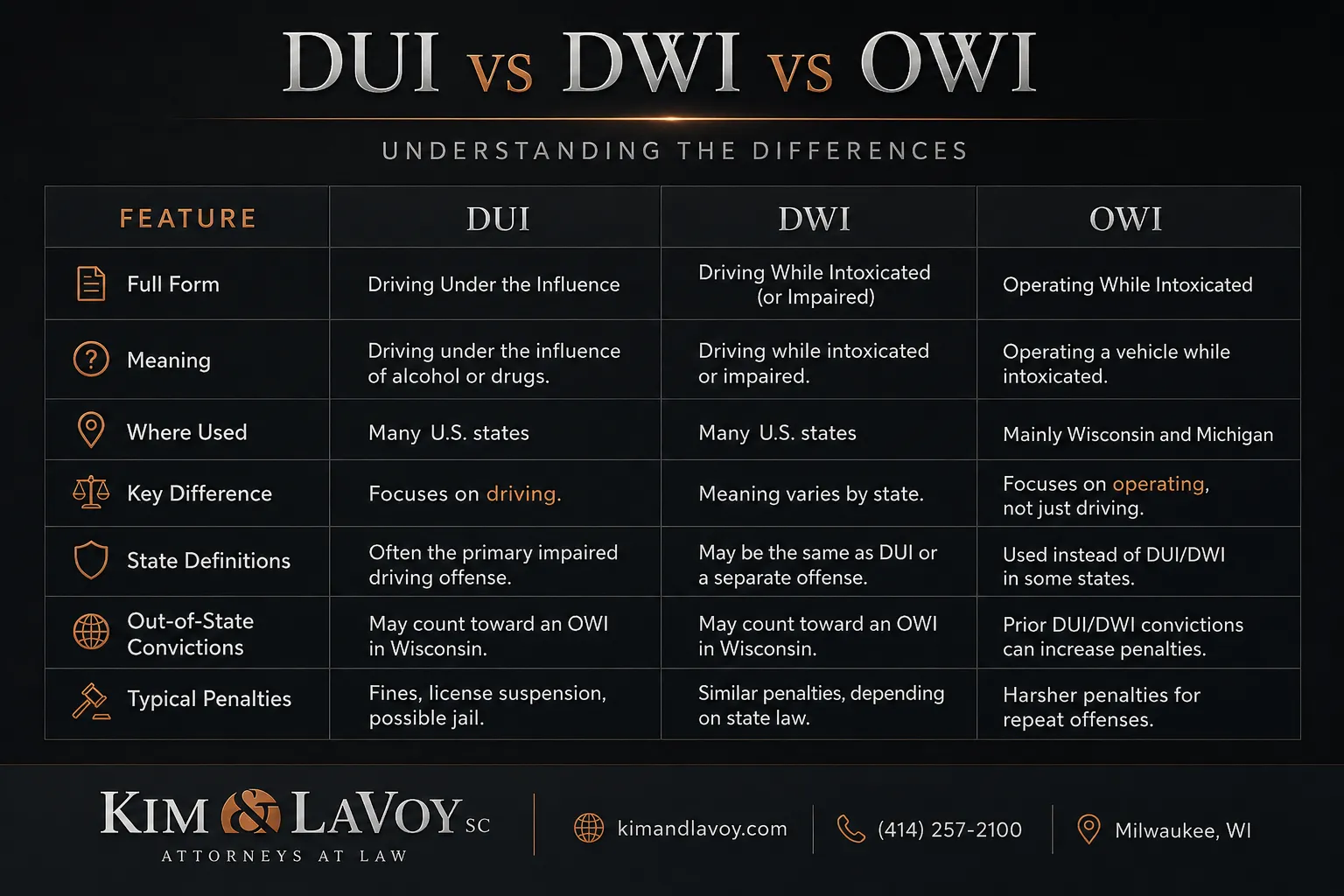
The terms OWI, DUI, DWI, and OUI are used across the United States to describe impaired driving offenses, but their exact meanings can vary by state.
- In many states, DUI means driving under the influence, while DWI means driving while intoxicated or driving while impaired.
- In some states, DUI and DWI refer to the same offense. In others, the difference depends on the driver’s blood alcohol concentration, the substance involved, or whether the person’s ability-impaired standard applies.
- DUI and DWI are the most common acronyms used across many states to describe impaired driving.
- OWI is used in states like Wisconsin and Michigan. The biggest difference is that OWI focuses on operating, not just driving.
- A DUI from another state can still matter in Wisconsin. If you have prior convictions or multiple DUI convictions from another state, those may affect how Wisconsin treats a new OWI case.
- This can change the seriousness of the charge, increase your penalties, and affect your driving privileges.
So, if you searched for intoxicated DUI, intoxicated DWI, or DUI vs DWI vs OWI, you are really trying to answer the same question: what kind of drunk driving offense am I facing, and what could it mean for my future?
Drunk Driving Laws in Wisconsin
Wisconsin drunk driving laws look at more than one factor. A case may involve your blood alcohol content, the way you were driving, field sobriety tests, chemical testing, the police officer’s observations, and whether the state believes you were too impaired to safely operate a vehicle.
The legal limit for most drivers in Wisconsin is a blood alcohol concentration of 0.08%. [Source]. This means that if your BAC is 0.08% or higher, you are considered over the legal limit for standard adult drivers. This is also the standard limit in most states, except in Utah, where it is 0.05%. [Source]
However, being under the legal limit does not always mean you cannot be charged.
If an officer believes your driving was affected by alcohol, drugs, prescription medication, or other impairing substances, an OWI charge may still follow.
This can feel frightening because your case may not be only about a number. It may also be about how the stop happened, how testing was done, what the officer wrote in the report, and whether the evidence truly supports the accusation.
What Happens After a Drunk Driving Arrest?
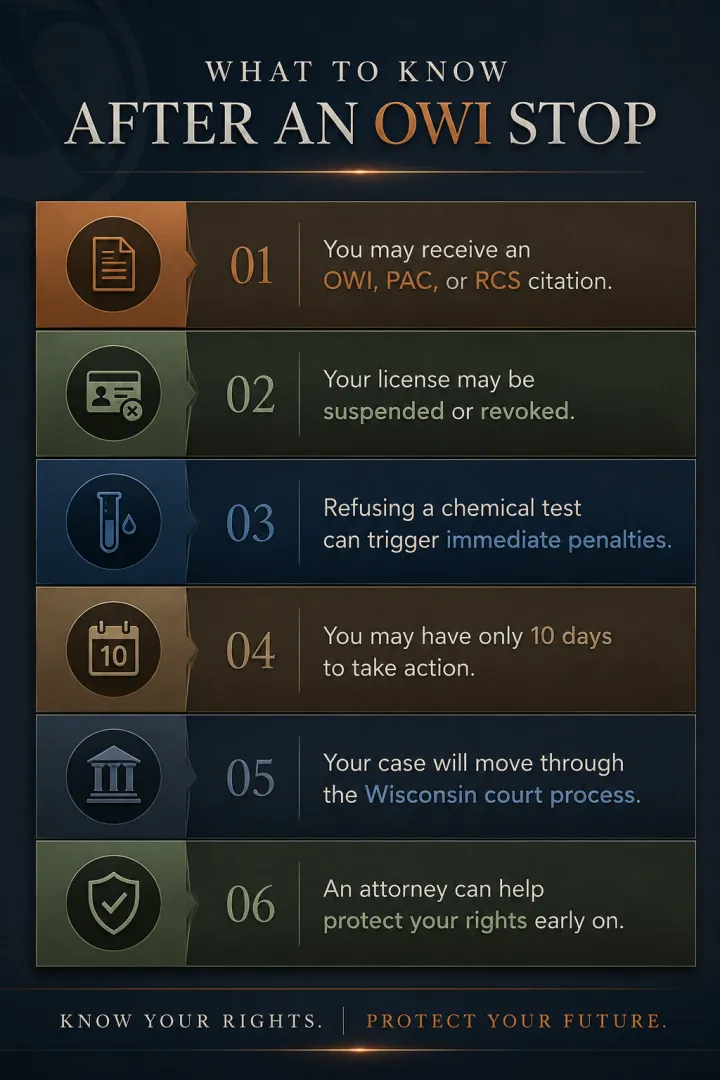
An OWI arrest or DUI arrest can feel like everything is moving faster than you can process. One moment you are pulled over, and the next you may have citations, a court date, possible license issues, and questions about your future.
In Wisconsin, after an OWI arrest, you may receive an OWI citation or a Prohibited Alcohol Concentration (PAC) or a Restricted Controlled Substance (RCS) citation if you are accused of operating with a prohibited alcohol concentration or a drug-related citation if restricted controlled substances are alleged.
You may also receive a Notice of Intent to Suspend or a Notice of Intent to Revoke your driving privileges. In Wisconsin, refusing an official chemical test violates the state’s Implied Consent Law, which means the officer can issue a Notice of Intent to Revoke your driving privileges right away. This is separate from the underlying OWI case and has its own strict deadline. In many cases, you only have 10 days to request a hearing or take action, so it is important not to ignore this notice. This deadline is set out in Wisconsin Statute § 343.305.
This is where the legal process becomes important. These documents can affect your driver’s license, your ability to work, your court obligations, and the timeline of your case.
Many first-time offenders have never been through anything like this before, which is why contacting a law firm like ours early is so important.
Legal Process: What Happens in Court?
The legal process for an OWI case may include an initial court appearance, license-related deadlines, evidence review, negotiations, and possibly a trial.
The court may dismiss the charge, find you not guilty, or convict you of OWI, PAC, or a related offense.
If convicted, your operating privilege may be revoked, and you may be required to complete an alcohol or drug assessment and a Driver Safety Plan.
If your blood alcohol content was 0.15 or higher, or if you refused a chemical test, you may also be required to use an ignition interlock device (IID). An ignition interlock device, or IID, is a breath-testing device installed in a vehicle that prevents the car from starting if the driver’s breath alcohol level is too high. In Wisconsin, an IID is required for repeat OWI offenders, first-time OWI offenders with a BAC of 0.15% or higher, and drivers who refuse a breath or blood test during a traffic stop. [Source]
This is why early legal guidance matters. An attorney can review whether the stop was lawful, whether the testing was reliable, whether the officer followed proper procedures, and whether there are weaknesses in the case.

“This doesn’t define who you are. Many of our clients, in all honesty, are first-time offenders. They’re not repeat offenders. They’re people that found themselves in bad situations just from circumstance.”
OWI Penalties Overview in Wisconsin
Penalties for a drunk driving offense increase significantly depending on the offense count and aggravating factors, such as a high BAC level, a minor in the vehicle, injury, refusal of chemical testing, or prior convictions.
Repeat OWI offenders and people facing subsequent offenses may face severe penalties, including longer jail sentences, higher fines, longer license suspension or revocation periods, ignition interlock requirements, and mandatory participation in alcohol education programs. [Source]
The Financial Cost of an OWI in Wisconsin
An OWI can cost far more than the fine listed on your citation. Even a first offense can come with court costs, state surcharges, insurance increases, license fees, assessments, and possible ignition interlock expenses. For many people, the financial pressure becomes one of the most stressful parts of the process.
By the time all related expenses are added, even a first OWI in Wisconsin can cost thousands of dollars and may exceed $10,000 in some cases. [Source]This is why it is important to understand the full financial impact early and speak with an attorney about ways to protect your license, your record, and your future.
How Kim & LaVoy Can Help
When you are facing an OWI, you do not just need someone to explain the law. You need someone who can help you understand what is happening, what your options are, and how to protect your future.
At Kim & LaVoy, we can help by:
- Reviewing the traffic stop, arrest, field sobriety tests, breath test, blood test, and police report
- Checking whether the officer followed proper procedures
- Looking for weaknesses in the evidence or issues that may create a reasonable doubt
- Explaining possible penalties, license consequences, court deadlines, and next steps
- Helping you understand whether your case may involve a civil violation, misdemeanor, or felony
- Building a defense strategy based on your specific situation
- Representing you in court and communicating with prosecutors on your behalf
- Helping you protect your driver’s license, record, job, and future where possible
Our goal is to make the process less overwhelming. Our team looks at both sides of your case: the legal side and the personal side, including how the charge could affect your work, family, finances, and peace of mind. We are here to help you navigate this charge with no judgment and an open understanding.
Facing Drunk Driving Charges in Wisconsin?
An OWI charge can feel overwhelming, especially when you are unsure what it means for your license, your record, your work, or your family. You do not have to wait until things feel more serious to ask for help. The sooner you speak with an attorney, the sooner you can understand your options and take the next step with more clarity.
If you are facing an OWI or drunk driving charge in Wisconsin, contact Kim & LaVoy S.C. to schedule a confidential consultation with an attorney who will listen, explain your options, and help you move forward.
Frequently Asked Questions About DUI vs. DWI vs. OWI
What are the Aggravating Factors That Can Make an OWI More Serious
Not every OWI case is treated the same. Certain facts can make the penalties more serious and increase the risk of long-term consequences. If a passenger under age 16 was in the vehicle, statutory penalties can be doubled. A first OWI may also be treated as a criminal offense instead of a civil violation. If the BAC was high, fines may be multiplied. For example, fines can be doubled for a BAC of 0.17 to 0.199 and tripled for a BAC of 0.20 to 0.249. If a driver refuses a chemical test, they may face separate license consequences and may be required to install an ignition interlock device. Wisconsin also has strict rules around restricted controlled substances. Even a trace of certain substances, such as marijuana, cocaine, or methamphetamine, can create serious legal concerns.
Will an OWI affect your future?
The answer depends on the type of offense and your history. In Wisconsin, a first OWI is generally a civil violation, but a second or later OWI is usually a criminal offense. Most DUI, DWI, and OWI charges in many other states are criminal offenses, which can limit future employment and housing opportunities. A DWI conviction in many states can remain on your criminal record indefinitely. A Wisconsin criminal OWI conviction can also create long-term consequences that may appear in background checks. This can affect employment opportunities, housing applications, professional licenses, insurance rates, commercial driving jobs, and, in some cases, immigration or travel concerns.
Does a DUI stay on the record forever?
In many states, DUI convictions can stay on a person’s record indefinitely. The answer depends on the state, the type of conviction, and whether expungement is available. A DUI conviction can also remain on your driving record for a long time, even when the criminal and driving consequences are treated differently. In Wisconsin, the question is usually about OWI rather than DUI. A first OWI may not create a criminal record in the same way a criminal conviction would, but it can still appear in driving records and certain background checks. A second or later OWI is more serious and can become part of your criminal record.
How long does an OWI stay on a record in Wisconsin?
For sentencing purposes, a prior OWI may count against you for 10 years in certain situations. However, if you have more than one prior offense, Wisconsin can look further back, and prior convictions may affect penalties in future cases. For your driving record, an OWI can remain visible and may affect insurance and licensing. For your criminal record, a second or subsequent OWI can remain long-term because it is treated as a criminal offense. The important thing to understand is that the 10-year lookback does not mean the OWI disappears. It only affects how certain prior offenses may be counted for sentencing in specific circumstances.
What is the difference between Reckless Driving vs OWI?
Some people wonder whether an OWI can be reduced to reckless driving. In some states, a DUI charge may be negotiated down to reckless driving depending on the facts and local law. In Wisconsin, whether that is possible depends heavily on the prosecutor, the evidence, your history, and the details of the case. No attorney can promise a specific result, but a strong defense starts by reviewing every detail. That includes the traffic stop, the officer’s observations, testing procedures, chemical testing, video footage, witness statements, and the state’s ability to prove the case beyond a reasonable doubt.
Legal Disclaimer:
This content is for general informational purposes only and is not legal advice. Every case is unique and outcomes vary. For advice specific to your situation, contact Kim and LaVoy S.C. directly.