
What Is a Pre-Sentence Investigation (PSI) and What Happens Next in Wisconsin?

This article is for anyone facing sentencing on a felony conviction or guilty plea in Wisconsin who wants to understand what a pre-sentence investigation (PSI) involves and how to prepare for it. A PSI report is one of the most important documents in your case. It goes directly to the judge before sentencing and shapes every decision that follows, from probation eligibility to prison classification.
A PSI is a formal process through which a probation officer gathers detailed background information about you and submits a pre-sentence report to the judge before sentencing. This page explains the process, what the probation officer is looking for, and what you can do to put your best case forward.
At Kim & LaVoy S.C., we’ve guided clients through this process countless times.

“So I think the big surprise that people have is that, boy, in Wisconsin, a lot of times things that seem not so big of a deal are treated very seriously.”
Key Takeaways
- A pre-sentence investigation (PSI) is ordered by the court after a conviction or guilty plea, usually in felony cases.
- A probation officer prepares the pre-sentence report by interviewing the defendant, contacting family members, employers, and law enforcement agencies.
- The pre-sentence investigation report is disclosed to both defense counsel and the prosecutor at least 35 days before sentencing.
- The judge considers but is not bound by the sentencing recommendation in the pre-sentence report.
- You have the right to review the report with your attorney and challenge factual errors before the hearing.
What is a Pre-Sentence Investigation Process in Wisconsin?
A pre-sentence investigation is a court-ordered formal process to gather detailed information about a convicted defendant before sentencing. It differs from a pre-trial status conference, which is held before the trial begins.
The PSI covers every aspect of the defendant’s background and the offense.
A probation officer of the Wisconsin Department of Corrections then summarizes the information and submits it to the court before the sentencing hearing.
What Triggers a PSI in Wisconsin?
A PSI isn’t ordered in every criminal case. It typically follows a felony conviction or a guilty plea to a felony charge. When the court orders this pre-sentence investigation, the probation department begins immediately.
In misdemeanor cases, a PSI is less common, though the court may still order one. You can read our guide for more information on the steps in a misdemeanor case in Wisconsin.
What is a Pre-Sentence Investigation Report?
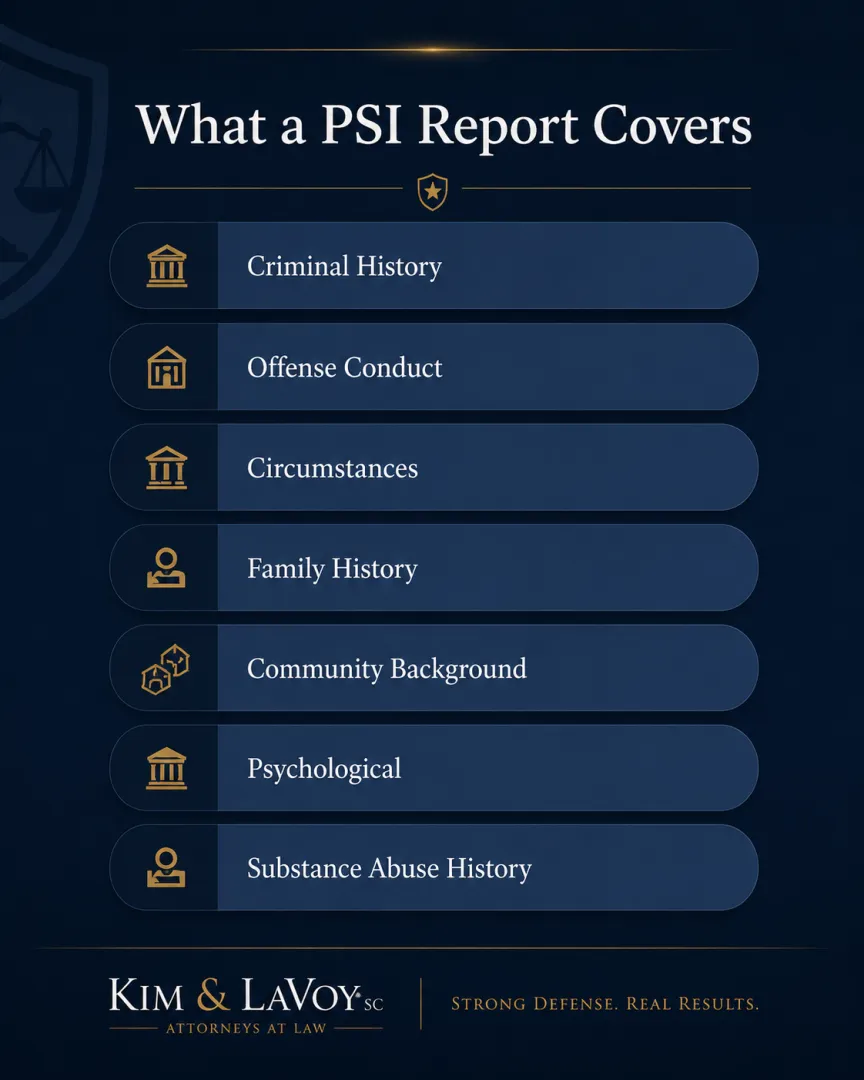
Probation officers review numerous documents and conduct interviews to build a complete picture of the offender and their history for the PSI. If you’re wondering what a PSI is in court, here’s what it usually contains.
Criminal History Records and Court Records
The defendant’s full criminal history, including prior arrests, convictions, court dockets, prior probation, and any probation violations. Other investigative reports on file are reviewed as well.
The Offense Conduct and Circumstances
This section covers the details of the offense, the defendant’s conduct, and any victim impact information. The officer may reach out to law enforcement agents, interview the prosecutor’s office, review trial transcripts, examine plea agreements, and gather factual findings.
Family History and Community Background
The probation officer gathers information on the defendant’s family members, family history, community ties, and emotional health history. Relatives will be asked to speak to the defendant’s character and background.
Psychological and Substance Abuse History
The probation officer also documents treatment history for psychological issues, emotional health, and substance abuse. Courts use this when weighing sentencing options.
“It’s not just a matter of getting people from point A to point B within the criminal justice system. But along the way, if we’re doing our job right, in my opinion, we’re also making sure that their mental health is good. We’re making sure that if there are any other substance abuse issues or mental health issues that may be present, that we are taking care of those issues. Because regardless of what happens to the case, we want to make sure that people don’t find themselves in the same position down the line.”
What is the Purpose of a PSI report?
The PSI gives the sentencing judge something a trial transcript can’t. It creates a full picture of who the defendant is, not just what they did. Judges consider pre-sentence reports before imposing sentences because a charging document alone doesn’t tell you much about a person’s work history, family situation, or treatment needs. The report also helps the court evaluate your risk level and set appropriate supervision conditions if you’re placed on probation or released after serving time. In federal cases, probation officers conduct the same type of investigation, though the process follows federal rules and guidelines rather than Wisconsin state court procedures.
How Long Does a PSI Investigation Take in Wisconsin?
In Wisconsin state court, most PSI investigations in Milwaukee and Waukesha Counties take between four to twelve weeks from the date the court orders the investigation to the date the pre-sentence report is submitted.
What is a PSI Hearing in Wisconsin?
A PSI hearing is the court proceeding at which the sentencing judge imposes the defendant’s sentence after reviewing the completed pre-sentence report. For context on earlier proceedings, see our article on understanding arraignment rules in Wisconsin.
What Happens at the Sentencing Hearing?
The judge has reviewed the pre-sentence report and received recommendations from both the prosecutor and your attorney. In some cases, the probation officer may also testify about their findings, allowing the court to ask questions directly about the investigation. The defendant can address the court directly, and the defendant’s family members or other persons may speak on their behalf.
Victims may submit impact statements. Defense counsel presents mitigating information, addresses the defendant’s conduct, challenges any errors in the PSI, and argues for the appropriate sentence.
Does the Judge Have to Follow the PSI Recommendation?
The sentencing recommendation in the pre-sentence report is not binding on the court. The judge considers the PSI, victim impact statements, the parties’ recommendations, and the defendant’s own statement, then applies sentencing guidelines.
“While we can’t guarantee what’s going to ultimately happen in your case, it is the best result you can expect under the circumstances.”
What Can You Do to Prepare for a PSI Investigation?
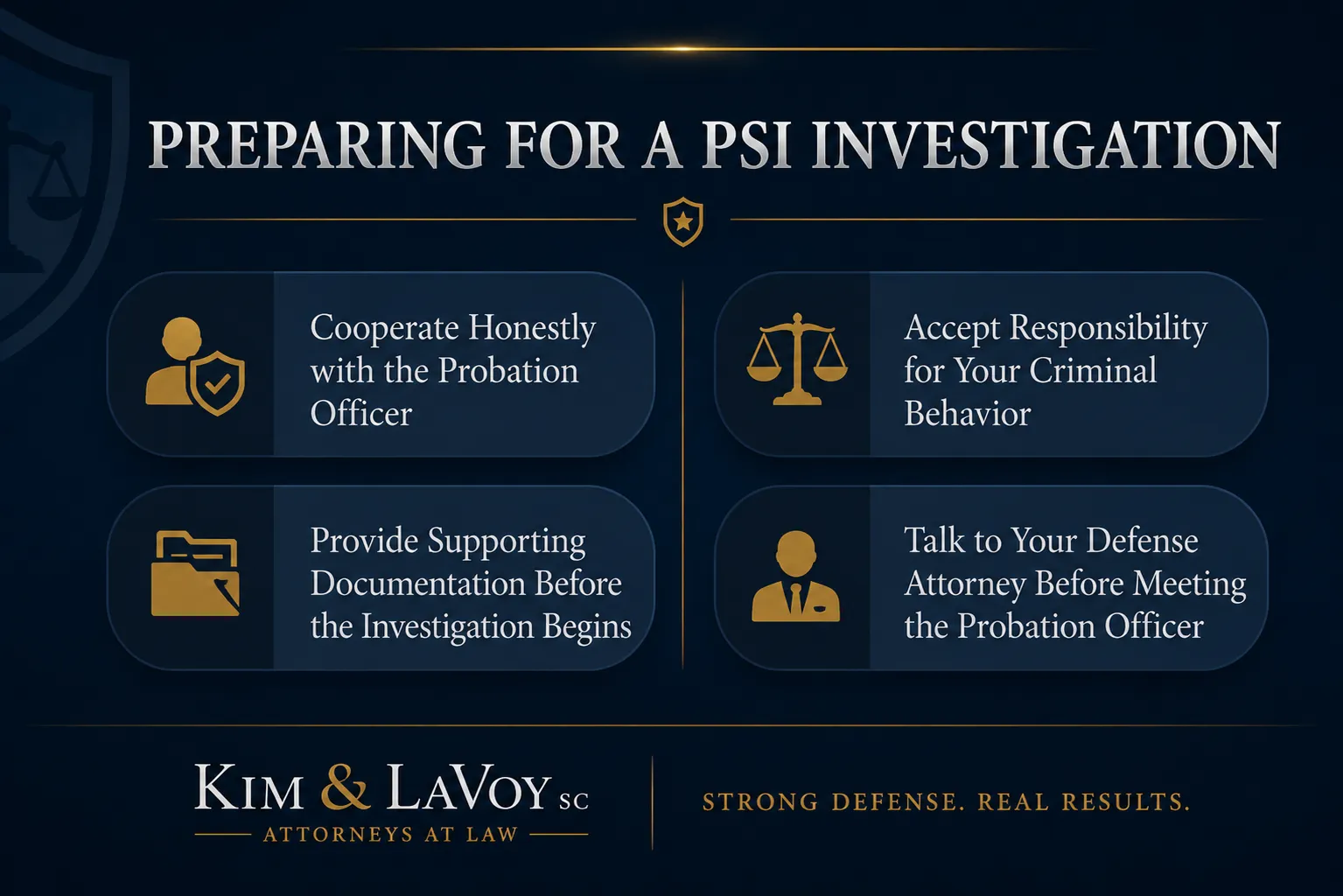
The probation officer’s investigation isn’t adversarial, but what gets recorded directly shapes the sentencing recommendation the judge reads.
Cooperate Honestly with the Probation Officer
The probation officer expects to meet with you and answer questions about your background. You can decline answering specific questions because that’s your right, but complete non-cooperation gets noted in the report and the court’s notice. Be accurate, consistent, and speak openly.
Accept Responsibility for Your Criminal Behavior
The officer evaluates not only what you did but how you understand it. Defendants who accept responsibility for their criminal behavior and show a genuine understanding of the harm they caused tend to receive more favorable assessments.
Provide Supporting Documentation Before the Investigation Begins
If you have employment records showing stable work history, documentation of substance abuse treatment, scholastic records, or letters of support, get them to your attorney. The probation officer will review numerous documents, and providing verified, favorable information gives you more control over how your background gets represented in the pre-sentence report.
Talk to Your Defense Attorney Before Meeting the Probation Officer
The initial meeting with the probation officer sets the tone for the entire pre-sentence investigation, and what you say will appear in the report. Speak to an attorney about what to say, what to decline, and how to frame your situation accurately.
“A lot of times people panic, right? And then after something like this happens, they panic, they start getting online, they start doing their own research, and they actually might end up making their case worse for themselves because they don’t realize that by doing these things, they’re actually butting the waters a little bit more. So what I always try and tell people is just freeze the situation, take a deep breath, and then call someone that can give you clear advice and guidance so that you can make decisions about what to do next with a clear head.”
Facing sentencing in Wisconsin? Talk to a defense attorney before the PSI process begins.
At Kim & LaVoy S.C., our defense attorneys have handled PSI preparation, plea deal negotiations, and sentencing hearings across Milwaukee, Waukesha, and surrounding Wisconsin counties.
Frequently Asked Questions
Is a pre-sentence investigation ordered in every criminal case in Wisconsin?
No. A PSI is most commonly ordered in felony cases and is required when a defendant is found guilty of certain sex offenses. In misdemeanor cases, the court has discretion to order one, but typically doesn’t.
Can I refuse to speak with the PSI investigator?
You can decline to answer specific questions, but speak with an attorney before your initial meeting with the probation officer. Completely refusing to participate gets noted in the report, and courts generally view it unfavorably.
Who sees the PSI report?
The pre-sentence report goes to the court and is disclosed to both the prosecutor and defense counsel. It’s not a public document, though supervising probation officers and prison classification staff may access it after sentencing.
Can errors in the PSI report be corrected?
Yes. Defense counsel can raise objections to factual findings that are inaccurate or misleading before the hearing. The court rules on any contested information. Errors that go unchallenged can follow a convicted offender through probation and beyond, affecting their prison classification and parole decisions.
What happens if I disagree with the PSI sentencing recommendation?
The officer’s sentencing recommendation isn’t binding, and your attorney can argue against it at the hearing. Counsel can present alternative options and challenge the factual basis of the recommendation. A disagreement alone won’t change anything, so your attorney needs a clear, evidence-based argument for why a different sentence is appropriate.
How does the PSI affect whether I get probation or prison?
The pre-sentence investigation report is the primary document the court uses to evaluate sentencing options. A well-prepared defendant with documented treatment, stable employment, and strong family support is generally in a better position, but outcomes depend on the nature of the crime, prior criminal history records, and the applicable sentencing guidelines.
Consider an Independent PSI
In some cases, your attorney can commission an independent PSI conducted by a separate evaluator who isn’t affiliated with the Department of Corrections. This independent assessment can take a more thorough look at your background, mental health, and rehabilitative potential than the standard pre-sentence report.
It’s not a guaranteed solution, but worth discussing with counsel.
Legal Disclaimer:
This article is for general informational purposes only and does not constitute legal advice. Every case is unique. Reading this content does not create an attorney-client relationship. Wisconsin law is subject to change. Contact Kim & LaVoy S.C. directly for legal advice tailored to your circumstances.