
Punishment for Juvenile Crimes in Wisconsin: Common Crimes, Charges & Consequences
Most parents who call us have not slept. They are not thinking about statutes or court dates yet. They are thinking about whether their kid is going to have a criminal record at 16, whether this follows them to college, whether they are going to lose everything over one bad decision or one bad night. Those are the right questions, and we hear them every single time.
What we tell every parent in that first conversation is that a charge is not a conviction, and this moment doesn’t have to become the thing that defines your child’s future. What happens next depends on what the charge is, how old your child is, and how quickly you act. The sooner we are involved, the more we can do. If you or your child is facing juvenile crime charges, contact our team at Kim & LaVoy S.C.
Key Takeaways
- In Wisconsin, the juvenile court has jurisdiction over children ages 10 to 16. At 17, your child is automatically processed in adult criminal court, without juvenile protections, under Wisconsin Statute § 938.12.
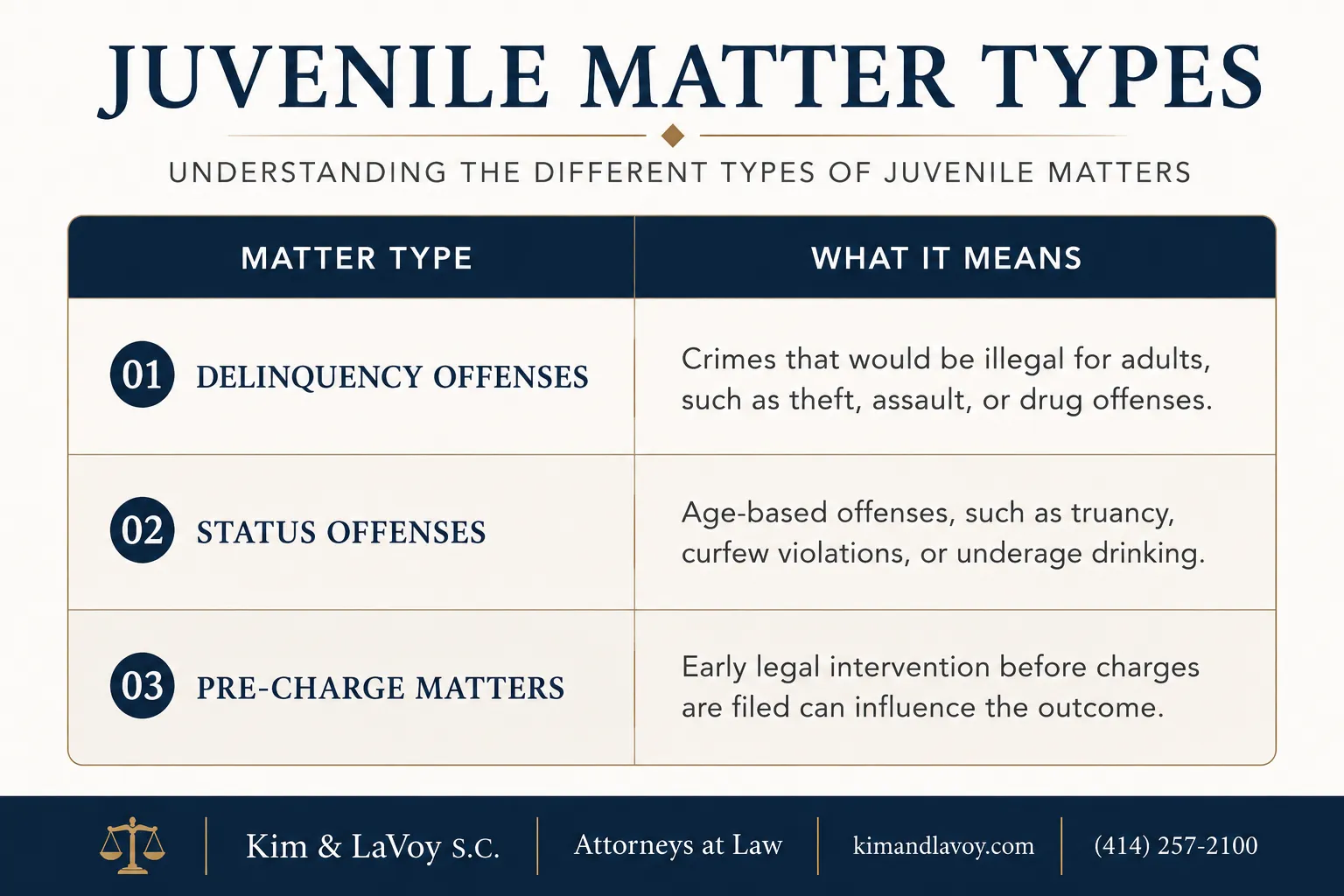
- Juvenile charges fall into three categories: delinquency offenses (acts that would be illegal for any adult), status offenses (only illegal because of age, like truancy or underage drinking), and pre-charge matters where no charges have been filed yet but police are involved.
- A juvenile adjudication is not the same as a criminal conviction. But it is nothing. It can affect school enrollment, college applications, professional licensing, and housing.
- Wisconsin courts have wide discretion in disposition. Outcomes range from counseling and community service all the way to placement in a juvenile detention facility or, for the most serious offenses, adult criminal court.
- In some jurisdictions, juveniles who commit minor offenses may be referred to programs like the Youth Crisis Stabilization and Reentry program, which allows them to make amends without receiving a criminal record if they complete the program.
- Juvenile records in Wisconsin are confidential, but do not disappear automatically. Your child may petition for expungement after turning 17 under Wisconsin Statute § 938.355(4m), but only after completing their dispositional order and only if the court finds it serves their interest without harming the public.
- For certain serious offenses, including homicide, a child as young as 10 can be charged in an adult criminal court under Wisconsin Statute § 938.183.
- The earlier we are involved, the more options we have. Diversion programs and deferred prosecution are available at the beginning of a case. Once the case moves forward without an attorney, those options tend to close.
How the Wisconsin Juvenile Justice System Actually Works
The Wisconsin juvenile system is designed around rehabilitation, not punishment. That is the theory. In practice, what your child faces depends heavily on the charge, the county, the judge, and the strength of the case built on their behalf.
Juvenile delinquency is governed by Chapter 938 of the Wisconsin Statutes. Under the statute, the juvenile court has jurisdiction over any child 10 years or older alleged to be delinquent.
Here is something most parents do not realize. Wisconsin is one of only three states, along with Georgia and Texas, that defines a juvenile as someone under 17. This means that your 17-year-old child is not protected by the Wisconsin juvenile system, and they go directly into adult criminal court.
The Three Categories of Juvenile Offenses
- Delinquency offenses are acts that would be illegal for an adult. Theft, assault, drug possession, sex offenses, and weapons charges all fall here. When a child commits a delinquent act, law enforcement refers the case to juvenile court intake.
- Status offenses are only illegal because of the person’s age. Truancy, curfew violations, and underage drinking are the most common. These carry different consequences than delinquency offenses, but they can still result in formal court involvement.
- Pre-charge matters are the most overlooked window. This is when police know something happened, but charges have not been filed yet. Getting an attorney involved here, before anything is formalized, can shape how the offense is characterized. That early intervention can make a material difference in what your child ultimately faces.

“These things happen. Let’s not make it ruin your child’s life. The goal is to get them through this process without completely undoing everything they’ve worked hard for.”
Types of Juvenile Crimes: Most Common Offenses in Wisconsin
Part of what makes these situations so disorienting is that what looked like a minor incident can become a serious charge very quickly. We see this constantly.
The most common charges include:
- Theft and shoplifting: The most common property crime among juvenile offenders.
- Disorderly conduct: A broad charge covering fights and public disturbances.
- Simple assault or battery: Including school altercations.
- Drug possession: Most often marijuana-related.
- Vandalism and malicious destruction of property: Graffiti, damaged vehicles, motor vehicle theft.
- Aggravated assault: Charged when a weapon is used or serious bodily harm results.
- Underage drinking: Possession or consumption of alcohol.
- Sex crimes and sexual offenses: Including sexting between minors, which can result in serious charges for juvenile sex offenders.
- Domestic violence: More common in juvenile cases than families expect.
- Truancy and curfew violations: The most common status offenses among juvenile males and female juveniles.
- Weapons possession: Triggers mandatory law enforcement referral under Wisconsin criminal law.
One thing worth knowing: zero-tolerance school policies have pushed more youth into the juvenile court system than at any previous point. What used to end in a call home now ends in an arrest. That doesn’t make the situation hopeless, but it does mean you shouldn’t wait to understand what your child is facing.
“We have had cases where kids are essentially playing pranks. Usually, back when I was growing up, if the police did get involved, they’d just tell you to knock it off and go home. These days, people are getting arrested and charged with misdemeanor and sometimes felony offenses for these things.”
Juvenile Misdemeanor Punishment vs. Juvenile Felony Charges
The Wisconsin juvenile court doesn’t use the same labels as the adult criminal court. There is also no jury. A judge reviews the evidence and decides both the finding and the disposition.
Under Wisconsin Statute § 938.341, a delinquent act that is equivalent to a felony triggers mandatory firearm restriction notices. And under Wisconsin criminal law, if your child faces adult charges later in life, a prior juvenile adjudication can be used to treat them more harshly. The record doesn’t disappear simply because it was handled in juvenile court.
Punishment for Juvenile Crimes: What the Court Can Order at Disposition
Wisconsin Statute § 938.34 gives Wisconsin courts a wide range of options when a juvenile is adjudicated delinquent. The table below shows how those options typically map to the type of offense. These are not automatic outcomes. They are the range the court can work within, and that range is precisely where we fight for your child.
Property crimes and drug-related crime make up the largest share of juvenile delinquency cases statewide.
Other Penalties and Consequences of Juvenile Offenses
- Probation supervised by a probation officer, which comes with strict conditions
- Home confinement or residential placement, which can include a foster home setting
- Placement in a juvenile detention facility for more serious offenses
- Treatment facilities for substance abuse or sex offense-related adjudications
- Firearm restrictions for felony-equivalent adjudications
- School expulsion, which can affect college applications and professional licensing well into adulthood
The most effective juvenile rehabilitation programs address specific risk factors of the individual while maintaining community connections. Research consistently shows that keeping a young person connected to family, school, and community during this process produces better outcomes than removing them from those environments.
When a Juvenile Can Be Charged as an Adult
This is the part of Wisconsin law that genuinely surprises most families, and it is important to understand it clearly.
Under Wisconsin Statute § 938.183, the adult criminal court has original jurisdiction over young offenders as young as 10 for alleged homicide. This includes first-degree murder and second-degree murder.
For juvenile offenders, the juvenile court may also waive jurisdiction under Wisconsin Statute § 938.18. Waiver may be sought at age 14 for specific serious offenses, and at age 15 for any state criminal law violation.
Being transferred to adult court means adult-level penalties, a permanent criminal record, and no juvenile court protections. Adults convicted of violent crimes or sex offenses face adult prisons. Legal counsel before a waiver hearing is critical.
What Happens to Your Child’s Record
This is one of the questions parents think about most and often do not ask directly: Will this be on their record forever?
Juvenile records in Wisconsin are confidential, but they do not disappear on their own. Adults carrying undisclosed juvenile records often find out about them the hard way, during a background check for a job, an apartment, or a professional license.
Your child may petition for expungement after turning 17 under Wisconsin Statute § 938.355(4m), but only if:
- They completed their dispositional order in full
- The court finds that expungement serves its interest without harming the public
The Second Chance Act (2007) and the Second Chance Reauthorization Act (2018) reflect federal recognition that rehabilitation and re-entry support for juvenile offenders produce better long-term outcomes than incarceration alone. Wisconsin’s own expungement and diversion tools exist within that same framework.
The expungement process has specific steps, and missing any of them can leave the record intact even when your child has done everything asked of them. We make sure that doesn’t happen.
How Kim & LaVoy Can Help
When a parent calls us after a juvenile arrest, the first conversation is not about statutes. It is about what actually happened, because the legal charge and the full picture are rarely the same thing. We want to understand the situation your child was in, not just the paperwork that came out of it.
Julius Kim spent years as a Milwaukee County Assistant District Attorney. He knows exactly how these cases are built, what prosecutors look for, and where the evidence can be challenged. That experience works in your child’s favor from day one.
Here is what we do when we work with families on juvenile charges:
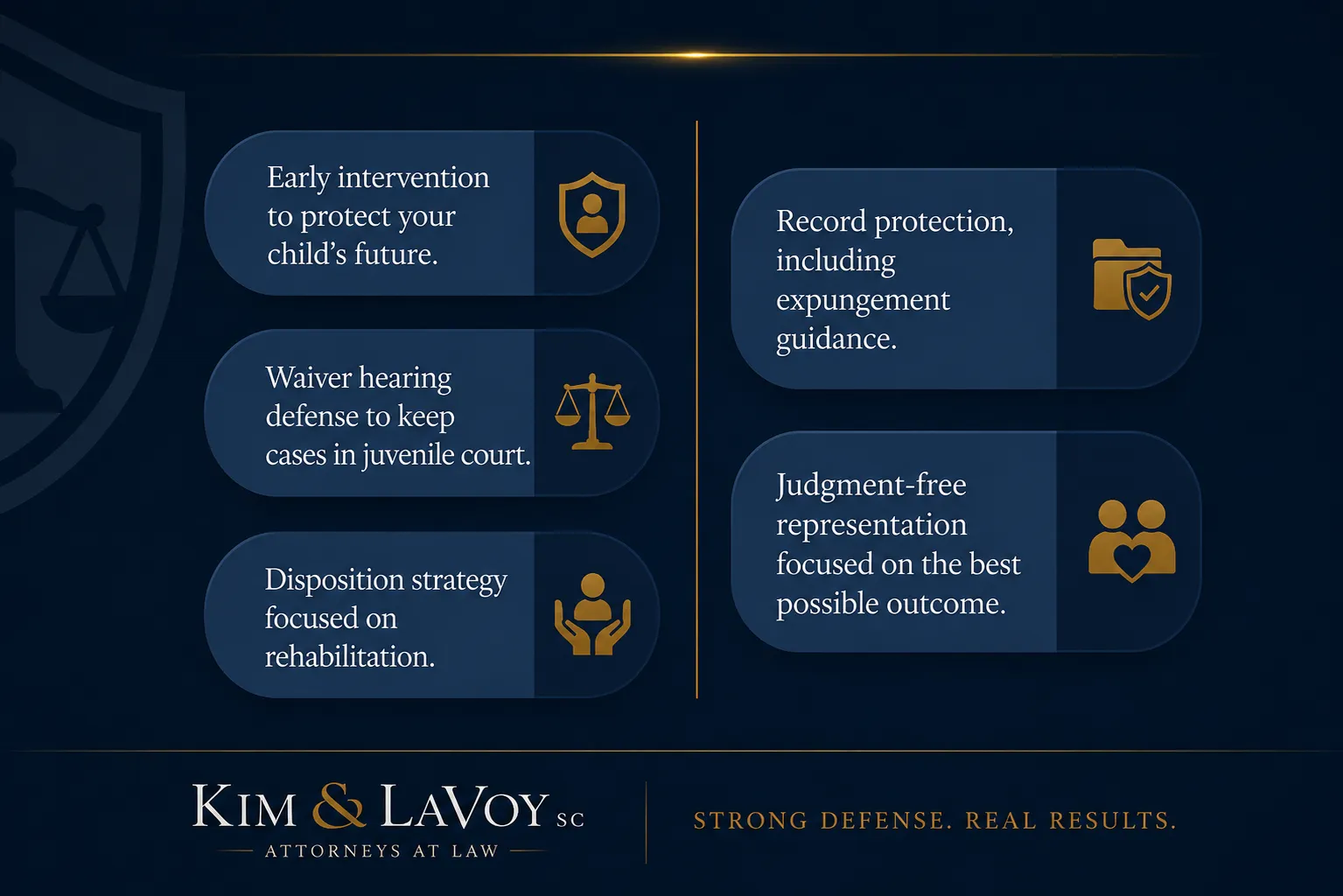
- Early intervention: We review the situation before charges are finalized, where possible. Under Wisconsin Statute § 938.245, first-time juvenile offenders may qualify for a Deferred Prosecution Agreement, which allows your child to complete counseling and community service without a formal criminal record. This window closes once the case moves forward unchallenged.
- Waiver hearing defense: If the prosecution seeks to move your child’s case to adult court, we challenge that at the waiver hearing. The difference between juvenile court and adult court is not procedural. It is the difference between a process designed to rehabilitate and one designed to punish.
- Disposition strategy: We work with you to build a clear picture of your child’s circumstances, progress, and willingness to engage with rehabilitation. Wisconsin courts have more flexibility at this stage than most families realize. That flexibility doesn’t happen automatically. It has to be argued for, with documentation and a real defense strategy behind it.
- Record protection: We identify whether expungement applies to your child’s case, when to petition, and what needs to be in place for that petition to succeed.
- No judgment: Our clients are people who made mistakes or who found themselves in situations they did not fully control. We are not here to assess whether your child deserves sympathy. We are here to make sure one charge doesn’t become the thing that closes every door in front of them.
You can read more about our approach on our juvenile crimes practice page, or see an overview of what families can expect at each stage of the juvenile justice process.
Is Your Child Facing Juvenile Charges in Wisconsin?
A juvenile charge is serious. It is also not the end of the story. Your child is not defined by this moment, and neither is your family. The Wisconsin juvenile system exists because the law recognizes that young people can and do change, that rehabilitation produces better long-term outcomes than incarceration, and that a mistake made at 14 should not automatically follow someone into adulthood.
But none of that happens on its own. It requires someone who knows the system, who can advocate at every stage, and who treats your child as a person and not just a case number. The earlier you call us, the more we can do.
If your child is facing juvenile charges in Wisconsin, contact Kim & LaVoy S.C. to speak with an attorney.
Frequently Asked Questions
What should parents do after a juvenile arrest?
Talk to a juvenile crimes defense attorney right away. Early involvement preserves diversion options and shapes how law enforcement officers respond. In Wisconsin, juvenile offenders may qualify for a Deferred Prosecution Agreement under Wisconsin Statute § 938.245, allowing a child to complete counseling and community service without a criminal record. For sexual crimes and sex offenses, waiting can result in lifetime registration requirements.
Can a child’s parents be held financially responsible?
Yes. Under Wisconsin Statute § 938.275, courts may order a child’s parents to contribute toward services, placements, and sanctions. Restitution to victims may also be ordered.
Can counseling or programs actually change the outcome?
Yes, and this matters more than most families realize. Juvenile offenders who engage with counseling or treatment before disposition give the court concrete evidence that change is already happening. According to a meta-analysis reviewed by the National Institute of Justice, cognitive behavioral therapy reduces recidivism among young offenders by 20 to 30 percent. Evidence-based therapies such as Multisystemic Therapy (MST) and Functional Family Therapy (FFT) can reduce recidivism by up to 35% by targeting the specific risk factors driving a young person’s behavior while keeping them connected to family and community. Programs that keep youth in their communities consistently outperform secure confinement on long-term outcomes. We identify which programs apply to your child’s situation and make sure that participation is documented in a way the court can actually consider.
What is the youngest age a child can be convicted of a crime in Wisconsin?
Under Wisconsin Statute § 938.12, juvenile court jurisdiction begins at age 10. For homicide, Wisconsin Statute § 938.183 gives adult criminal court original jurisdiction over children as young as 10. Being adjudicated delinquent is not the same as a criminal conviction. The juvenile justice system uses that terminology intentionally: it aims to rehabilitate rather than punish, and a judge reviews evidence without a jury trial. The U.S. Supreme Court bans the death penalty and mandatory life-without-parole sentences for juveniles, though the United States remains the only country to have sentenced children as young as 13 to life without parole.
State-by-state laws dictate when a juvenile can be tried as an adult, with serious crimes often triggering automatic transfer. According to the Equal Justice Initiative, 13 states have no minimum age, meaning children as young as 8 have been tried as adults. In 2021, Michigan, New York, and Vermont raised the maximum age for juvenile offenders to under 19. Wisconsin, Georgia, and Texas remain the only three states defining a juvenile as someone under 17.
Our guide on understanding the juvenile justice system in Wisconsin explains what families can expect at every stage.
Is juvenile offending treated the same everywhere in Wisconsin?
No. Punishments vary by county, judge, and the child’s history. A juvenile delinquent facing a first crime in a smaller county has very different options than one with a prior record in Milwaukee. For young offenders facing sex crimes or sexual crimes, charges carry mandatory registration requirements regardless of location.
How does the school-to-prison pipeline affect juvenile delinquency?
Research shows students who receive a suspension are less likely to graduate and more likely to be arrested or placed on probation. According to a 2018 U.S. Government Accountability Office report, Black students made up 15.5% of public school students but approximately 39% of suspensions in 2013-14. Wisconsin’s diversion tools, including Deferred Prosecution Agreements, are designed to interrupt this cycle for first-time juvenile offenders.
What factors increase the risk of juvenile delinquency?
The leading risk factors for juvenile offending include poor parental supervision, peer rejection, association with anti-social peer groups, older siblings with criminal records, low impulse control, and family instability. Courts and criminal law attorneys weigh these factors because addressing them is central to any rehabilitation plan.
Do juvenile criminal records follow a child into adulthood?
Juvenile records in Wisconsin are confidential, but do not disappear automatically. Unlike adult criminal records, which are permanent and harder to erase, juvenile records can be expunged under Wisconsin Statute § 938.355(4m) once a child turns 17 and completes their dispositional order. An unexpunged criminal record can affect employment, housing, and professional licensing.
Legal Disclaimer:
This content is provided for general educational purposes only and does not constitute legal advice. Every criminal case is unique. Contact a licensed attorney to discuss the specific facts of your situation.