
What Happens When a Case Goes to Trial in Wisconsin
What happens when a case goes to trial can feel like a mystery when you’re the one facing charges. If your criminal case can’t be settled with a plea agreement, you’re probably scared, confused, and unsure of what comes next. That’s why you need a skilled, experienced attorney to represent you.
The definition of a criminal trial is a formal, structured process where a prosecutor and defense attorney present evidence before a judge or jury to determine whether the defendant committed the crime.
Not all cases go to trial; the majority of cases end in a plea agreement. But when a case does go to trial, every defendant and their family should understand the process.
We handle criminal defense exclusively across Milwaukee, Waukesha, Brookfield, West Bend, Ozaukee County, and throughout Wisconsin. Julius Kim, our Managing Partner and former Milwaukee County Assistant District Attorney, has tried cases from both sides of the courtroom.
Key Takeaways
- Going to trial means the prosecutor must prove the defendant committed the crime beyond a reasonable doubt before a judge or jury.
- Twelve jurors must reach a unanimous verdict to convict or acquit in a Wisconsin jury trial.
- The process includes jury selection, opening statements, direct examination and cross-examination, closing arguments, jury instructions, and jury deliberations.
- The defendant decides whether to accept a plea agreement or proceed to trial. The district attorney’s office decides what charges to file.
- A defendant has the constitutional right to remain silent and does not have to present a case.
- What happens after trial depends on the verdict: an acquittal ends the case, while a guilty finding leads to a sentencing hearing at a later date.
What Does Going to Trial Mean in a Criminal Case?
It means no plea agreement satisfied both sides, and now a jury will determine whether the prosecutor can prove the defendant committed the crime. In Wisconsin, criminal cases move through the circuit court system. A trial can last anywhere from one day to several weeks, often preceded by months of pre-trial discovery and preparation.

“The criminal justice system is a human process. It’s a human system. And prosecutors don’t want to lose cases. They don’t want to be in trial needlessly for a week or two when they have their own lives to live also.”
Why Do Cases Go to Trial Instead of Settling with a Plea Agreement?
Cases go to trial when the district attorney’s office offers a deal that carries overly severe penalties, when the defendant maintains innocence, or when the defense attorney identifies proof problems in the prosecution’s case.
“While we can’t guarantee what’s going to ultimately happen in your case, it is the best result you can expect under the circumstances.”
Who Decides If a Case Goes to Trial?
The defendant decides whether to accept a plea bargain or reject it and proceed. The district attorney decides what charges to file and what plea agreement to offer. If the prosecutor and defense attorney cannot reach terms, the case moves toward a trial date.
In felony cases, a preliminary hearing determines whether probable cause exists. In the federal system, a grand jury reviews evidence behind closed doors during grand jury proceedings to decide whether to issue an indictment. Wisconsin does not typically use a grand jury for state criminal prosecutions, but federal cases tried here require grand jury review under the Fifth Amendment.
The defendant enters a plea at the arraignment. If the defendant pleads guilty, the court moves to sentencing. Before pleading guilty, consider your options as soon as possible with an attorney who handles courtroom work regularly.
What Happens During a Wisconsin Criminal Trial?
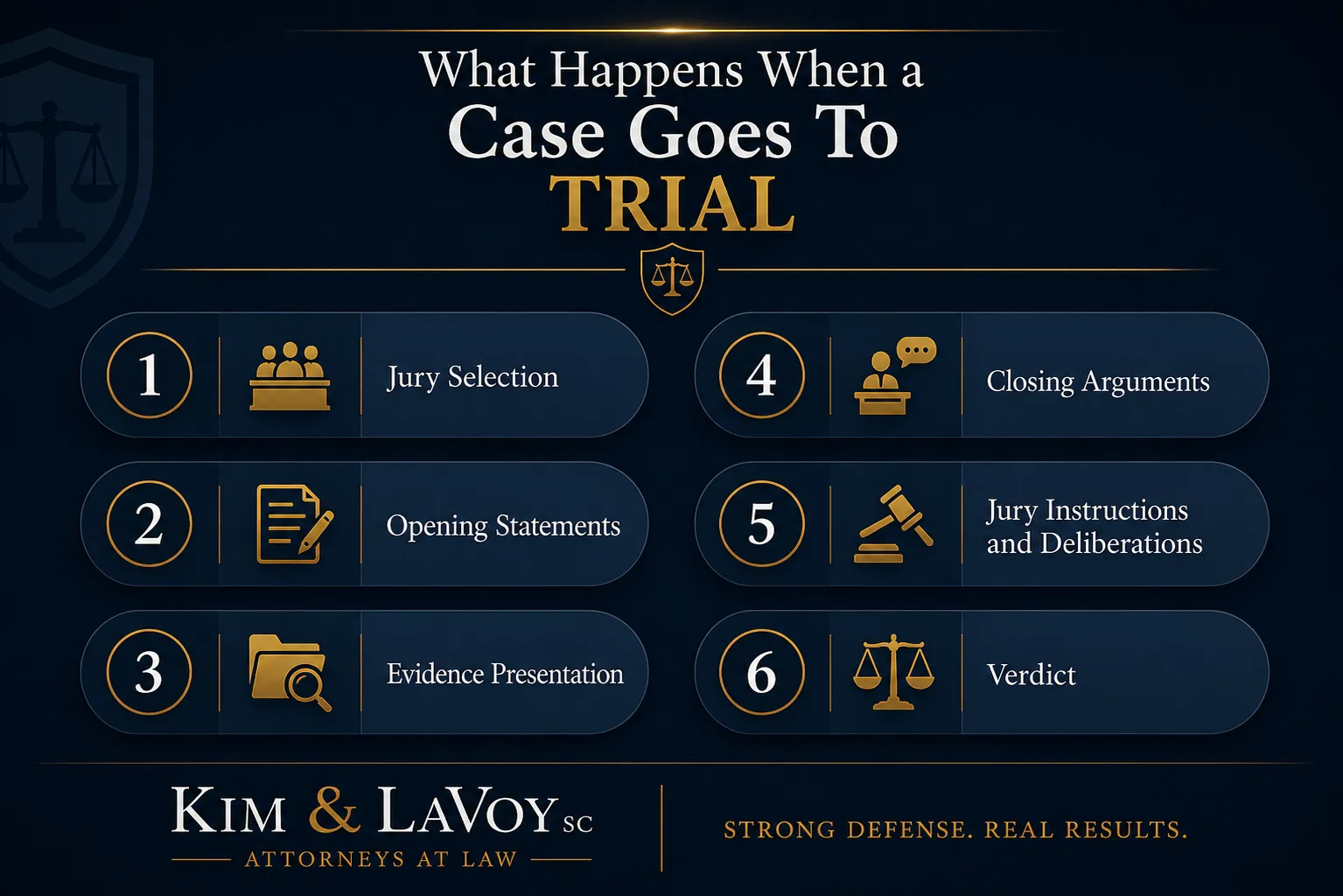
Step 1: Jury Selection
The trial begins with jury selection, also known as voir dire. Twelve jurors are randomly selected from the jury pool. Jurors come from voter registration records. Both the prosecutor and defense attorney can ask potential jurors questions, and each side has a limited number of peremptory challenges under Wisconsin Statute § 972.03. Neither side may use peremptory challenges to exclude jurors based on race, sex, or other protected characteristics. The judge oversees the process and rules on challenges for cause.
Step 2: Opening Statements
After jury selection, opening statements begin. Both sides prepare opening statements to outline their case. The prosecutor goes first and presents witnesses for direct examination. The defense attorney gets to cross-examine each one. Witnesses undergo direct examination and cross-examination during the proceedings, while the court reporter records everything.
Step 3: Evidence Presentation
The defense can then present witnesses and evidence. The defendant has the constitutional right to remain silent, as the burden of proof lies entirely with the prosecution. Called cross-examination because one side questions the other side’s witness, this process gives the accused person a chance to challenge the prosecutor’s case.
Step 4: Closing Arguments
Closing arguments happen after all witnesses have been presented. The prosecutor argues for a guilty verdict in closing arguments, and the defense can argue why the prosecution did not prove its case. Closing arguments summarize testimony and the evidence presented at trial.
Step 5: Jury Instructions and Deliberations
The judge then instructs the jury on the relevant laws during jury instructions. Jury deliberations follow. Jurors discuss the case privately during deliberation. The jury must reach a unanimous decision. A hung jury occurs when jurors cannot agree. The court determines whether to declare a mistrial and whether the district attorney will retry with a new trial.
Step 6: The Verdict
Once the jury has finished deliberating and reached a verdict, the verdict is announced in open court. If found guilty, a sentencing hearing follows at a later date.
What Happens After Trial If the Defendant is Found Guilty?
In a criminal trial, the defendant is either convicted or acquitted. An acquittal ends the case permanently. If found guilty, the judge determines the sentence. A probation officer may prepare a pre-sentence investigation report, and a victim advocate may submit a statement. Under Wisconsin Statute § 973, the judge considers offense severity, criminal history, and community safety.
If the defendant’s attorney believes legal errors occurred, they can file an appeal to a higher court. The criminal appeals process reviews whether the trial court applied the law correctly.
What Role Does Your Defense Attorney Play at Trial?
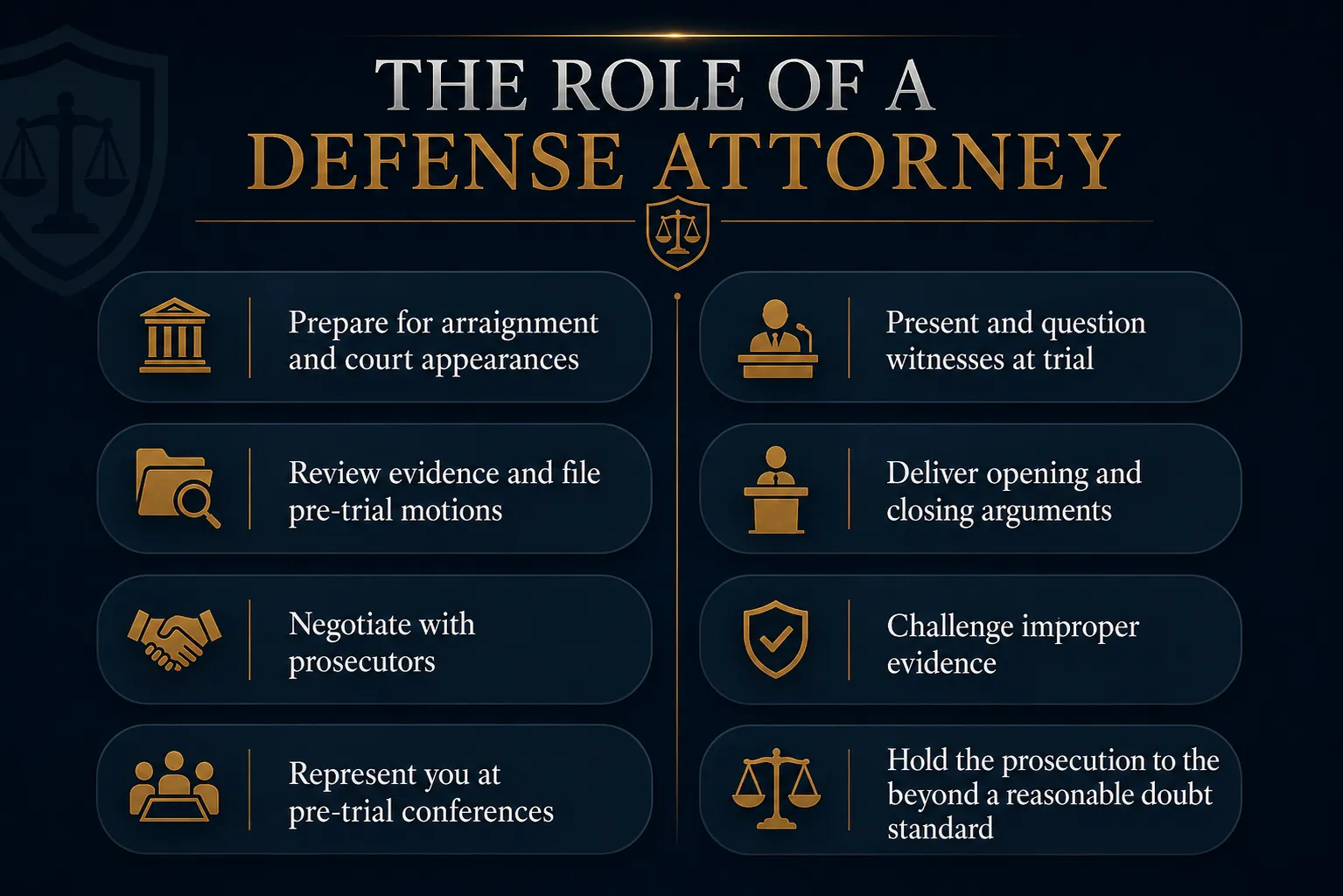
Your defense attorney manages every phase of the criminal justice process on your behalf, including preparing for your arraignment.
Before the trial date, your attorney reviews all evidence, files pre-trial motions, and negotiates with the district attorney’s office. They will also represent you in your pre-trial status conference.
During the actual trial, your attorney conducts direct examination of your witnesses, cross-examines the prosecution’s witnesses, delivers opening statements and closing arguments, and challenges evidence the prosecutor tries to admit. The goal is to hold the prosecutor to the beyond a reasonable doubt standard.
“You might have an attorney that has practiced law for 20 years, but has never really tried cases or isn’t known to be able to try cases well. That person is not going to really carry as much weight in terms of the ability to negotiate better deals on behalf of his or her clients with the prosecutors, because the prosecutors know that if they don’t give a better offer or give a better deal, there’s not really going to be a consequence.”
Facing a Criminal Charge in Wisconsin?
You deserve an attorney who will give you straightforward answers, whether that means negotiating a plea agreement or preparing for trial. Kim & LaVoy S.C. handles criminal defense exclusively, serving Milwaukee, Waukesha, Brookfield, West Bend, Ozaukee County, and throughout Wisconsin. Julius Kim trained police officers at the police academy and spent years as a prosecutor before building a 100% criminal defense practice.
Frequently Asked Questions About What Happens When a Case Goes to Trial
Can I change my mind about going to trial?
Yes, a defendant can accept a plea deal at almost any point before the jury makes its final decision. Once a unanimous verdict comes in, the option to plead guilty to lesser charges typically disappears. Talk to your lawyer about the risks before deciding.
What is the difference between a jury trial and a bench trial?
In a jury trial, twelve jurors hear the evidence and must reach a unanimous decision. In a bench trial, the judge decides the verdict alone. The defendant decides which type to request. Bench trials move faster and can benefit defendants when the case involves complex legal arguments.
How long does a criminal trial take in Wisconsin?
A trial can last anywhere from one day to several weeks. Simple misdemeanor cases may wrap up in a single day. Complex felony cases with multiple witnesses can stretch for weeks. The median time to resolve a Wisconsin felony from filing to closure was 252 days in 2024.
Does going to trial make things worse if I’m convicted?
Going to trial can lead to harsher sentences than a plea bargain because the defendant loses any negotiated concessions. But it also gives the defendant the only shot at a full acquittal. The right decision depends on the evidence and the strength of the prosecution’s case. Your lawyer can give you an honest assessment.
What does “beyond a reasonable doubt” mean in court?
Beyond a reasonable doubt means the evidence must be strong enough that a reasonable person would have no logical reason to believe the defendant is innocent. If the jury has any reasonable doubt about whether the defendant committed the crime, it must return a not guilty verdict.
Legal Disclaimer:
This article is for general informational purposes only and does not constitute legal advice. Every case is unique. Reading this content does not create an attorney-client relationship. Wisconsin law is subject to change. Contact Kim & LaVoy S.C. directly for legal advice tailored to your circumstances.