
Operating with a Restricted Controlled Substance in Wisconsin: What It Means and What Comes Next

Getting charged when you operate with a restricted controlled substance (RSC) in your blood can feel unfair, especially when you felt completely sober behind the wheel. You might have used marijuana days earlier or taken a medication you never thought twice about. Now you face a court date and hard questions.
The state does not have to prove you drove badly or that the drug affected you. Only one question decides the case: whether a person had a detectable amount of a restricted controlled substance in the blood while operating a motor vehicle.
Julius Kim, Managing Partner at Kim & LaVoy S.C., has been on both sides of these cases as a former Milwaukee County Assistant District Attorney. Before you make a decision you can’t undo, talk to his team.
Key Takeaways
- It’s unlawful to operate a motor vehicle with any detectable amount of a restricted controlled substance in your blood, even with no impairment.
- Restricted controlled substances include active Delta-9 THC, cocaine, methamphetamine, and other Schedule I drugs in Wisconsin Statute § 961.14.
- An RCS charge is presence-based, while a drug OWI requires proof that a person could not drive safely.
- The first offense is a civil violation, the second offense is a criminal misdemeanor, and the fourth offense is a Class H felony.
- The Delta-9 THC threshold is one nanogram per milliliter under Wisconsin Statute § 885.235, and inactive Carboxy-THC alone cannot support a conviction.
- A valid prescription can serve as an affirmative defense for certain other drugs.
What Is a Restricted Controlled Substance in Wisconsin?
A restricted controlled substance covers a defined group of drugs that the law treats with zero tolerance behind the wheel.
The Wisconsin restricted controlled substance list pulls from Schedule I of Wisconsin Statute § 961.14 above and names active Delta-9 THC on its own. The drugs that most often lead to a person testing positive include:
- Cocaine and its metabolites
- Methamphetamine and heroin
- Active delta-9 THC, the psychoactive compound in marijuana
- A controlled substance analog of any listed Schedule I drug

“I think the big surprise that people have is that, boy, in Wisconsin, a lot of times things that seem not so big a deal are treated very seriously.”
How is an RCS Charge Different from a Standard OWI?
A drug OWI asks whether a substance left a person unable to safely operate a motor vehicle. An RCS charge skips that question and only focuses on the presence of a substance.
The contrast comes down to presence versus impairment. To win, the state shows only that a person had a detectable amount of a substance in the blood while operating a motor vehicle. No impairment finding is required on the blood test result itself to convict for RCS. You can operate a motor vehicle perfectly and still be charged. No proof of influence on driving is required.
The Problem with THC in the Bloodstream
THC can linger long after any effect wears off, so a person operating a motor vehicle days after use can feel completely sober and still test above the cutoff. The threshold is one nanogram per milliliter of active Delta-9 THC, and inactive Carboxy-THC cannot make a jury find a person guilty on its own.
Prescription Drugs Are Prosecuted Differently
Prescription cases run the opposite way. When a lawfully prescribed medication shows up, the state prosecutes under the impairment-based OWI law. Prosecutors must prove that the other drug impaired a person’s driving ability. See our breakdown of prescription drugs and OWI.
Restricted Controlled Substance Penalties: What Are the Consequences?
Penalties climb sharply with each conviction. The first offense is a civil violation, and every offense after that carries more criminal weight.
Penalty enhancers raise these numbers. A minor under the age of 16 in the vehicle or a high THC reading can each add to what you face. Our guide on how Wisconsin OWI penalties escalate shows how the penalties compound.
A marijuana conviction carries lasting weight. Our overview of why marijuana charges stay harsh adds context, and our drunk driving defense page explains how we handle these cases.
Is There an Affirmative Defense If the Substance Was Legally Prescribed?
Yes, and this affirmative defense rarely gets explained clearly anywhere else. The law builds an affirmative defense when you operate with a restricted controlled substance because a medical professional prescribed it. A valid prescription anchors it.
When a doctor lawfully prescribes a drug, the case shifts onto the impairment-based OWI track, which forces prosecutors to prove the drug rendered a person incapable of safely driving.
Active Delta-9 THC sits apart, since Wisconsin runs no medical marijuana program and a card from a legal state creates no protection. Our look at whether Delta-8 and Delta-9 are legal in Wisconsin sorts through that gray area.
How RCS Cases Are Defended
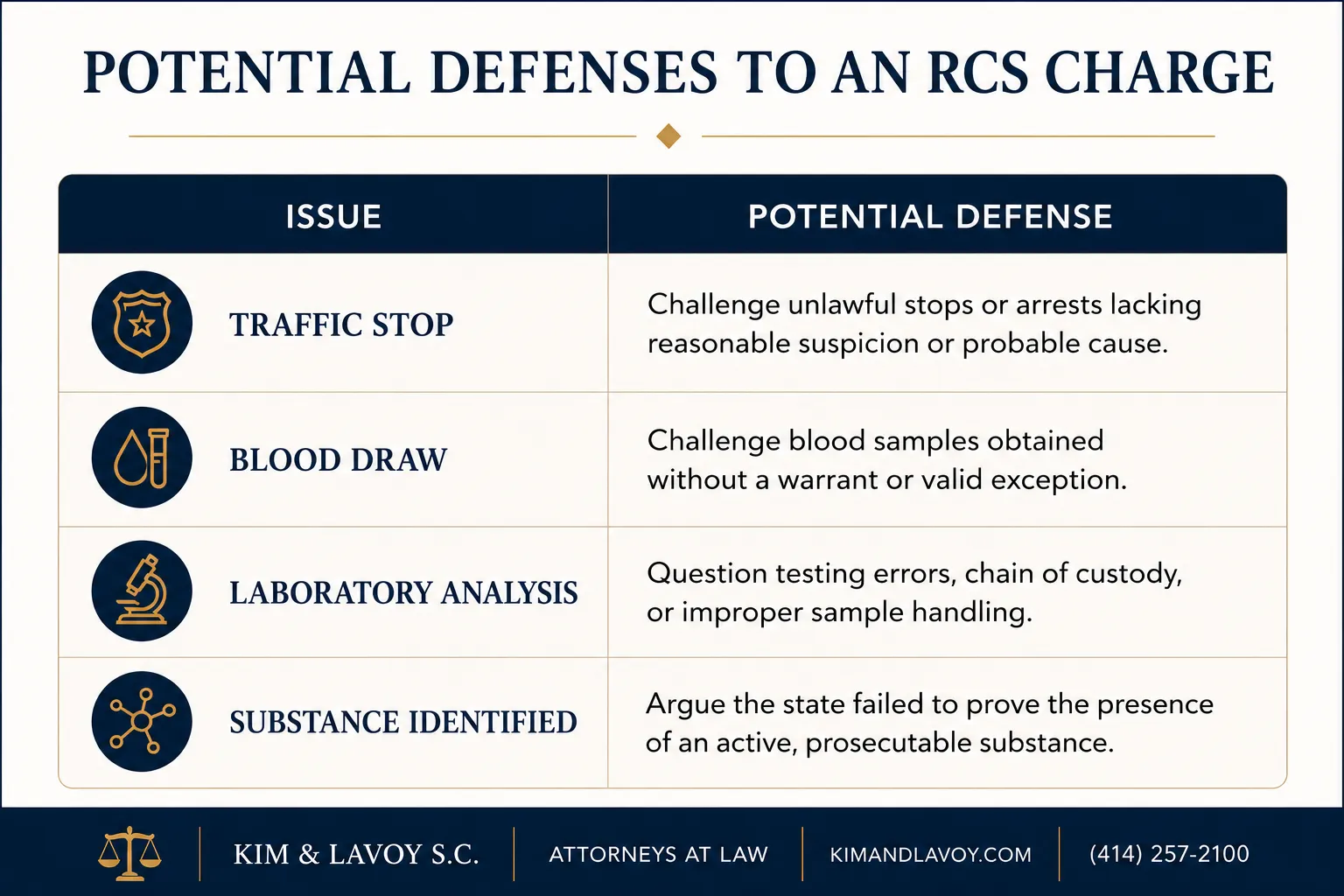
A presence-based charge does not mean a hopeless case. These cases turn on procedure, science, and the conduct of the stop, and a careful review of the testing evidence regularly surfaces problems.
“A lot of times, people panic, right? And then after something like this happens, they panic, they start getting online, they start doing their own research, and they actually might end up making their case worse for themselves. What I always try to tell people is just freeze the situation, take a deep breath, and then call someone who can give you clear advice and guidance so that you can make decisions about what to do next with a clear head.”
Here Are the Procedural Steps When You Operate With a Restricted Controlled Substance:
- The traffic stop: A law enforcement officer needs reasonable suspicion to stop a vehicle and probable cause to arrest. An illegal arrest or an unlawful stop without probable cause can lead a court to suppress the evidence.
- The blood draw: A blood draw usually needs a warrant or a valid exception. When an officer skips the warrant, the blood sample can be challenged.
- Laboratory analysis: A chemical test must follow proper handling and storage. Errors in the lab testing or the chain of custody can undermine a blood test, and a person can request a second blood test of the sample.
- The substance itself: The state must show an active, prosecutable substance. Inactive Carboxy-THC alone does not meet the definition, so a report showing only metabolites falls short.
Under the 2025 Wisconsin Act 99, an officer may now use preliminary oral fluid screening at the roadside, much like a preliminary breath test for alcohol under the implied consent law.
That screening supports an arrest, yet one or more tests at the lab still decide the case. Field sobriety tests and oral fluid testing stay investigative tools.
Julius Kim trained officers at the police academy, so he reads investigative files knowing how they build them.
“While we can’t guarantee what’s going to ultimately happen in your case, what we can guarantee is the best result you can expect under the circumstances.”
That inside view helps our firm spot weaknesses in cases, as you’ll see on our drug offenses defense and traffic violations pages.
Charged with Operating with a Restricted Controlled Substance in Wisconsin?
Operating with a restricted controlled substance charge lands hard, and the fear of what it means for your job, your license, and your family is real. Slow down and get advice before you say or sign anything. Early legal guidance changes outcomes, especially when blood evidence and an arrest are in play.
Thankfully, you don’t have to face it alone.
Kim & LaVoy S.C. focuses entirely on criminal defense. We give you an honest read with no false promises, just clear guidance grounded in years inside Wisconsin courtrooms.
Frequently Asked Questions About Operating with a Restricted Controlled Substance
Can I be charged if I used marijuana days ago and am not currently high?
Yes. Wisconsin charges presence, not impairment, so active Delta-9 THC at one nanogram per milliliter or higher can support a charge even when you feel completely sober, as THC stays in the blood even after any influence on driving fades.
Is a first offense restricted controlled substance charge a crime in Wisconsin?
No. A first offense is a civil forfeiture, though the right to operate a motor vehicle is restricted through a license revocation, plus a fine and an assessment. Our first-time OWI consequences guide covers what a first charge means.
What substances count as restricted controlled substances?
The list in Wisconsin Statute § 961.14 includes active Delta-9 THC, cocaine, methamphetamine, and heroin, plus a controlled substance analog of those drugs. A drug lawfully prescribed by a medical professional falls under the impairment-based OWI law instead.
Does a restricted controlled substance charge show up on a background check?
A first-offense civil penalty creates no criminal record, yet the citation and driving record entry can surface. A second or later offense is a criminal conviction that appears on a background check, and a felony fourth offense carries the heaviest effect on employment.
Can an RCS charge be reduced or dismissed?
It can, depending on the facts. Cases fall apart when a stop lacked probable cause, when a blood draw skipped a required warrant, or when the testing broke protocol.
What is the difference between an RCS charge and a PAC charge?
A Prohibited Alcohol Concentration (PAC) charge rests on a prohibited alcohol concentration shown by a chemical test, while an RCS charge rests on a detectable amount of a restricted controlled substance.
Legal Disclaimer:
This article is for general informational purposes only and does not constitute legal advice. Every case is unique. Reading this content does not create an attorney-client relationship. Wisconsin law is subject to change. Contact Kim & LaVoy S.C. directly for legal advice tailored to your circumstances.