
What Does a Defense Lawyer Do? Understanding Their Role in a Criminal Case
Here’s what usually happens. You get arrested, or you find out charges might be coming, and the first thing you do is pull out your phone and start searching. You read five articles, a few Reddit threads, and a legal Q&A site from a state you don’t even live in.
By the time you actually talk to an attorney, you’ve already decided how bad things are, and you’re usually wrong in one direction or the other. It’s either not as bad as you think, or it’s more serious than you realize, and you’re not taking it seriously enough.
We see this all the time at Kim & LaVoy S.C., and it’s one of the biggest mistakes people make in the first 48 hours. A criminal defense attorney’s job is to replace all that guesswork with facts, to tell you where you actually stand, and to make sure the system treats you fairly from start to finish.

“I treat this position as a vocation, not just a profession. It’s a calling. If you’re doing the job right, you’re not just getting people from point A to point B in the criminal justice system. You’re making sure their mental health is okay, that they’re not making things worse for themselves, and that they feel supported through something that can be genuinely overwhelming.“
Key Takeaways
- The primary role of a criminal lawyer is to serve as your legal advocate throughout every stage of a criminal case, from the first police interaction through sentencing and beyond.
- Under the Sixth Amendment, all criminal defendants have the right to defense representation and a fair trial, whether through a private criminal lawyer or the public defender’s office.
- Most Wisconsin cases are resolved through plea negotiations, not trials. Your criminal lawyer’s preparation and reputation with the prosecuting attorney directly affect the deals you’re offered.
- Getting a criminal lawyer involved early can influence how your entire case is set up, including which judge is assigned and what bail conditions will look like.
- No legal professional can guarantee a specific outcome. What we can guarantee is that your client rights are protected and every option is explored.
- Criminal penalties go beyond jail time. A conviction can affect your employment, housing, and family. A thorough criminal lawyer accounts for all of that from day one.
What Is a Criminal Defense Lawyer?
A criminal defense lawyer is a licensed attorney who represents people facing criminal charges. Your defense attorney’s job is to protect your legal rights throughout the criminal justice system and make sure the state actually proves its case before anything happens to you.
Under the Sixth Amendment to the U.S. Constitution, every person facing criminal charges has the right to legal representation. Under the Supreme Court’s decisions in Gideon v. Wainwright (1963) and Argersinger v. Hamlin (1972), no person may be sentenced to imprisonment unless they were represented by private or court-appointed counsel, or knowingly waived that right. This applies to all criminal cases, from minor offenses and misdemeanors to severe offenses and felonies.
In Wisconsin, Wisconsin Statute § 967.06 sets a broad standard that if you are detained or arrested for any offense punishable by incarceration, you must be informed of your right to an attorney as soon as practicable after detention.
Public Defenders vs. Private Defense Attorneys
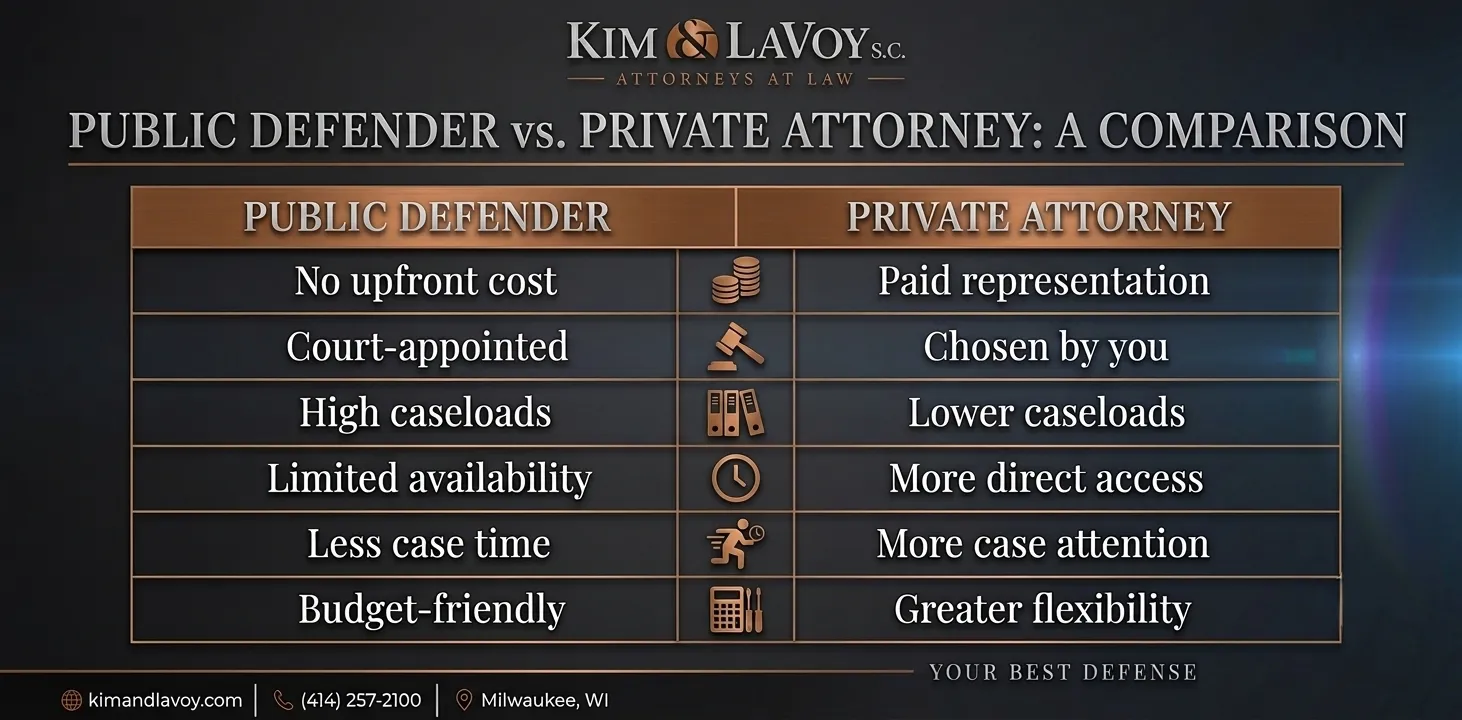
If you can’t afford your own attorney, a public defender will be appointed to you at no cost by the court. Public defenders are qualified criminal defense lawyers who handle criminal cases every day, and they provide real legal representation.
That said, public defenders carry large caseloads. Wisconsin has faced an ongoing public defender shortage that limits how much time each attorney can dedicate to your case. A private criminal defense attorney can often spend more time on investigation, case preparation, and direct communication with you.
One thing people worry about but rarely ask is whether hiring a private attorney means you look guilty. The answer is no, it doesn’t, it means you’re taking your situation seriously. The choice between a public defender and a private attorney usually comes down to your financial situation and the complexity of what you’re facing. At Kim & LaVoy, we discuss fees openly during the initial consultation so you know exactly what to expect.
What Is the Role of a Defense Attorney in Criminal Law?
Your criminal defense lawyer is both an officer of the court and your advocate. Those sound like they conflict, but they don’t. Under Wisconsin’s Rules of Professional Conduct for Attorneys SCR 20, your defense attorney has a duty to:
- Keep you informed about your case at every stage
- Communicate all plea offers to you promptly and clearly
- Protect your constitutional rights throughout the legal process
- Advise you honestly so you can make your own informed decisions
Your attorney works for you. Not the court, not the prosecution, and not the system. Their obligation is to make sure the process is fair and that you understand what’s happening at every step.
What Does a Defense Attorney Do During a Criminal Case?
Reviewing Your Charges and Explaining Your Options
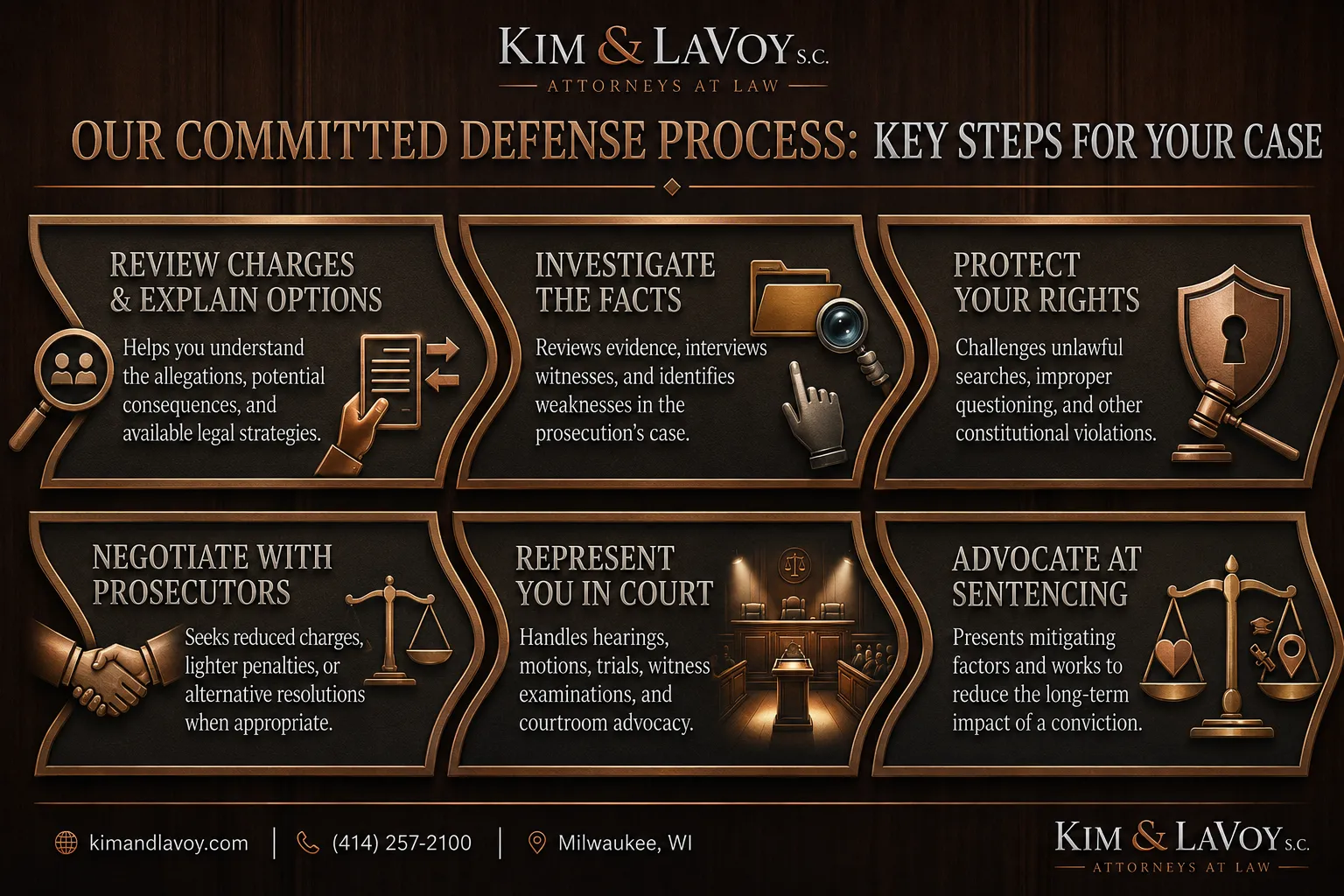
When we take on your case, the first thing we do is listen. We review the charges, explain what they mean under Wisconsin law, and walk through your realistic options.
Something people rarely think to ask in that first conversation is: “What is a fair resolution to all of this?” Most people come in focused on the immediate fears, like whether they’ll go to jail, whether they can keep driving, or whether this will show up on a background check. Those are legitimate concerns. But a good defense attorney also keeps an eye on the bigger picture and helps you understand what the case is actually worth, not just what it feels like right now.
“People don’t know what they don’t know. And the only way that they can really figure out what options are available and how to make things the best they possibly can be is by talking to an attorney that knows what they’re doing.“
One of your earliest decisions will be how to approach your arraignment, which is the first court hearing where you formally enter a plea. Our blog on arraignment rules in Wisconsin explains why having a defense lawyer with you at that stage matters more than most people realize.
Investigating the Facts
We don’t take the prosecution’s version of events at face value. Your defense attorney conducts an independent investigation, which includes:
- Reviewing the police report for errors, inconsistencies, or missing information
- Interviewing witnesses before memories fade or stories change
- Examining the prosecution’s evidence and identifying weaknesses
- Visiting the scene where relevant
- Working with expert witnesses or reviewing forensic evidence when needed
Under Wisconsin Statute § 971.23, you have the right to request discovery. That means your attorney can access the evidence and witness statements the prosecution plans to use against you at trial. Thorough fact-finding at this stage is where a strong defense often begins.
Protecting Your Constitutional Rights
One of the most important things we do is check whether law enforcement followed proper procedure during your arrest, your questioning, and any searches. If the police conducted an unlawful search, failed to read you your rights, or pressured you into making a statement, your defense attorney can file motions to suppress that evidence, which means the prosecution may not be able to use it against you.
A question people think about but rarely ask out loud: “I already talked to the police. Did I make things worse?” The honest answer is, it depends on what you said. But even if you said something you wish you hadn’t, that doesn’t mean your case is over. There are legal protections around how statements are obtained, and your attorney will review all of that. Our blog on the right to remain silent in Wisconsin explains when and how to invoke it.
Negotiating with Prosecutors
Most criminal cases in Wisconsin are resolved through plea negotiations, not trials. A well-negotiated plea bargain can reduce your charges, limit your penalties, or open the door to alternative options like diversion programs.
But here’s something most people don’t realize: the quality of the deal you’re offered depends heavily on how seriously the prosecution takes your attorney. Prosecutors know which defense lawyers prepare their cases thoroughly and which ones are willing to take a case to trial if the offer isn’t fair.
“But if a prosecutor knows that a certain lawyer or certain law firm is ready, capable, and willing, and does litigate these issues once they bring them up, that’s going to get their attention, and that’s going to result in getting better deals and better results for clients.“
Under Wisconsin’s Rules of Professional Conduct SCR 20:1.4, your attorney must inform you of every plea offer and make sure you understand the implications before you decide. You always make the final call. If you’re weighing a guilty plea, our blog on considering your options before pleading guilty walks through what to think about first.
Representing You in Court
If your case goes to trial, your defense attorney handles:
- Opening and closing arguments
- Cross-examination of the prosecution’s witnesses, including police officers
- Presentation of evidence and defense witnesses
- Jury selection, including questioning potential jurors for bias
The goal is to challenge the prosecution’s evidence and create reasonable doubt. In serious cases, thorough pre-trial preparation, including early witness interviews and motion practice, can be the difference between a conviction and an acquittal.
Advocating at Sentencing
A guilty plea or guilty verdict does not end your attorney’s work. At sentencing, we present mitigating circumstances and argue for the most favorable outcome possible.
Something people often don’t think about until it’s too late: a criminal conviction in Wisconsin affects more than jail time and fines. These are called collateral consequences, and they include:
- Losing your current job or being disqualified from future employment
- Professional license suspension or revocation
- Being turned down for housing
- Custody and family court implications
- Immigration consequences
- Losing your right to own a firearm
A thorough defense attorney factors all of this in from the very beginning of your case, not just when you’re standing in front of the judge.
What a Criminal Defense Lawyer Can and Cannot Do in Wisconsin
This table addresses common misconceptions, grounded in Wisconsin’s Rules of Professional Conduct SCR Chapter 20.
Common Misconceptions About Criminal Defense
“Only guilty people need a defense attorney.” This is one of the most harmful things people believe about the criminal justice system. Innocent people get charged. Evidence gets misread. Procedures get skipped. A criminal defense lawyer’s job is to keep the process honest for every person who goes through it, regardless of the facts.
“If I’m guilty, there’s no point in hiring a lawyer.” This is the other mistake we see all the time. Even if you did what you’re accused of, the situation may not be as bad as you think, or it could be more serious than you realize. There may be options you don’t know exist: a charge reduction, a drug treatment program, or a diversion agreement that could result in a dismissal. None of those options surfaces without an attorney who knows the system and the people working in it.
“A criminal defense attorney can guarantee results.” Any lawyer who tells you they can guarantee a specific outcome is not being honest with you. As Julius Kim tells clients:
“I can’t guarantee how this is going to end up, but I can guarantee you that the result that we get for you is the best you can expect under the circumstances. Our job is not to get you off. Our job is to make sure that things are done fairly.“
How Kim & LaVoy Can Help
When you’re facing criminal charges, you need more than legal services. You need a criminal lawyer who will tell you the truth about where you stand and build a solid defense strategy around the specific facts of your situation.
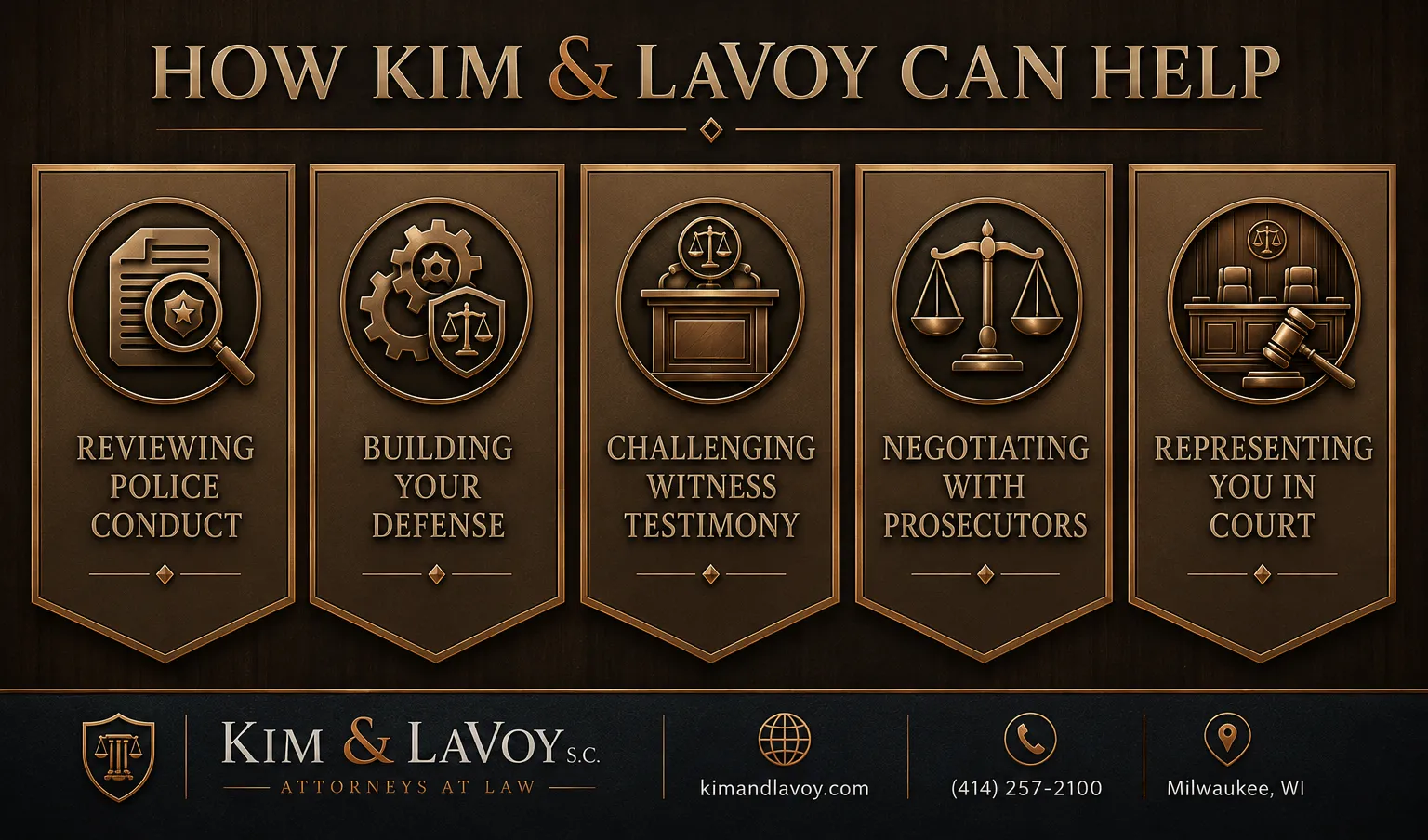
At Kim & LaVoy, our work on a client’s case includes police reports review, arrest circumstances, and all available evidence. Specifically, we help by:
- Checking whether law enforcement followed proper criminal procedure during the stop, search, or arrest
- Working with private investigators and expert witnesses to build a compelling case for the defense
- We cross-examine witnesses at trial and present evidence on your behalf
- Negotiating with the prosecuting attorney to resolve legal issues before they reach the courtroom
- Representing you at arraignment, pretrial conferences, hearings, trial, and sentencing
“I look at every case as kind of two sides. One is kind of the court side and the court proceedings, and the other side is kind of the personal side. We have to make sure that a person is taken care of on a personal level to make sure that that person does not end up re-offending down the line.“
Facing Criminal Charges in Wisconsin?
If you or someone you love is facing criminal charges in Wisconsin, the worst thing you can do is wait and hope the situation goes away on its own. We see that happen, and it almost always makes things harder.
“When we get involved in a case early, then we have some input as to how that table is set for the rest of the case.“
At Kim & LaVoy S.C., our defense lawyers have spent decades working with people at their most vulnerable moments. Whether your case involves a plea negotiation, a trial, or pre-charging representation, we are here to help you understand your options and take the next step with clarity.
Frequently Asked Questions About Criminal Defense Counsel
What is a defense attorney’s main responsibility?
The main responsibility of a criminal defense lawyer is to protect the client’s legal rights and ensure the prosecution meets its burden of proof before any conviction is entered. That covers case preparation, filing motions, plea negotiations, and, where necessary, trial, while keeping clients informed so they can make informed decisions throughout the legal process.
What can a defense attorney not do?
A defense attorney cannot knowingly present false evidence, help a client lie to the court, or destroy evidence. They cannot accept or reject a plea offer without the client’s informed consent, guarantee an outcome, or compel a crime victim to participate in a pretrial interview. The role of a criminal defense attorney is to defend individuals zealously within the rules of the legal process.
Is a DA more powerful than a judge?
No, a district attorney decides which criminal charges to bring, while a judge oversees the legal process, rules on motions, and imposes sentences. In jury trials, the jury determines guilt. In bench trials, the judge does. They hold different authorities at different stages, and an experienced defense lawyer understands how to navigate both.
Do criminal attorneys only work at trial?
Most of the work happens outside the courtroom: reviewing evidence, building a defense strategy, negotiating with prosecutors, and advising clients. The appeals process is another area where a criminal defense lawyer’s involvement can matter significantly.
What are collateral consequences in a criminal case?
Collateral consequences are the effects of a conviction beyond jail time or fines, including job loss, professional license suspension, housing restrictions, and immigration consequences. A knowledgeable criminal defense attorney factors these into the client’s interest from the beginning.
Can a criminal defense lawyer help before charges are filed?
Yes. Pre-charging representation allows an attorney to get involved during the investigation stage, before formal criminal charges are filed. In some cases, it can prevent charges from being filed at all.
“When we get involved early, we have some input in how the table is set for the rest of the case. That matters more than most people realize.“
Legal Disclaimer:
This content is provided for general educational purposes only and does not constitute legal advice. Every criminal case is unique. Contact a licensed attorney to discuss the specific facts of your situation.