
What Is Bail Jumping in Wisconsin? Charges, Bond Conditions & Consequences
Let’s be honest about what’s probably going through your head right now. You’re not looking this up out of curiosity. Something happened, and now you’re trying to figure out how bad it is, whether you or someone you love is in real trouble. You might be embarrassed. You might be angry at yourself, or at the situation. You might be terrified to call a lawyer because doing so makes it feel more real.
We get it. That’s exactly the kind of moment we work in every day. Bail jumping in Wisconsin is a serious criminal charge, but one many people face because they did not fully understand what was required of them. If you or someone you love is dealing with a felony or misdemeanor charge, understanding what bail jumping means can make a real difference in what comes next.
Key Takeaways
- In Wisconsin, bail jumping is its own criminal charge under Wisconsin Statute § 946.49, filed separately from whatever your original case involves.
- The charge applies when someone who was released on bond intentionally fails to comply with any condition the court set.
- If your original charge is a misdemeanor, bail jumping is a Class A misdemeanor, carrying up to 9 months in jail and a $10,000 fine.
- If your original charge is a felony, bail jumping is a Class H felony, carrying up to 6 years in prison and a $10,000 fine.
- Both penalties stack on top of whatever sentence may result from the original charge.
- Violating multiple bond conditions can mean multiple bail jumping counts, each with its own maximum penalty.
- Wisconsin does not use commercial bail bondsmen. All bonds go through the court.
- Getting an attorney involved early gives you the best chance to push back on conditions that are hard to comply with before a violation happens.
What Is Bail Jumping in Wisconsin?
Bail jumping in Wisconsin is the charge that applies when a person who has been released from custody intentionally fails to comply with the terms of their bond. It’s governed by Wisconsin Statute § 946.49.
To convict you, the state must prove three things:
- You were charged with a crime.
- You were released from custody on a bond with conditions set by the court.
- You intentionally failed to comply with at least one of those conditions.
Wisconsin courts read the word “intentionally” broadly. Missing a court date, contacting someone you were ordered to avoid, committing a new offense while released, or testing positive for drugs or alcohol when testing was required can all support a bail jumping charge.
One thing that surprises many people: bail jumping is prosecuted completely independently of the original charge. Wisconsin courts have held that the underlying offense is not a lesser included offense of bail jumping, which means you can be convicted of and sentenced for both. You’re not just dealing with one case anymore. You’re potentially dealing with two.

“A lot of people don’t realize that bail jumping is a separate charge. They’re already dealing with one case, and now they’re facing another one, sometimes more serious than the first. The earlier we get involved, the more we can do to protect them from that happening.”
How Bail and Bond Work in Wisconsin
When you’re arrested, you appear before a judge or court commissioner at an initial appearance. The court decides whether to release you and what conditions apply. Wisconsin Statute § 969.001 defines bail as the monetary conditions of release.
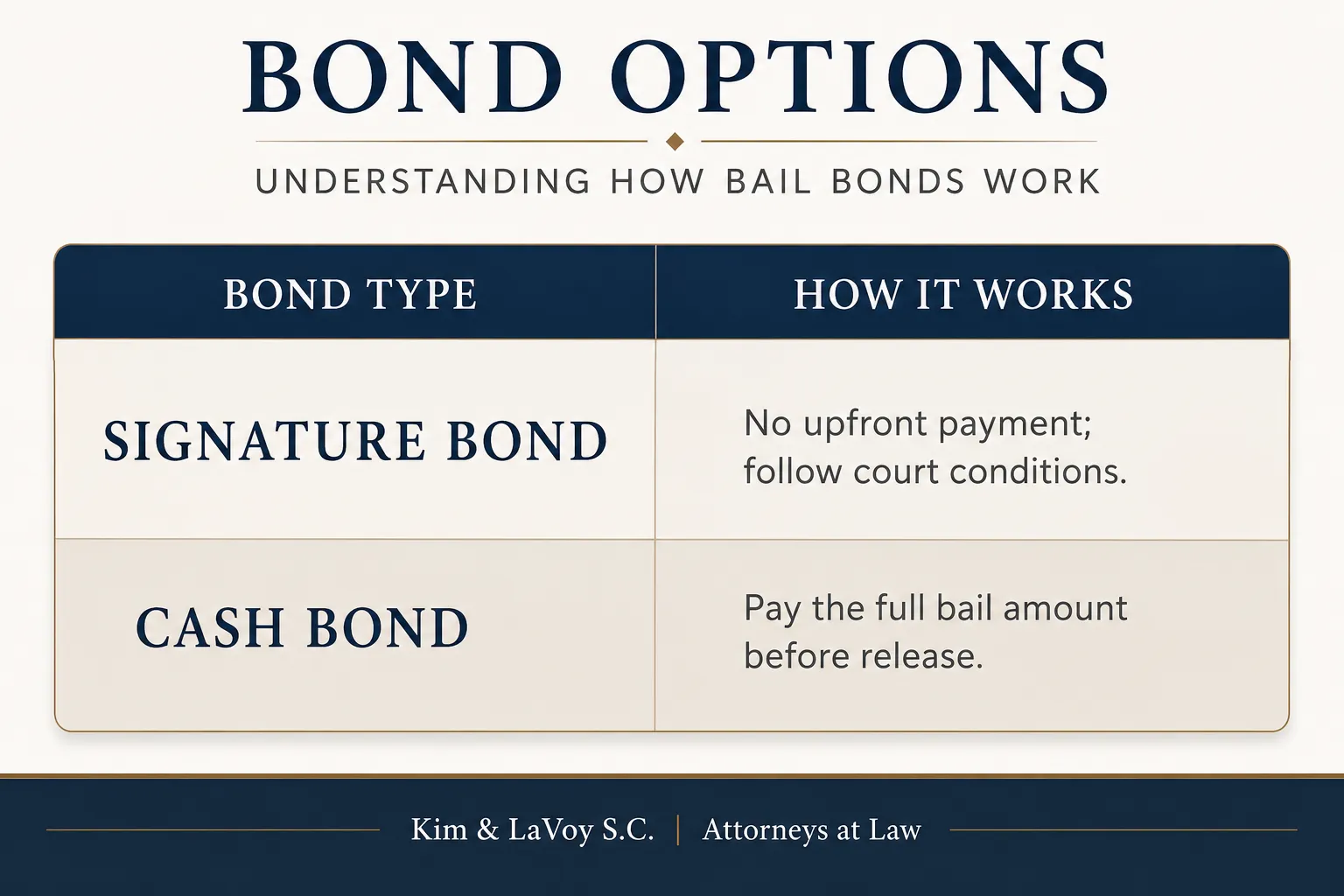
Wisconsin uses two primary bond types:
- Signature bond: No money is paid up front. You sign a written promise to appear and follow every condition the court sets. The full bond amount only becomes owed if you violate the terms.
- Cash bond: The full bail amount must be deposited with the county jail or court before you’re released from custody.
Wisconsin does not allow commercial bail bondsmen. The process runs entirely through the court.
What Is a Signature Bond in Wisconsin?
A signature bond, sometimes called a personal recognizance bond, is the most common form of release in Wisconsin. You don’t pay anything up front. You sign a legally binding promise to appear at all future court dates and comply with every condition the court sets.
If you violate any term, the full bond amount can become owed immediately, and a bail jumping charge follows. You can technically be charged with bail jumping before you even physically leave the jail, since a violation can occur the moment the conditions become binding.
Common Bail Conditions in Wisconsin
Bond conditions vary by case and by judge. Some feel manageable. Others can create real hardship depending on your job, your housing, or your family situation. Nobody tells you that clearly enough at the outset. Common conditions include:
- Appearing at all scheduled court dates
- Committing no new crimes while released
- No contact with alleged victims or witnesses
- Staying away from specific locations
- Submitting to drug and alcohol testing
- Surrendering firearms
- Not leaving the state of Wisconsin
If a condition feels impossible to comply with, given your real-life circumstances, that is a conversation to have with us before something goes wrong, not after. Courts can sometimes modify conditions. Once there’s a violation on record, those conversations become much harder.
“We tell every client: read every condition. Ask questions. If something feels impossible to comply with given your situation, tell us before you walk out of that courtroom, not after something goes wrong.”
What Happens When Bail Conditions Are Violated?
Things move quickly once a violation occurs, and the process doesn’t wait for you to figure out what’s happening. Here’s what typically follows:
- The court issues a warrant for your arrest.
- Your bond is revoked.
- A higher cash bond may be set before you can be released again.
- Your original case keeps moving on its own timeline throughout this process.
- Separate bail-jumping charges are filed on top of your original charges.
- If you violated multiple conditions, each one can support its own bail jumping count.
No double jeopardy protection applies here. Even if you’re found not guilty on the original charge, you can still be convicted of bail jumping. Wisconsin treats these as entirely separate offenses.
If you’re already dealing with probation or parole alongside a new case, the stakes compound quickly. Our team handles probation and parole violations and understands how these situations interact.
Misdemeanor Bail Jumping vs. Felony Bail Jumping in Wisconsin
The classification depends entirely on what you were originally charged with.
Both carry a potential $10,000 fine, and both run separately from whatever sentence results from the original charge. And if you’re already navigating a felony or misdemeanor case, even one bail-jumping count significantly increases your total exposure. That’s why acting early matters.
How Kim & LaVoy Can Help

Here’s what most people don’t ask but really want to know: can this actually be defended? Can anything be done, or is it just about damage control? The honest answer is that it depends on the facts, and we won’t know until we look at them. What we can tell you is that we’ve seen these situations before, we know how Wisconsin prosecutors and judges handle them, and we know what it takes to protect your position.
Here’s what we do when you come to us with a bail jumping charge, or when you’re trying to prevent one:
- Review your bond conditions and the specific facts of any alleged violation
- Assess whether the state can actually prove intentional noncompliance, because that’s what they have to show
- Push back on conditions that are unreasonable or unworkable before a violation happens
- Work to get bail conditions modified when your circumstances change
- Challenge the bail jumping charge directly where the evidence doesn’t support it
- Coordinate your bail jumping defense alongside your original case so nothing falls through
- Communicate with prosecutors on your behalf to protect your position throughout the process
- Give you a realistic picture of what the charge means for your record, your freedom, and what comes next
Julius Kim spent years as a Milwaukee County Assistant District Attorney. He’s been on the other side of these cases and knows exactly how they’re built. That perspective shapes how we approach every case we take on. We’re not here to get you from point A to point B and move on. We want to understand your situation, your concerns, and what’s actually at stake for you.
“While we can’t guarantee what’s going to ultimately happen in your case, the best result you can expect under the circumstances is what we go for. Our job is to make sure that things are done fairly.”
Facing a Bail Jumping Charge in Wisconsin?
A bail jumping charge doesn’t close the door on you. But it does mean the timeline matters, because the longer you wait, the fewer options we have. The sooner you talk to us, the sooner we can understand exactly what you’re dealing with and start working on it.
At Kim & LaVoy S.C., we look at the full picture. Not just the charge in front of us, but the person behind it. If you have questions about bail jumping charges or need guidance on your original charges and bond conditions in Wisconsin, contact our team!
“Our job is to make sure that the result we get for you is the best you can expect under the circumstances. We can’t always control how a situation started. But we can make sure it’s handled fairly from here.”
Frequently Asked Questions About Bail Jumping in Wisconsin
What are the penalties for bail jumping in Wisconsin, and is it a felony?
It depends entirely on what you were originally charged with, and that’s what most people don’t realize until they’re already dealing with it. Under Wisconsin Statute § 946.49, here’s how it breaks down:
- If your original charge was a misdemeanor: bail jumping is a Class A misdemeanor, carrying up to 9 months in county jail and a fine of up to $10,000.
- If your original charge was a felony: bail jumping is a Class H felony, carrying up to 6 years in prison and a fine of up to $10,000.
Both penalties run independently of whatever sentence follows from the original charge.
Can you be charged with jumping bail and still face your original charges at the same time?
Yes. Double jeopardy protections don’t apply. Wisconsin law treats the charge underlying a bail jumping charge as a separate criminal offense, not a lesser included offense, so a defendant can be prosecuted and punished for both under Wisconsin Statute § 946.49. A not guilty verdict on the original charges does not affect the bail jumping charge. If you’re facing multiple bail jumping charges alongside your original case, that exposure compounds quickly.
What happens to your cash bond if you fail to appear or violate your conditions in Wisconsin?
If a defendant fails to comply with bond conditions, the court can declare the bail forfeited. If the defendant does not surrender within 30 days, judgment can be entered for the full bail amount plus court costs. For a cash bond, that money can be lost entirely. For a signature bond, the full amount becomes owed even though nothing was paid up front. These consequences stack on top of any bail jumping charges and any sentence on the underlying case.
A defendant’s physical departure isn’t required to trigger this. A missed court appearance, a failed drug test, or contact with a protected person is enough. Talk to an attorney before a person fails to comply, not after.
Can you go to jail for a misdemeanor in Wisconsin?
Yes. A Class A misdemeanor in Wisconsin carries up to 9 months in county jail and a fine of up to $10,000. Misdemeanor bail jumping falls into this category, which means that exposure is on top of whatever sentence might follow from your original charge.
What happens if you break a signature bond in Wisconsin?
Breaking a signature bond triggers a bail jumping charge under Wisconsin Statute § 946.49. The court can issue a warrant, revoke the bond, and require a higher cash bond before you can be released again. The full financial amount tied to the signature bond also becomes owed. You can read more about how Wisconsin has debated the structure of its bail system in our post on whether Wisconsin should introduce stricter bail laws.
What’s the worst felony charge you can get in Wisconsin?
Wisconsin classifies felonies from Class A through Class I. Class A carries a maximum of life in prison. Felony bail jumping is a Class H felony, near the lower end of that scale, but it still carries up to 6 years in prison. Any felony conviction in Wisconsin carries consequences beyond incarceration, including long-term effects on employment, housing, firearm rights, and background checks.
Legal Disclaimer:
This content is provided for general educational purposes only and does not constitute legal advice. Every criminal case is unique. Contact a licensed attorney to discuss the specific facts of your situation.