
What Is Disorderly Conduct in Wisconsin? Charges, Penalties & Defenses

Most people who end up with a disorderly conduct charge in Wisconsin didn’t plan for it. An argument got heated. Voices got loud. Someone called the police. And now you’re sitting with a piece of paper that feels completely out of proportion to what actually happened.
You’re probably wondering whether this will show up on background checks, whether you actually need a defense attorney for something like this, or whether you can just pay the fine and move on. And underneath all of that, there’s a question most people don’t say out loud: Does this make me a criminal?
The short answer is that it depends on how the charge was filed, and the difference between the two paths is bigger than most people realize. At Kim & LaVoy S.C., we’ve walked hundreds of people through this exact situation, and we can tell you that it’s almost always more manageable than it feels right now.
Key Takeaways
- Disorderly conduct in Wisconsin is defined under Wisconsin Statute § 947.01 and covers behaviors from loud arguments to physical fighting on public or private property.
- Disorderly conduct can be filed as a criminal Class B misdemeanor, which carries up to 90 days in jail and a $1,000 fine, or as a municipal ordinance violation, with no jail time mandated. The way your charge is filed changes everything.
- If you received a municipal ticket, don’t just pay it. Paying counts as pleading guilty and can still appear in public court records.
- A domestic-related disorderly conduct charge triggers a mandatory $100 domestic abuse surcharge and may result in federal firearms restrictions.
- Being charged is not the same as being convicted. Defense strategies exist, including First Amendment protections, evidence challenges, and reductions from criminal charges to municipal violations.
- A disorderly conduct conviction stays visible on the Consolidated Court Automation Programs (CCAP) for 20 years. The long-term consequences are real.
- Talking to an experienced criminal defense attorney before your first court appearance gives you the best chance to protect your record.
What Is Disorderly Conduct in Wisconsin?
Under Wisconsin Statute § 947.01, disorderly conduct is defined as engaging in violent, abusive, indecent, profane, boisterous, unreasonably loud, or otherwise disorderly conduct under circumstances where the behavior tends to cause or provoke a disturbance. The charge can apply in a public or private place.
Here’s the part that surprises most people: the statute doesn’t require proof that you intended to cause a disturbance. It only requires that your behavior was likely to provoke one. That means you can be charged with disorderly conduct even if nothing actually escalated, as long as the circumstances created a real risk that it could have.
If you’re struggling to understand how a heated argument or a loud disagreement turned into a criminal charge, you’re not the only one. This is one of the most broadly written laws in Wisconsin, and it catches a lot of people off guard.

“A lot of people are genuinely shocked by how seriously Wisconsin treats things that seem like minor incidents. The system can be more punitive than people expect, and that is exactly why understanding your situation early matters.“
What Behaviors Can Lead to a Disorderly Conduct Charge?
Wisconsin’s disorderly conduct law is sometimes called a “catch-all” offense because of how many different situations it covers. To convict you, the prosecution has to prove two things beyond a reasonable doubt: that you engaged in one of the prohibited behaviors, and that the context of what happened had a real tendency to disrupt the peace.
The types of conduct that can lead to a charge include:
- Physically fighting or threatening someone
- A loud argument or unreasonable noise that disturbs others
- Provocatively using abusive language toward another person
- A dispute with a family member or partner that tends to disturb the surrounding area
One thing that catches a lot of people off guard is that this charge isn’t limited to bars, parking lots, or public spaces. An argument inside your own home can result in a disorderly conduct charge if the behavior risks spilling over into the surrounding community, as confirmed in State v. Schwebke (2002 WI 55). So if you’re thinking, “this happened in my own house, how can it be a crime?” the answer is that Wisconsin law doesn’t draw that line the way most people expect.
It’s also worth knowing that if, at the time, you were carrying a firearm or knife, openly or concealed, it does not constitute disorderly conduct under Wisconsin law unless other facts indicate criminal or malicious intent, as per Wisconsin Statute § 947.01(2). For more on how carrying a weapon can affect the charges you face, read our article on carrying a knife in Wisconsin.
Penalties for Disorderly Conduct in Wisconsin
This is where things get confusing, and where the stakes can become real. Disorderly conduct can be filed in two completely different ways, and the path your case takes changes everything about what happens to your record, your freedom, and your future.
Criminal charge vs. municipal ordinance violation
Beyond jail and fines, a court may also require:
- Probation
- Mandatory counseling
- Community service
- No-contact restrictions
A disorderly conduct conviction creates a criminal record that employers, landlords, and licensing agencies can see. If you hold a professional license, work in healthcare, education, law enforcement, or any regulated field, a conviction could directly affect your ability to keep that position.
One thing we tell every client is that if you received a municipal ticket, don’t just pay it and assume it’ll go away. Paying a municipal ordinance ticket is treated as a guilty plea, and the conviction may still appear in public court records. Before you pay anything, talk to an attorney so you understand what that payment actually means for your record.
Is Disorderly Conduct a Violent Crime?
This is a question we hear often, and the answer matters more than you might think.
No, disorderly conduct is not categorized as a violent crime in Wisconsin on its own. But the circumstances of your case can change the picture. When a disorderly conduct charge involves a domestic relationship, a mandatory $100 domestic abuse surcharge applies under Wisconsin Statute § 973.055, and a federal firearms restriction may apply under 18 U.S.C. § 922. If the same incident also involved physical force, reckless endangerment, or other conduct, prosecutors may file additional charges that carry their own, potentially more serious, penalties.
Can disorderly conduct penalties increase?
The disorderly conduct charge itself is a Class B misdemeanor under Wisconsin Statute § 947.01. It doesn’t become a felony just because a weapon was present, someone was injured, or the incident happened near a school. But here’s what can happen: prosecutors may file additional, separate charges alongside the disorderly conduct charge based on the same set of facts.
Here’s how that works in practice:
- If a dangerous weapon was involved, prosecutors may add a sentence enhancement under Wisconsin Statute § 939.63, which can add up to 6 months to your misdemeanor sentence, bringing the maximum sentence to 9 months. Wisconsin courts have held that this enhancement doesn’t automatically convert the misdemeanor charge to a felony.
- If someone was physically injured, a separate battery charge under Wisconsin Statute § 940.19 may be filed.
- If the conduct was reckless and endangered safety, prosecutors may charge a felony as per Wisconsin Statute § 941.30.
These are separate offenses with their own classifications and penalties. Your disorderly conduct charge stays a misdemeanor, but a single incident can produce multiple charges, and some of those may be felonies. This is one of the most important reasons to talk to a criminal defense attorney early, before the full scope of charging decisions is made.
What Happens After a Disorderly Conduct Arrest or Citation?
If you’re not sure what to expect next, here’s what the process typically looks like, depending on how your charge was filed.
If you were arrested and booked:
- You’ll post bond or appear before a judge before being released
- You’ll receive a court date for your first appearance
- If you miss that court appearance, a warrant will be issued for your arrest
If you received a misdemeanor citation:
- You must appear in court on the date printed on the citation
- Missing that date means the court will issue a warrant for your arrest
If you received a municipal ordinance ticket:
- You can pay the fine or contest it at a court appearance
- But remember: paying without contesting it means you’re accepting a conviction on the record
Whatever form your charge took, the sooner you talk to us, the more options we have to work with.
“Getting involved early is always better than waiting. The earlier we are in a case, the more we can do to make sure things are set up in your favor from the beginning.“
What that means for you is that your attorney can weigh in on bail conditions, judge assignments, and how the prosecutor approaches your case from day one. Those early decisions shape the entire trajectory of what comes next. If you’re unsure what steps to take in a misdemeanor case, it’s worth understanding the process before your first court date.
Defense Strategies for a Disorderly Conduct Charge
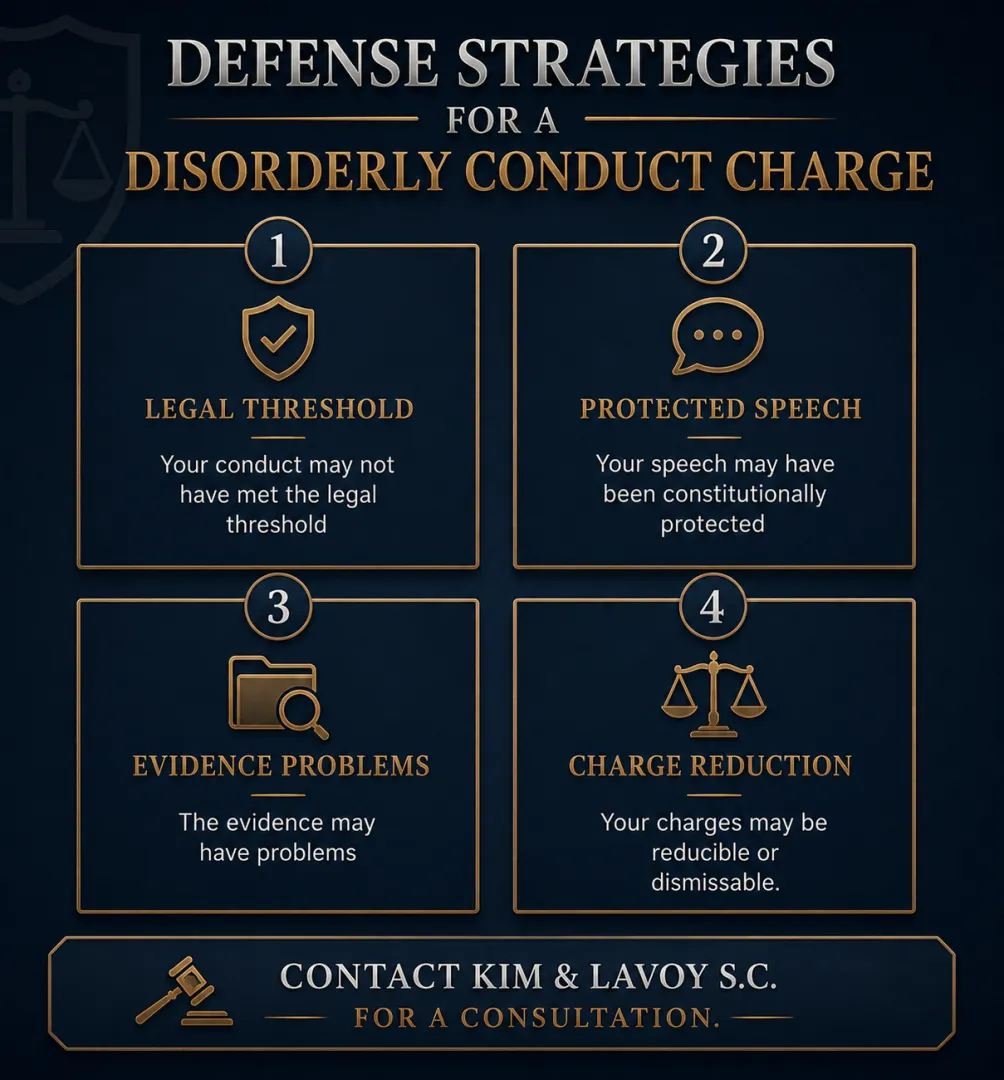
We want to be direct about something: being charged is not the same as being convicted. We see people come in convinced that the outcome is already decided, and that’s rarely true. Real defense strategies exist, and the facts of your situation matter more than you might think right now.
- Your conduct may not have met the legal threshold. The prosecution has to prove that your actions had a real tendency to disturb the peace, not just that someone was annoyed or upset. Courts have drawn a clear line here, as per State v. Douglas D. (2001 WI 47). If the situation was misunderstood or exaggerated by a witness or responding officer, that’s something we can challenge.
- Your speech may have been constitutionally protected. If what you said was protected by the First Amendment, the disorderly conduct statute can’t reach it, as per State v. A.S. (2001 WI 48). Free speech protections are strict, and context matters.
- The evidence may have problems. Video footage, witness statements, or text message records can show that what happened didn’t meet the legal standard. A strong defense often starts with gathering this kind of evidence early, before it disappears.
- Your charges may be reducible or dismissable. In many counties, we can negotiate a reduction from a criminal misdemeanor to a municipal ordinance violation, which means you avoid a criminal record entirely. Pleading guilty without exploring these options first is a mistake that’s difficult to undo.
“People don’t know what they don’t know. And the only way that they can really figure out what options are available and how to make things the best they possibly can be is by talking to an attorney that knows what they’re doing.“
Domestic Dispute and Disorderly Conduct Charges
If your disorderly conduct charge involves a spouse, partner, or family member, you need to know that the stakes are higher than in a standard case. We work with people in this situation regularly, and we understand how complicated and emotional it can be, especially when the charge came out of a moment that felt nothing like a “crime.”
Under Wisconsin law, when the offense involves a domestic relationship, additional consequences attach automatically:
- A mandatory $100 domestic abuse surcharge under Wisconsin Statute § 973.055
- Possible firearm restrictions under federal law
- No-contact conditions that a court may impose, which can affect where you live and who you communicate with
A charge that starts as a misdemeanor disorderly conduct case can become significantly more complicated when a domestic relationship is involved. If you’re in this situation, please don’t wait to get legal representation. The earlier we can step in, the more we can do to protect your rights and your daily life.
Public Intoxication and Disorderly Conduct
Public intoxication is not a standalone criminal offense in Wisconsin. But loud or aggressive behavior while intoxicated that causes an immediate breach of the peace is one of the most common ways disorderly conduct charges come about. If alcohol was involved, it can affect how the prosecution’s case is built against you and what the court may require upon conviction, such as an alcohol assessment or counseling.
How Kim & LaVoy Can Help You
When you’re dealing with a disorderly conduct charge, you need more than a legal definition. You need an experienced criminal defense attorney who will hear what actually happened and give you an honest picture of where you stand.
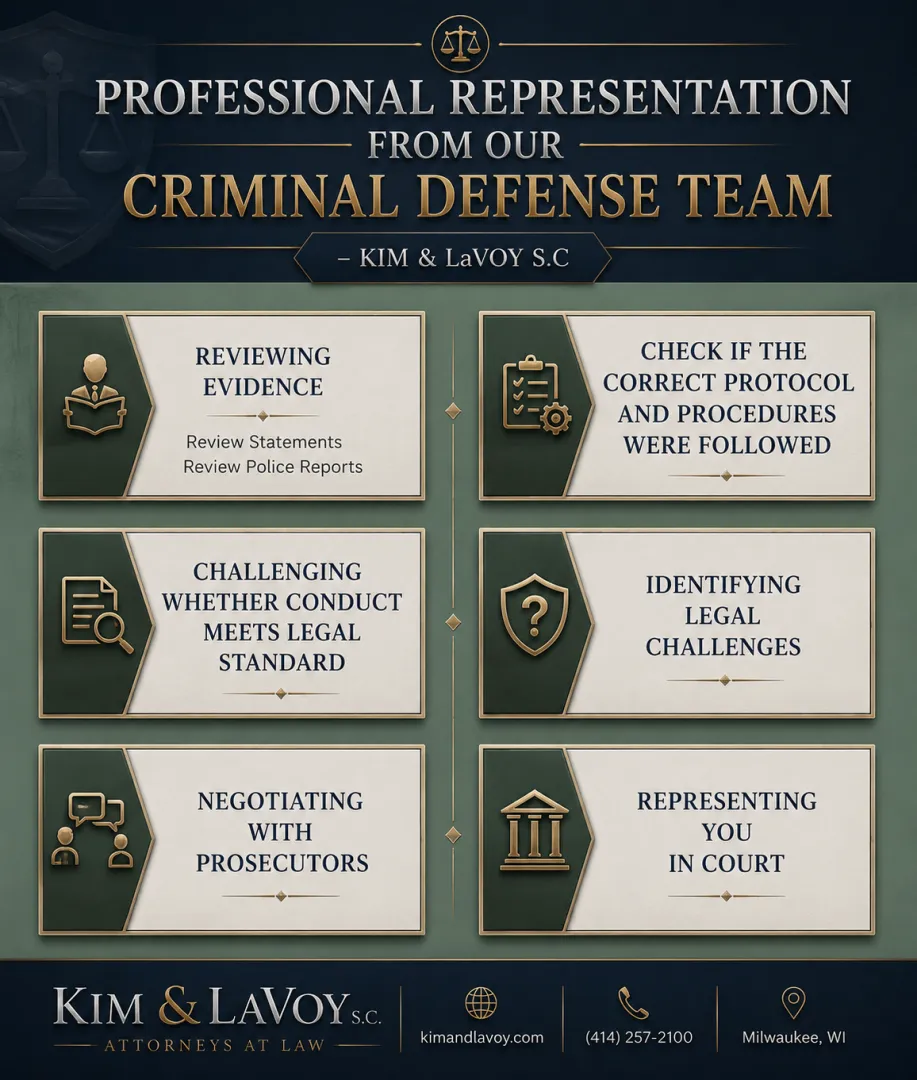
Here’s what professional representation from our criminal defense team looks like:
- Reviewing the police report, witness statements, and available evidence
- Checking whether the officer followed proper procedures during the arrest or citation
- Challenging whether your conduct meets the legal standard for disorderly conduct under Wisconsin law
- Identifying legal challenges or proof problems in the prosecution’s case
- Negotiating with prosecutors for reduced criminal charges, including reductions to a municipal ordinance violation that keeps your record clean
- Representing you in court so you don’t have to face the process alone
Our Managing Partner, Julius Kim, is a former Milwaukee County Assistant District Attorney. Our defense team knows how the other side builds these cases and where they fall apart.
“This doesn’t define who you are. Many of our clients, in all honesty, are first-time offenders. They’re not repeat offenders. They’re people that found themselves in bad situations just from circumstance.“
Facing a Disorderly Conduct Charge in Wisconsin?
You don’t have to wait until things feel more serious to reach out. If you’re unsure whether your charge is “bad enough” to need an attorney, that uncertainty itself is a good reason to call. The sooner you talk to us, the sooner you’ll know exactly what you’re dealing with and what your options are.
If you’re facing a disorderly conduct charge in Wisconsin, contact Kim & LaVoy S.C. to schedule a confidential consultation with an attorney who will listen, give you a straight answer, and help you move forward.
Frequently Asked Questions
How bad is disorderly conduct on your record?
A disorderly conduct conviction creates a criminal record that shows up in background checks run by employers, landlords, and licensing agencies. It can affect job opportunities, housing applications, and certain professions that require a professional license or security clearance.
In Wisconsin, misdemeanor convictions remain visible on CCAP for 20 years. The conviction record held by the Wisconsin Crime Information Bureau does not automatically disappear. The long-term consequences are real and often underestimated.
For more on how these charges play out specifically in Milwaukee, read our post on what constitutes disorderly conduct in Milwaukee.
Is disorderly conduct a violent misdemeanor?
No, disorderly conduct is not classified as a violent misdemeanor in Wisconsin. It is a Class B misdemeanor under Wisconsin Statute § 947.01, but it is not categorized as a crime of violence on its own. When the conduct involves physical fighting or a domestic violence situation, additional criminal charges may be filed that carry a violent classification.
What does it mean if you get charged with disorderly conduct?
It means a police officer or prosecutor believes your behavior met the legal standard under Wisconsin law. Being charged is not the same as being convicted. You have the right to contest the charge, challenge the evidence, and explore whether reduced charges or dismissal are possible.
If a weapon was involved in the incident, read our article on carrying a knife in Wisconsin to understand how weapon-related conduct can affect the charges you face.
Is disorderly conduct an assault charge?
No. The two are separate offenses under Wisconsin law. Disorderly conduct under Wisconsin Statute § 947.01 covers disruptive behavior that tends to cause a disturbance. Wisconsin does not have a standalone assault statute. What other states call assault is charged in Wisconsin as battery under Wisconsin Statute § 940.19, disorderly conduct, or recklessly endangering safety. These are separate offenses with different elements and different penalties. It is possible to face both battery and disorderly conduct charges arising from the same incident, but they are legally distinct. If you are facing felony or misdemeanor charges alongside a disorderly conduct charge, the stakes are considerably higher.
Can you go to jail for disorderly conduct in Wisconsin?
Yes. Disorderly conduct charged as a criminal offense carries up to 90 days in jail and a fine of up to $1,000, as per Wisconsin Statute § 939.51(3)(b). Courts may also impose probation or counseling. Jail is not guaranteed, but it is a real possibility when aggravating circumstances or prior criminal history are present.
How long does disorderly conduct stay on your record in Wisconsin?
A conviction for this charge stays visible on CCAP for 20 years. The record held by the Wisconsin Crime Information Bureau does not expire automatically.
Expungement is possible in limited circumstances. Under Wisconsin Statute § 973.015, a court may order expungement at sentencing if the person was under 25 at the time of the offense, the court finds expungement is in the person’s interest, and the person completes all sentence requirements, including any probation or fines. In most situations, expungement must be ordered at sentencing and cannot be applied for afterward.
How much is bail for disorderly conduct in Wisconsin?
There is no fixed bail amount set by state law. Bail varies by county, judge, the circumstances of the arrest, and criminal history. In many first-offense cases, a person may be released on a signature bond with no cash required. In cases involving domestic violence or prior convictions, cash bail may be set. An attorney can appear at the bail hearing and argue for conditions that allow you to return to daily life while the case moves forward.
Legal Disclaimer:
This article is for general informational purposes only and does not constitute legal advice. Every case is unique. Reading this content does not create an attorney-client relationship. Wisconsin law is subject to change. Contact Kim & LaVoy S.C. directly for legal advice tailored to your circumstances.