
Wisconsin Drinking Laws: What Residents Need to Know
Wisconsin drinking laws are unique. Ohio, Missouri, Texas, and Louisiana are the only other states that allow persons under 21 to drink under very specific circumstances. However, the drinking laws in Wisconsin are much more lenient than those in other states.
In Wisconsin, the legal drinking age is 21. However, people under 21 can legally consume alcohol in bars, restaurants, or private properties if they are accompanied by their parent, legal guardian, or a spouse of legal drinking age.
At Kim & LaVoy, S.C., we see these cases every day. We know that most people who find themselves in trouble with Wisconsin drinking laws are not bad people. They are people who have simply found themselves in a difficult moment. We know exactly what to expect in your criminal case.

“I get it. This doesn’t define who you are. Many of our clients, in all honesty, are first-time offenders. They’re not repeat offenders. They’re people who found themselves in bad situations just from circumstance. Let’s see if we can try and get you through this process, get you through this case without completely undoing everything that you’ve worked hard for.”
Julius Kim
• Kim & LaVoy S.C.
Key Takeaways
- The legal drinking age in Wisconsin is 21, but minors may consume alcohol when accompanied by a parent, legal guardian, or spouse of legal drinking age.
- Underage drinking violations are generally civil offenses but can still result in fines, license suspensions, and other penalties.
- Wisconsin has a zero-tolerance policy for drivers under 21 who consume alcohol.
- Open container laws prohibit alcohol that is accessible to passengers in most vehicles.
- Public drinking rules vary by municipality and may be restricted outside designated entertainment districts.
- Repeated alcohol-related offenses can lead to misdemeanor or felony charges.
What Is Wisconsin’s Legal Drinking Age?
The legal drinking age is age 21, but Wisconsin law allows individuals under 21 to consume alcohol if they are accompanied by a parent, legal guardian, or spouse who is of legal drinking age, as per Wisconsin Statute §125.07. The legislature adopted the current age-21 rule after the National Minimum Drinking Age Act of 1984, effective September 1, 1986, with a grace period for some 18-to-20-year-olds.
If you are under 21, Wisconsin alcohol laws also prohibit the following:
- Buying or trying to buy alcohol yourself.
- Having alcohol in your possession without a good reason.
- Using a fake ID to try to buy alcoholic beverages.
Penalties for Underage Drinking
Underage drinking on its own is not a misdemeanor or a criminal offense under the Wisconsin state legislature. Instead, a first offense is treated as a civil violation.
But that does not mean it should be taken lightly.
Drinking laws and penalties for those under 21 are tiered. For minors, it is illegal to purchase, possess, or consume alcohol unless an exception applies. If you are caught knowingly possessing or consuming alcohol between the ages of 17 and 20, here’s what you’re looking at: 125.07(4)(b) Wisconsin Statutes
- First offense: a fine of $100–$200.
- Second offense in the same year: a fine of $200–$300.
- Third offense in the same year: a fine of $300–$500.
- Four or more offenses in a year: a fine of $500–$1,000.
A first violation may also result in a 90-day loss of driving privileges.
One thing Julius hears from clients regularly is how surprised they are by the seriousness with which Wisconsin treats what they thought was a minor violation.
“People sometimes don’t realize how punitive it really is. People oftentimes will call us, and they’re really surprised that law enforcement or the various prosecutors’ offices have taken something that they think is seemingly innocuous – but they’re treating it very seriously.”
Julius Kim
• Kim & LaVoy S.C.
Underage Drinking and Driving
The state has a zero-tolerance policy on underage drunk driving. It is called the “Not a Drop” law, and under-21 drivers cannot operate a motor vehicle with any Blood Alcohol Concentration (BAC). If any BAC is detected, it can result in a three-month suspension of driving privileges.
Additionally, Wisconsin law states that a driver is considered ‘under the influence’ if their ability to operate a vehicle is impaired by alcohol or controlled substances, regardless of their BAC results.
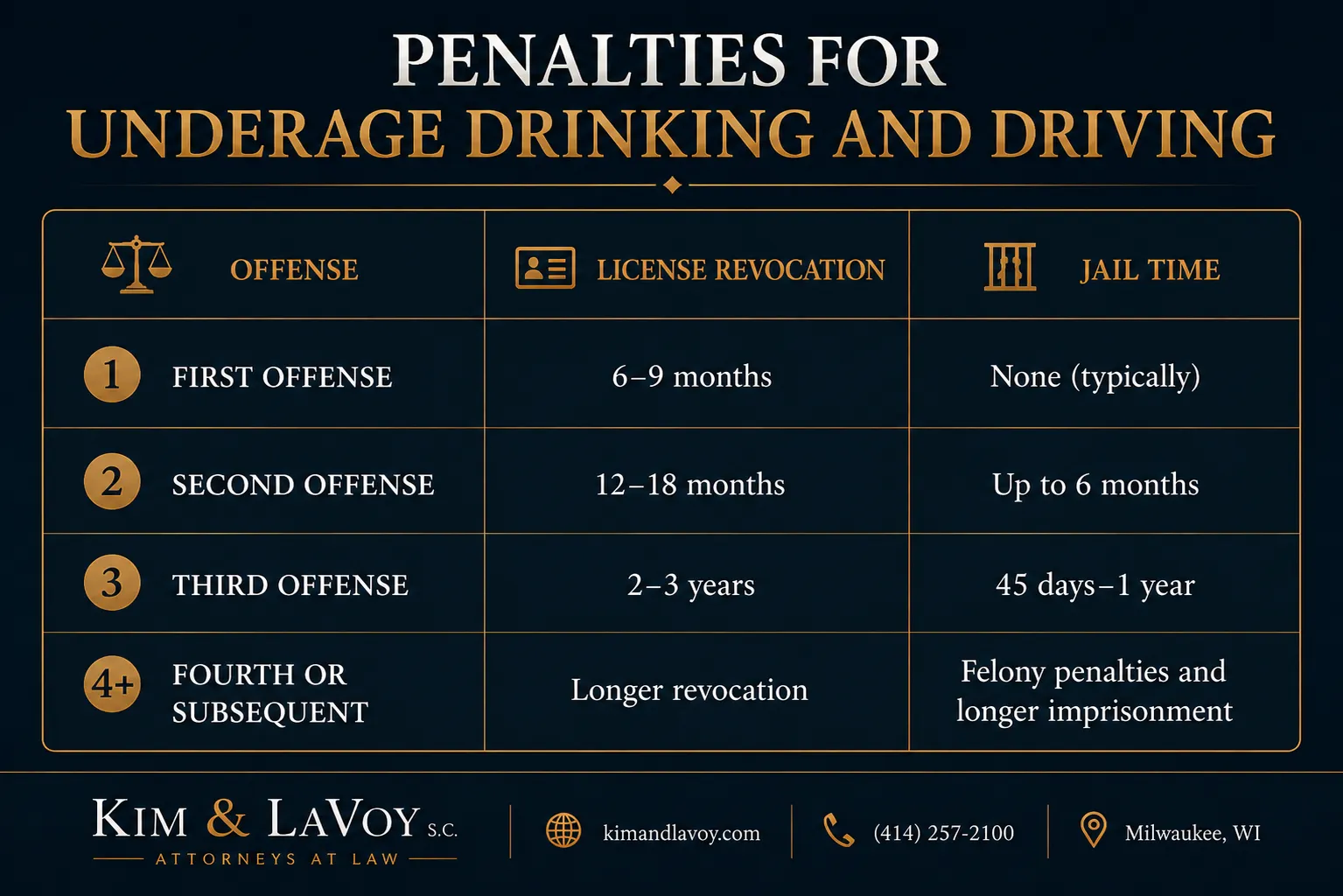
A first offense is still treated as a civil traffic violation, but there are still consequences. A minor caught driving under the influence for the first time can face fines in the hundreds, a 6–9 month suspension, or alcohol education classes.
Here’s where it gets serious. Further violations can result in more severe penalties, and if a traffic violation causes injury, then a misdemeanor or felony charge becomes a real possibility.
Here’s the typical range of consequences for Operating While Intoxicated (OWI), as per the Wisconsin Department of Transportation:
- First Offense:
- Fines between $150 and $300.
- Possible license revocation for 6–9 months.
- Mandatory Alcohol Assessment & Education Program if BAC is 0.15 or more.
- Second Offense:
- Fines between $350 and $1,100.
- License revocation for 12-18 months.
- Up to 6 months of prison time.
- Third Offense:
- Fines between $600 and $2,000.
- License revocation for two to three years.
- Between 45 days and one year in prison.
- Fourth or More Offenses: Can result in more serious felony charges.
Drivers in Wisconsin with three or more prior OWI convictions cannot operate a motor vehicle with a BAC greater than 0.02%.
Julius has seen this pattern many times. People treat a first offense as no big deal and then find themselves completely blindsided when an arraignment for a second or third offense carries consequences they were not prepared for.
He explains that this mostly happens when someone is stopped and later arrested by a police officer. The resulting consequences can escalate quickly after repeated alcohol consumption and driving behavior.
“Wisconsin is the only state in the union where a first offense is considered a non-criminal offense. A lot of times, people don’t realize that second, third, and fourth offenses are much more serious. In fact, they carry mandatory jail time. People think a situation is not that serious because of the way it was treated initially. And then they’re suddenly slapped in the face with these really serious consequences. And it’s a shock to them.”
Julius Kim
• Kim & LaVoy S.C.
Can Underage Drinking Affect School or Employment Opportunities?
Research from the U.S. National Library of Medicine has found that underage drinkers are at an elevated risk for neurodegeneration, particularly in parts of the brain responsible for learning and memory, as well as impairments in functional brain activity and neurocognitive defects.
It does not stop there. A pattern of underage drinking can make it harder to get into college or earn a scholarship. It can affect your chances of getting a job, because employers care about reliability and self-control. And if there is a criminal record tied to an OWI, those doors become even harder to open.
Wisconsin Alcohol Laws You Should Know
Open Container Laws in Wisconsin
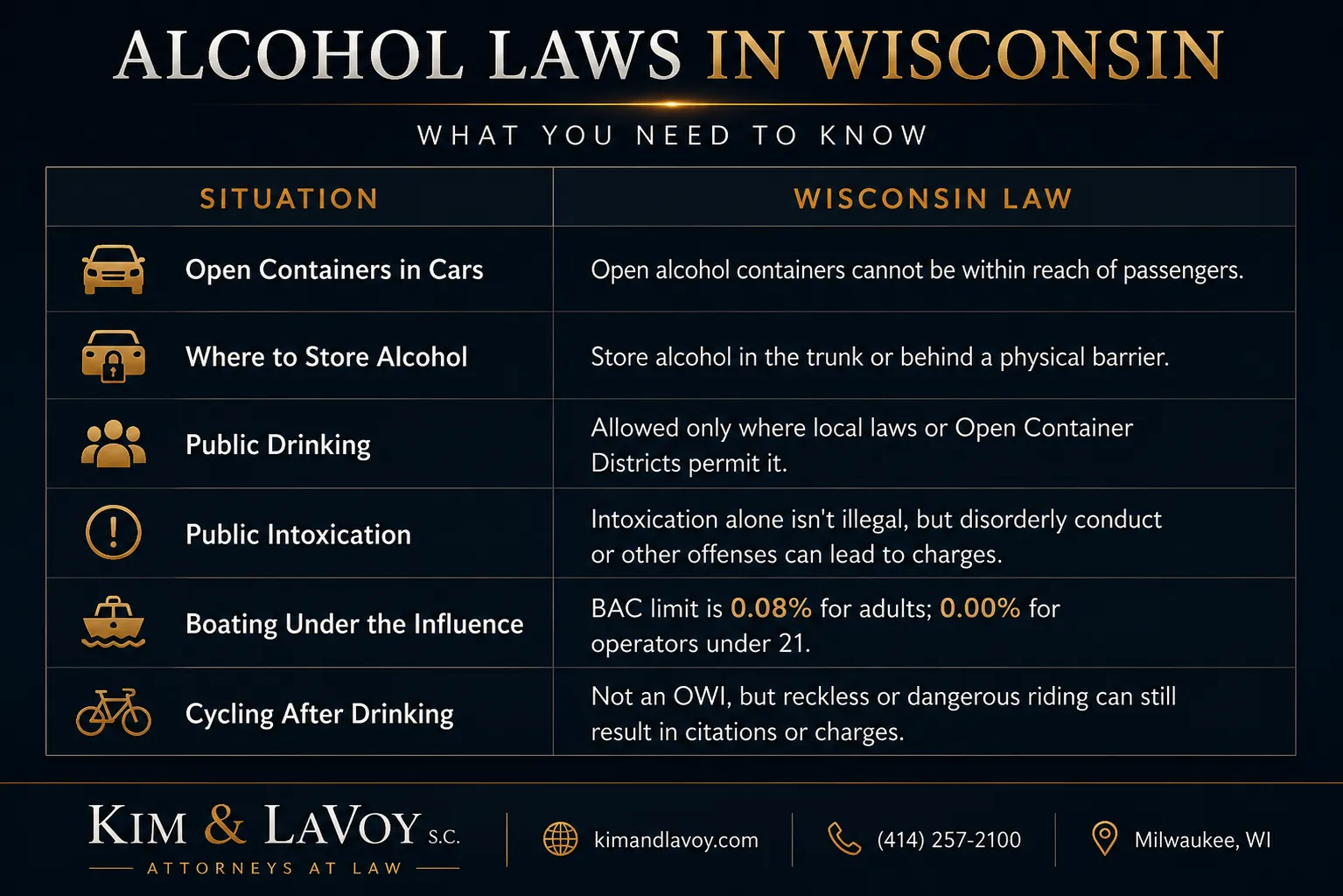
Wisconsin alcohol laws are clear on this. You cannot have an open container of alcohol in your car where passengers can reach it.
- Open containers in cars: The rule applies to everyone in the car on a public road. Break it, and you are looking at a ticket and a fine. The only exceptions are chauffeured limousines and motorhomes.
- Where alcohol should be stored: You may only store alcohol in your trunk. There needs to be a clear physical barrier between the alcohol and the passenger area, which means you can’t store it in your glove box.
Public Wisconsin Drinking Laws
This is where things vary a lot depending on where you are. Public drinking rules are not the same across all of Wisconsin. Some cities and towns have designated areas where it is perfectly legal to drink outside.
- Public drinking: If you are over 21, drinking in public is not, in itself, illegal in Wisconsin. But there is a general rule that it is restricted to sidewalks, streets, and public property, unless the local municipality has set up a designated Open Container District.
- Public intoxication: If someone has had too much alcohol and starts causing a scene through disorderly conduct or domestic violence, that’s when the law steps in.
A first offense might result in a warning. But if someone was hurt or property was damaged, prosecution and civil action are both on the table.
Drinking and Different Types of Vehicles
The rules around drinking aren’t limited to cars. Boats and bicycles both come into the picture.
- Boating under the influence: The law is strict here. If you are under 21, you cannot operate a boat with any detectable alcohol in your system, 0.00% is the limit. Adults operating boats for personal use must stay at or below 0.08%. Violations can lead to fines, and repeat offenders can face prison time.
- Cycling after drinking: Technically, riding a standard bicycle while intoxicated does not qualify for an OWI charge. But that does not mean a free pass. Police can still stop you for reckless riding, traffic violations, or endangering pedestrians.
Facing Charges Related to Alcohol or OWI?
Wisconsin drinking laws are more nuanced than many people realize. While the state allows certain exceptions for minors consuming alcohol with a parent or guardian, there are still significant consequences for underage drinking, OWI offenses, open container violations, and alcohol-related criminal charges.
As Julius Kim often reminds clients, one mistake does not have to define your future. The most important thing is understanding your rights, addressing the issue early, and making informed decisions moving forward.
If you are facing charges related to underage drinking, OWI, open container violations, or another alcohol-related offense, contact Kim & LaVoy, S.C. for a consultation. Our team can help you understand your options and work to protect everything you have worked hard to build.
Frequently Asked Questions About Wisconsin Drinking Laws
When Can You Buy Alcohol in Wisconsin?
Generally, alcohol sales start at 6 a.m. Under state law, the hours for retail sale vary depending on the type of alcohol being sold. Retail liquor and wine sales are prohibited from 9:00 p.m. to 6:00 a.m. Bars must close between 2:00 a.m. and 6:00 a.m., Monday through Friday, and between 2:30 a.m. and 6:00 a.m. on Saturdays and Sundays, except on New Year’s Eve. Wisconsin Legislature: 125.68(9)(e)
Local municipalities in Wisconsin can further restrict retail sales of alcohol or ban the issuance of retail liquor licenses altogether, leading to some municipalities being effectively ‘dry’.
How Late Can You Buy Alcohol on Sunday?
Usually until 9 p.m. on Sundays. This varies depending on the location and type of purchase, so checking local rules is always a smart move.
Can You Walk With a Beer?
It depends entirely on where you are in Wisconsin. Some cities and towns allow public consumption in designated areas, others do not. Don’t assume anything and check the local rules that apply where you are.
Is Underage Drinking a Misdemeanor?
A first offense is typically a civil violation. But it can become more serious if it is not your first time, if a fake ID was involved, or if someone was injured while you were intoxicated.
Can a Passenger Drink Alcohol in a Car?
No. Passengers may not consume alcohol in a moving vehicle on a public road in Wisconsin. Chauffeured limousines and motorhomes are the only exceptions.
Can You Drink While Fishing?
Having a drink on the shore while you wait for a bite is completely fine. But if you are operating a boat, the legal limit applies: 0.08% for adults, and 0.00% for anyone under 21.
Legal Disclaimer
This content is provided for general educational purposes only and does not constitute legal advice. Every criminal case is unique. Contact a licensed attorney to discuss the specific facts of your situation.