
Wisconsin Drug Sentencing Guidelines: Charges, Penalties, and What to Know

If you are reading about Wisconsin drug defense law right now, you might be sitting in your car in a parking lot trying to figure out how bad this is going to be. Or maybe you’re at your kitchen table after everyone else has gone to bed, too embarrassed to ask anyone in your life what happens next. You might be wondering if this means prison, if you’ll be convicted, or if one mistake could cost you your job.
We’ve sat across from hundreds of people in this exact position, and the first thing we want you to know is that what you’re reading online is not the full picture. The distance between what could happen and what actually happens is often determined by the decisions you make right now.
At Kim & LaVoy S.C., we’ll walk you through how Wisconsin drug sentencing guidelines actually work, what the penalties look like, and what options may be available that you don’t know about yet.
Key Takeaways
- Drug offenses in Wisconsin are prosecuted under the Uniform Controlled Substances Act § 961 of the Wisconsin Statutes. Your sentence depends on three things: the action (possession, delivery, or manufacture), the type of substance, and the quantity involved.
- A first offense for marijuana possession is a Class A misdemeanor carrying up to 6 months in jail and up to $1,000 in fines. A first offense for heroin or methamphetamine possession is a Class I felony carrying up to 3.5 years in prison.
- Any second or subsequent drug possession offense in Wisconsin automatically escalates to a Class I felony, regardless of the substance. A second marijuana misdemeanor becomes a felony.
- Possession with intent to deliver is always a felony, with penalties that scale based on the weight and type of the drug.
- Factors like prior convictions, proximity to a school, involvement of a minor, firearm possession, or a death connected to distribution can push your case into a much higher penalty range.
- Wisconsin funds 61 treatment courts and 30 diversion programs statewide through the Treatment Alternatives and Diversion (TAD) program. Completing one of these programs can lead to reduced or dismissed charges.
- A drug conviction can affect far more than your court case. It can follow you into job applications, housing, your driver’s license, and background checks for years.
- Talking to an attorney early gives you the best chance to understand your charges, find weaknesses in the evidence, and explore options you didn’t know were on the table.
How Drug Offenses Are Prosecuted Under Wisconsin Law
One of the first questions we hear from people is some version of “how serious is this, really?” The honest answer is that it depends on how your case is classified, and Wisconsin’s system is more nuanced than most people expect.
Drug offenses in Wisconsin are prosecuted under the Uniform Controlled Substances Act, Chapter 961 of the Wisconsin Statutes. The law looks at three things to determine how your case is charged and sentenced: the action involved (were you possessing, delivering, or manufacturing?), the type of drug, and the amount or surrounding circumstances.
The law classifies controlled substances into five schedules based on their potential for abuse and accepted medical use:
- Schedule I drugs have a high potential for abuse and no accepted medical use. This includes heroin, LSD, other hallucinogens, and cannabis.
- Schedule II drugs also have a high potential for abuse, but do have some accepted medical uses. This group includes cocaine, methamphetamine, morphine, codeine, and other narcotic drugs used in medical settings.
- Schedules III through V cover substances with lower potential for abuse. Penalties decrease across these categories.
Why does this matter to you? Because where your substance falls on this schedule shapes the charge level, the potential sentence, and the defense strategy your attorney can build. Many people assume all drug charges are treated the same. They’re not.
Common Drug Possession Charges in Wisconsin
If you’ve been charged, the specific type of charge changes everything about your potential fines, jail time, and what goes on your record. Here’s what you need to know about the main categories.
- Simple drug possession means holding a controlled substance for personal use. This covers marijuana, cocaine, heroin, methamphetamine, and prescription drugs held without a valid prescription. What surprises many of our clients is that even possessing a small amount of a Schedule I or II substance can result in a felony charge under Wisconsin Statute § 961.41.
- Possession with intent to deliver is where things get more serious quickly. The state doesn’t need to catch you in the act of selling. If prosecutors argue that the quantity or circumstances, such as packaging materials, scales, large amounts of cash, or multiple phones, suggest the drugs weren’t just for personal use, they can charge you with intent to deliver. This is always a felony, and the penalties scale based on the weight of the drug.
- Manufacture or delivery covers producing, distributing, or selling controlled substances. This is always a felony and carries the steepest penalties under Wisconsin law.
Other charges that can come alongside or in addition to these include:
- Drug paraphernalia possession (a misdemeanor carrying up to 30 days in jail and up to $500 in fines)
- Offenses involving an underage person, which can double the maximum penalty
- Driver’s license suspension for up to five years following any drug conviction, something most people don’t see coming until it’s already happened
Something else worth knowing is that while alcohol is not a controlled substance under the Uniform Controlled Substances Act, being involved in an incident where both drugs and alcohol are present can affect how charges are filed and how a judge views your case.
Drug Charges and Sentences in Wisconsin
We know this is probably the section you scrolled to first. The table below reflects penalties directly from Wisconsin Statute § 961.41. These are statutory maximums, meaning they represent the ceiling, not what necessarily happens in every case. Your actual sentence depends on the circumstances, your prior history, and how your case is handled.
Penalties vary based on individual circumstances. This table reflects statutory maximums under Wisconsin Statute § 961.41 and is not legal advice.
One thing that surprises people: any subsequent offenses involving possession of any controlled substance in Wisconsin automatically escalate to a Class I felony. A second marijuana misdemeanor becomes a felony. A second cocaine charge becomes a felony. The fines and prison exposure jump up each time.
Factors That Affect Sentencing
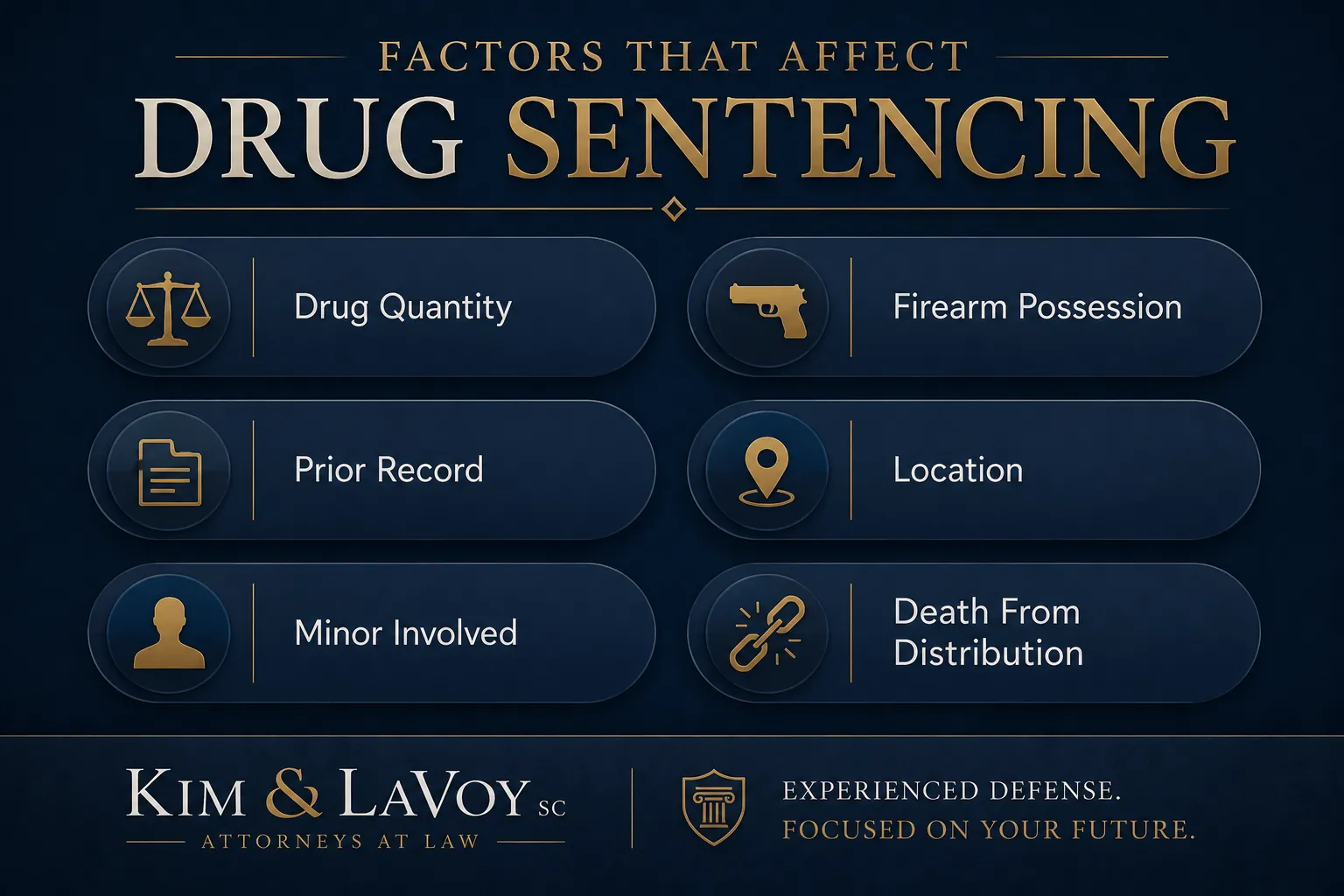
Several factors can push your drug offense into a higher felony class or lead to a longer sentence. Penalties vary based on how many of these factors are present in a case. Here’s what courts and prosecutors look at:
- The quantity of the drug: Larger amounts trigger higher felony classes and longer potential sentences. Even the difference between a few grams can change your charge classification entirely.
- Where you were: Being charged with possessing or distributing drugs near a school, park, or youth center adds penalties, which can include a supervised work program in some counties.
- Your prior record: Prior convictions elevate misdemeanors to felonies and increase sentencing ranges. This is one of the most common factors we see pushing cases into more serious territory.
- Involvement of a minor: Distribution to an underage person can double the maximum penalty.
- Firearm possession: Being found with a firearm during a drug offense brings additional felony charges on top of the drug charge itself.
- A death connected to distribution: When selling or delivering narcotics leads to someone’s death, the charge escalates to a Class C felony, carrying up to 40 years in prison and up to $100,000 in fines. In federal cases, life imprisonment is possible.
Manufacturing or delivering narcotics in the state can lead to up to 30 years in prison and fines up to $1,000,000 in the most serious cases under federal law.
Understanding what the prosecution is looking at helps us build a stronger defense. Many of these factors can be challenged, and how evidence was gathered around each one matters.
Are There Mandatory Minimum Sentences?
Yes, in specific situations. Wisconsin has special sentencing provisions for repeat offenders and for crack cocaine offenses above certain thresholds. Federal law adds another layer for distribution networks, with mandatory minimums that give judges far less flexibility than state courts allow.
Here’s something you should know: a lot of people Google their charges, see the maximum penalty, and assume that’s what’s going to happen to them. That’s rarely how it works. Maximum penalties and mandatory minimums are two different things. Most drug possession charges in Wisconsin do not carry mandatory minimums. But whether those provisions apply to your specific case depends on the substance, the amount, and your history, and it’s one of the first things we evaluate when we review a case.

“While we can’t guarantee what’s going to ultimately happen in your case, what we can tell you is that we will fight to get you the best result you can expect under the circumstances.”
Alternatives to Incarceration
This is the section that changes the conversation for a lot of our clients. Because when you’re facing drug charges, it’s easy to think jail is the only possible outcome. It’s not.
Wisconsin has invested heavily in treatment-based alternatives. The state’s Treatment Alternatives and Diversion (TAD) program funds 61 treatment courts and 30 diversion programs across Wisconsin as of 2025. These programs are designed for non-violent offenders where substance abuse was a contributing factor. If you’re accepted and you complete the program, the results can be significant:
- Reduced or dismissed charges
- No conviction on your criminal record
- Connection to treatment for substance use disorders and mental health services
- A path forward that addresses the root of the problem, not just the legal consequence
Does this actually work? A 2024 evaluation of Wisconsin’s Madison Addiction Recovery Initiative (MARI), published in the Journal of Substance Use & Addiction Treatment, found that participants who received a clinical assessment and six months of individualized treatment were less likely to be re-arrested, incarcerated, or die of an overdose in the year following their initial arrest.
But here’s the part most people miss: these programs are not offered to you automatically. Someone has to identify that you’re eligible, make the argument to the prosecutor, and present you as a candidate. That’s work your attorney does on your behalf, and it’s one of the most important reasons to have representation early.
“People don’t know what they don’t know. And the only way that they can really figure out what options are available and how to make things the best they possibly can be is by talking to an attorney that knows what they’re doing.“
How Kim & LaVoy Can Help You Through This
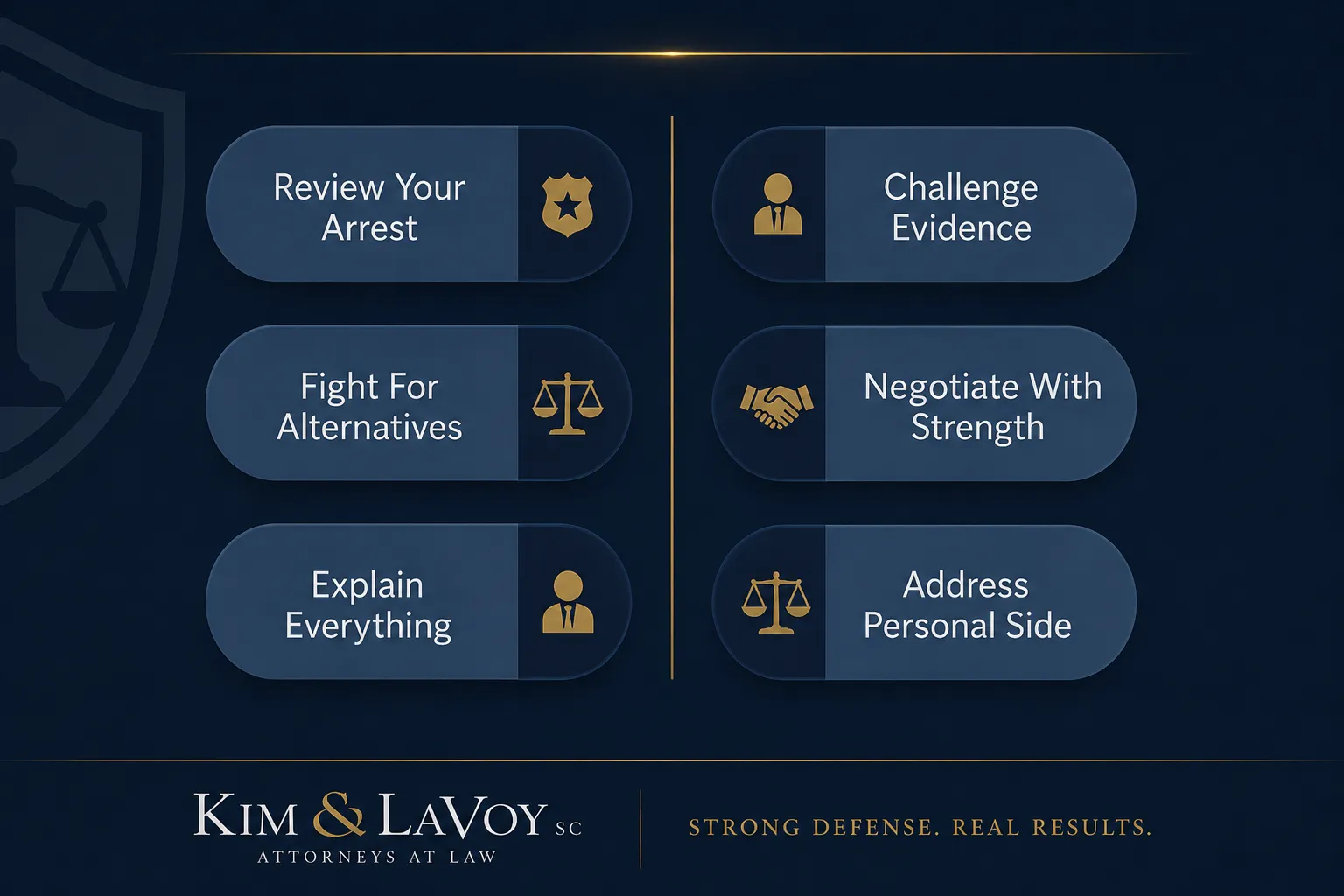
Reading about drug sentencing guidelines and actually navigating your case are two very different things. You need someone in your corner who knows the prosecutors, understands the system, and will look at every angle of your situation. Here’s what we do when you come to us:
- Review your arrest from the ground up: We examine how you were stopped, searched, and arrested. If law enforcement didn’t follow proper procedures, an unlawful search can lead to evidence being thrown out entirely.
- Challenge the evidence: Was the substance properly tested? Was the chain of custody maintained? Were the drugs confiscated through a lawful process? These details matter.
- Fight for alternatives: We identify whether diversion programs or treatment courts are an option for you. Not every attorney knows how to navigate these programs. We do.
- Negotiate from a position of strength: Our team is led by Julius Kim, a former Milwaukee County Assistant District Attorney. Prosecutors respond differently to attorneys they know are prepared to go to trial.
- Explain everything in plain language: Your charges, possible penalties, court deadlines, and realistic expectations for what comes next.
- Address the personal side: If substance abuse or mental health issues are part of the picture, we help you address those too, because we genuinely want you to come out of this in a better place.
“I look at every case as kind of two sides. One is kind of the court side and the court proceedings, and the other side is kind of the personal side. We have to make sure that a person is taken care of on a personal level to make sure that that person does not end up re-offending down the line.“
Ready to Talk Through Your Options?
A drug charge does not define what comes next. But how you respond in the days immediately after matters more than most people realize.
At Kim and LaVoy S.C., we take time to understand the full picture: the charge, the person, and the circumstances. Our attorneys have handled drug cases involving everything from first offense possession to serious distribution charges across Wisconsin, and we know that early representation makes a real difference.
Frequently Asked Questions About Wisconsin Drug Sentencing
What is the law on drug possession in Wisconsin?
Drug possession in Wisconsin is governed by the Uniform Controlled Substances Act, Chapter 961 of the Wisconsin Statutes. Possessing any controlled substance without a valid prescription is illegal. Penalties depend on the schedule of the substance, the amount, and your prior convictions. First offense cannabis possession is a misdemeanor. First offense heroin or methamphetamine possession is a Class I felony. Our post on defending drug offenses and what it means for clients explains how these cases get handled in practice.
What is the minimum sentence for drug possession?
For a first offense involving marijuana or cannabis, there is no mandatory minimum jail time, though up to 6 months is possible. A first-time conviction for heroin or methamphetamine starts at a Class I felony with up to 3.5 years in prison. Subsequent offenses escalate the maximum penalties significantly and can move a case into a higher felony class, but they do not automatically trigger mandatory minimums for most drug possession charges. Mandatory minimums in Wisconsin apply in specific, narrower situations involving crack cocaine thresholds or habitual offender statutes.
Does Wisconsin have mandatory minimum sentences?
Yes, in specific situations. Special sentencing provisions apply to crack cocaine above certain thresholds and to repeat offenders with multiple prior convictions. Federal law imposes its own mandatory minimums, generally more severe than state-level penalties. Whether those provisions apply depends on the substance, the amount, and your history.
Is there a way around mandatory minimum sentences?
Sometimes. Participation in a diversion program or drug treatment court can allow a case to resolve without triggering mandatory minimums. Charge negotiation and evidence challenges are also tools that make a real difference. Prescription drug situations carry their own complexity. If legally prescribed medication led to a drug-related charge, our post on prescription drugs and OWI arrests covers how those cases are treated differently.
What evidence is needed for a drug conviction?
The state must prove beyond a reasonable doubt that you knowingly possessed a controlled substance. That means establishing the substance was in your actual or constructive possession, that police followed proper procedures, and that lab testing confirms what the substance is. How evidence was gathered matters. An unlawful search is a violation of your rights and can lead to evidence being excluded entirely.
What is the statute of limitations on drug charges in Wisconsin?
For misdemeanor drug charges, prosecutors generally have three years to file. For felony drug charges, the limit is six years under Wisconsin Statute § 939.74. The clock can be paused in certain situations, such as leaving the state. If you believe charges may come from something in the past, timing still matters.
Legal Disclaimer:
This content is for general informational purposes only and is not legal advice. Every case is unique and outcomes vary. For advice specific to your situation, contact Kim and LaVoy S.C. directly.