
Wisconsin DUI Penalties: How They Escalate with Repeat Offenses

If you have been charged with Operating While Intoxicated (OWI) in Wisconsin, you need straight answers. How serious is this? What exactly happens next?
Wisconsin uses an escalating system of penalties, where each conviction is treated more seriously than the last.
Even a first offense can mean fines, a suspended license, and higher insurance. Repeat offenses can mean prison time, a felony record, and consequences that last long after any sentence ends.
That’s why it’s so important to have an empathetic and experienced attorney in your corner if you’re charged with drunk driving. Here at Kim & LaVoy, we provide exactly that.

“I get it. This doesn’t define who you are. Many of our clients, in all honesty, are first-time offenders. They’re not repeat offenders. They’re people who found themselves in bad situations just from circumstance. Let’s see if we can try and get you through this process, get you through this case without completely undoing everything that you’ve worked hard for.”
Julius Kim
• Kim & LaVoy S.C.
Key Takeaways
- Wisconsin uses an escalating OWI penalty system, with consequences becoming more severe for each subsequent offense.
- A first-offense OWI is generally a civil violation, while second and third offenses are criminal misdemeanors and a fourth offense is a felony.
- Factors such as a high BAC, a child passenger, refusal of chemical testing, or causing injury can significantly increase penalties.
- OWI convictions remain on a person’s driving record permanently under Wisconsin’s lifetime lookback period.
- Early legal representation can be critical to protecting driving privileges and identifying potential defenses.
OWI vs DUI in Wisconsin: What’s the Difference?
Wisconsin uses OWI in its statutes, but Driving Under the Influence (DUI) means the same thing. A driver may be charged if they operate a vehicle while impaired, have a Blood Alcohol Concentration (BAC) at or above the legal limit, or have a detectable restricted controlled substance in their system. To avoid confusion, we’ll only use OWI to match Wisconsin’s terminology.
The standard legal BAC limit is 0.08%, set by the Wisconsin Department of Transportation. Commercial drivers face a stricter BAC limit of 0.04%, with a first-offense OWI triggering a 1-year commercial driver’s license disqualification.
Under 21? The “Not a Drop” law applies – any detectable alcohol is a violation.
Wisconsin OWI Penalties at a Glance
Potential penalties increase based on BAC levels, any prior offenses, and aggravating factors such as minor passengers or injuries, as well as the length of time between offenses.
A first-offense OWI in Wisconsin is treated as a civil violation, while second and third offenses are misdemeanors, and a fourth offense is classified as a felony, as seen in the table below.
| OWI Offense | Classification | Potential Consequences |
|---|---|---|
| First-offense | Civil offense | Fines, license revocation, and/or alcohol assessment |
| Second-offense | Criminal misdemeanor | Mandatory jail time, fines, Ignition Interlock Device (IID) requirement |
| Third-offense | Criminal misdemeanor | Higher fines, longer jail time, and IID |
| Fourth-offense | Felony | Prison time, long-term license revocation, permanent record |
| Fifth-offense | Felony | Substantial prison time, possible permanent license revocation |
OWI Wisconsin First Offense
A first-offense OWI is generally treated as a civil traffic violation, and not a criminal offense, as per Wisconsin Statute §346.65. In Wisconsin, first-time OWI offenders usually do not face jail time unless they had a passenger under the age of 16 in the vehicle with them or they injured someone. These are aggravating circumstances that can lead to jail time.
Don’t let that fool you, though. Fines for a first OWI offense in Wisconsin range from $150 to $300, with total costs potentially exceeding $800 due to court fees. You can also face license revocation for 6 to 9 months, a mandatory alcohol assessment, an order to have an Ignition Interlock Device (IID) installed, and higher insurance premiums.
For high-BAC offenses, meaning a blood alcohol concentration of 0.15 or higher, or for any second offense, you may need an IID installed at your own expense for at least one year, as per Wisconsin Legislature §343.301. This device is used to monitor and prevent further OWI offenses. Once installed, before the car can start, the driver must blow into the device, and if alcohol is detected, the vehicle will not start.
If a child under 16 was in the vehicle, the offense can become criminal, with a $350 to $1,100 fine, 5 days to 6 months in jail, and a 12-to 18-month license revocation.
“People sometimes don’t realize how punitive it really is. People oftentimes will call us, and they’re really surprised that law enforcement or the various prosecutors’ offices have taken something that they think is seemingly innocuous, but they’re treating it very seriously. In Wisconsin, a lot of times, things that seem not so big of a deal are treated very seriously.
• Kim & LaVoy S.C.
OWI Second Offense in Wisconsin
A second offense is only treated as a misdemeanor if it occurs within 10 years of the first offense. Wisconsin law mandates jail time for second offenses, per Wisconsin Legislature §346.65. How much jail time depends on timing of the offense and aggravating factors.
This is the point where long-term consequences become life-changing. A criminal conviction affects employment and housing background checks and can cost you professional licenses.
You can potentially face:
- Fines of $350 to $1,100 plus court costs.
- A minimum sentence of 5 days, and up to 6 months, in jail.
- Up to 18 months’ revocation of driving privileges.
- Mandatory IID installation.
- Alcohol rehabilitation requirements.
Losing your regular driving privileges may mean seeking an occupational license for limited travel.
OWI Third Offense in Wisconsin
A third OWI offense can still be classified as a misdemeanor in some circumstances, but the penalties can reach felony-level severity. Courts will weigh up your BAC level, whether an accident occurred, your prior criminal history, and compliance with previous OWI court orders.
A third offense can bring fines from $600 to $2,000, a minimum of 45 days, and up to 1 year in jail. For a third OWI offense, the license can be revoked for up to three years in Wisconsin. Penalties increase when blood alcohol concentration is higher, and other penalties can include mandatory IID and ongoing alcohol treatment.
Drivers with three or more previous drunk driving convictions may also face lower BAC limit restrictions. They can be prohibited from driving with a BAC above 0.02%.
“Wisconsin is the only state in the union where a first offense is considered a non-criminal offense. A lot of times, people don’t realize that second, third, and fourth offenses are much more serious. In fact, they carry mandatory jail time. People think a situation is not that serious because of the way it was treated initially. And then they’re suddenly slapped in the face with these really serious consequences. And it’s a shock to them.”
• Kim & LaVoy S.C.
OWI Fourth Offense in Wisconsin
Under Wisconsin Legislature §346.65, a fourth OWI offense in Wisconsin is automatically classified as a felony, which significantly increases the penalties compared to previous offenses. These can include fines from $600 to $10,000, up to 6 years in prison, extended supervision, long-term license revocation, mandatory IID, and a permanent criminal record.
These consequences can also negatively affect firearm ownership, employment, housing, and professional licensing.
As of April 25, 2016, both fifth and sixth OWI convictions in Wisconsin are classified as Class G felonies, which carry a mandatory prison sentence of a minimum of 1.5 years and a maximum of up to 10 years.
If the offense involved an accident causing injuries or death, prosecutors may add felony charges like vehicular homicide, carrying up to 25 years in prison and fines up to $100,000, as per Wisconsin Legislature §940.09.
For all these reasons, you must have an experienced and competent attorney for your arraignment.
Factors That Can Increase Wisconsin OWI Penalties
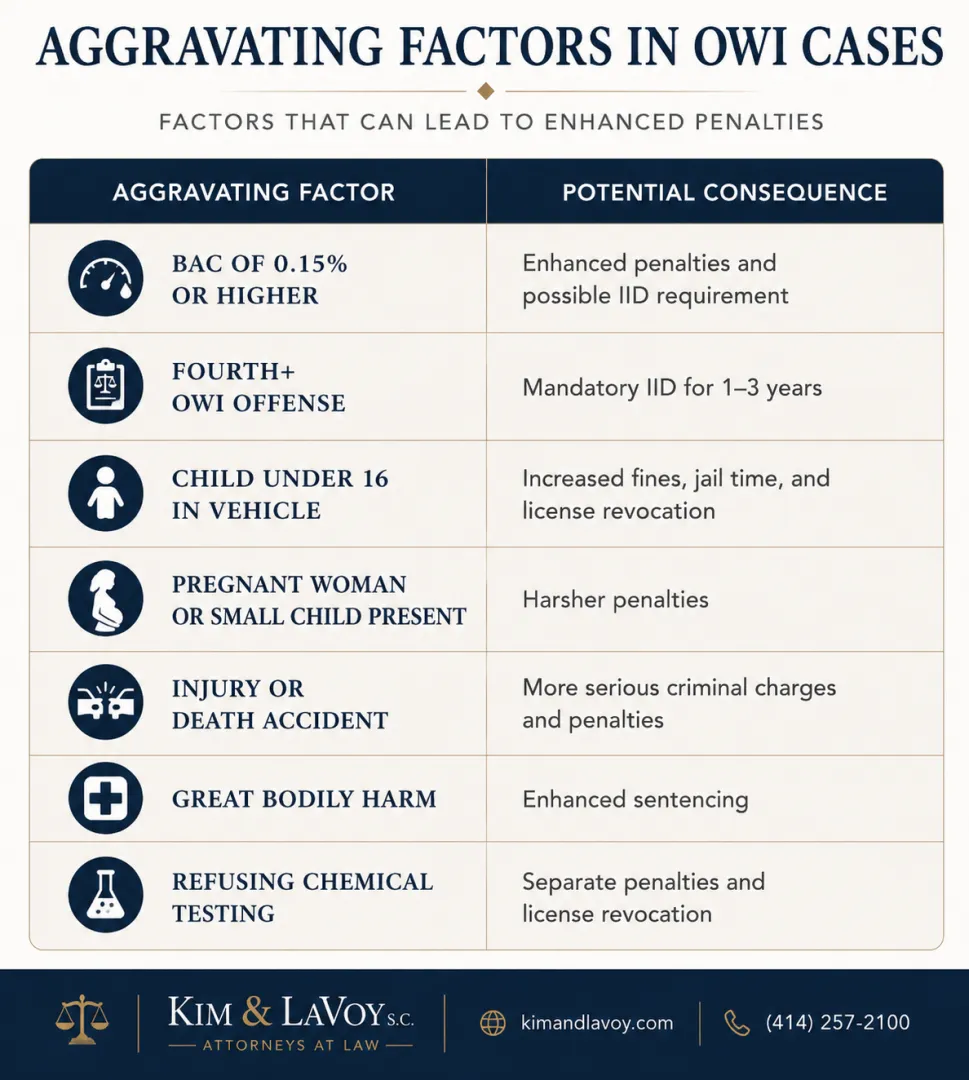
At any offense level, certain circumstances make the consequences significantly worse, and penalties increase sharply when serious safety risks are involved, including having a pregnant woman or small child in the vehicle, or causing great bodily harm.
A BAC of 0.15% or higher can trigger mandatory IID requirements and enhanced sentencing. For a fourth offense or higher, the device is typically required for 1 to 3 years in every vehicle the person owns or drives unless a Wisconsin court grants an exemption.
Having a child under 16 in the vehicle increases fines, prison exposure, and license revocation.
An accident involving injury or death leads to more serious criminal charges. Penalties also rise dramatically when a minor passenger is present or someone is injured.
Refusing chemical testing under Wisconsin’s implied consent law can trigger separate penalties, including license revocation, a notice of intent to revoke operating privileges, and only 10 days to request a hearing, even without a conviction.
Does an OWI Stay on Your Record in Wisconsin?
Yes. Wisconsin’s lifetime lookback period means every prior conviction stays on your driving record permanently and cannot be expunged, no matter how long ago it happened.
OWI convictions can affect both your driving record and criminal record, depending on the offense level, and they typically lead to higher insurance rates. Getting legal advice early is one of the most important things you can do.
Understanding the Consequences of an OWI Conviction
Wisconsin takes Operating While Intoxicated offenses seriously, and the consequences become increasingly severe with each subsequent conviction. While a first offense is generally treated as a civil violation, repeat offenses can lead to mandatory jail or prison sentences, lengthy license revocations, substantial fines, and a permanent criminal record. Additional factors, such as a high blood alcohol concentration, a child passenger, refusing chemical testing, or causing injury, can further increase the penalties.
Understanding how Wisconsin’s OWI laws work and seeking legal guidance as early as possible can help you make informed decisions about your case and protect your future.
Charged With an OWI in Wisconsin?
Being charged is not the same as being convicted. But what happens next, who you talk to, what you say, and who represents you can make an enormous difference.
Whether you are dealing with a first offense or a felony-level repeat charge, the attorneys at Kim & LaVoy S.C. can evaluate the evidence and review law enforcement procedures. This includes whether the arresting officer had legal grounds for the stop, whether field sobriety tests were administered properly, and whether chemical evidence in OWI cases was handled correctly.
We identify potential defenses and help protect your driving privileges by fighting drunk driving charges where the facts support it, with reassurance and empathy. Julius himself spent years as an Assistant District Attorney for Milwaukee County and brings that prosecutorial insight to every case.
Frequently Asked Questions About Wisconsin OWI Penalties
Is a first OWI a criminal offense in Wisconsin?
Generally no. A first offense is treated as a civil violation unless aggravating circumstances like injuries, a minor passenger, or an extremely high BAC are involved.
Is a fourth OWI a felony in Wisconsin?
Yes. A fourth offense is classified as a felony under Wisconsin Legislature §346.65.
Does an OWI affect insurance rates?
Yes. Most drivers face significant premium increases or policy cancellations following a conviction.
What should I do after being charged?
Get legal advice before doing anything else, especially before talking to law enforcement.
Make note of every court date, attend all hearings, and understand that OWI charges can escalate from a civil first offense to misdemeanors, for second and third offenses, and a felony at the fourth offense.
“Generally speaking, when the police want to talk to you about something, talking to them is a mistake. Even if you’re completely innocent, what you say might get twisted around. People think they can talk their way out of criminal charges. But by the time police officers are talking to you, they’ve already decided in their heads that this person has done something wrong. Simply and politely say you’d like to speak with an attorney first. Then call one.”
• Kim & LaVoy S.C.
Legal Disclaimer
This content is provided for general educational purposes only and does not constitute legal advice. Every criminal case is unique. Contact a licensed attorney to discuss the specific facts of your situation.