
The Differences Between Assault and Battery in Wisconsin

The differences between assault and battery in Wisconsin catch most people off guard after an arrest. You may have heard both words used the same way. Maybe a bail bondsman said it, or a worried relative, or it was written in the police report itself. In Wisconsin, the two words are not interchangeable. The state does not use “assault” as a standalone charge for physical attacks or threats.
If you are staring at paperwork from the disorderly conduct and battery statutes, that confusion is normal. You might be the accused, or you might be the victim trying to understand the case. This page breaks down how Wisconsin defines these charges, what separates a misdemeanor from a felony, and explains what a conviction could mean for your record, your job, or your family. Talking to a defense attorney early gives you more options, not fewer.
Key Takeaways
- Wisconsin has no standalone “assault” charge for physical attacks or threats, since conduct like that is prosecuted as battery, disorderly conduct, or reckless endangerment. [Wis. Stat. § 940.60][§ 947.01][§ 941.30]
- Battery is a Class A misdemeanor punishable by up to 9 months in jail and a $10,000 fine. [Wis. Stat. § 940.60(1)][§ 939.51]
- Aggravated battery can reach a Class E felony, carrying up to 15 years in prison and a $50,000 fine. [Wis. Stat. § 940.60(3)][§ 939.50]
- The battery statute was renumbered from Wisconsin Statute § 940.19 to § 940.60 in 2025 under Wisconsin Act 24. [2025 Wis. Act 24]
- Self-defense is a recognized privilege under Wisconsin law, allowing reasonable force against a genuine threat. [Wis. Stat. § 939.48]
- A domestic relationship between the parties triggers a mandatory $100 surcharge under Wisconsin law. [Wis. Stat. § 973.055]
Assault and Battery Meaning: Why People Confuse the Terms
In everyday conversation, assault involves a threat or an attempted attack. Battery involves actual physical contact or physical harm. That split exists in many states. Wisconsin folds both ideas into a smaller set of statutes, and that is where the confusion starts.
What most people call assault in Wisconsin is usually charged as battery, disorderly conduct, or recklessly endangering safety, as an “assault” charge for physical attacks or threats does not exist in Wisconsin law. The charge chosen by prosecutors depends on whether physical contact happened. [Wis. Stat. § 940.60][§ 947.01][§ 941.30]

“Many of our clients, in all honesty, are first-time offenders. They’re not repeat offenders. They’re people that found themselves in bad situations just from circumstance.”
That distinction matters because the charge on your paperwork sets the penalty you actually face. It is not based on the word a witness used at the scene, as a shove during an argument is not the same as a punch that breaks a nose. Wisconsin’s disorderly conduct and battery laws treat them differently.
Legal Definition of Assault and Battery
Battery under Wisconsin Statute § 940.60(1) is defined as an act by a person causing bodily harm to another person. The act must be done with intent to cause bodily harm, and without that person’s consent. Bodily harm is defined as physical pain, injury, illness, or any physical impairment in Wisconsin Statute § 939.00(4), which sets a low bar for a misdemeanor battery charge.
Wisconsin has no general assault statute, and conduct that would be called “assault” elsewhere gets handled differently here. A raised fist, a threat, or a near miss without contact gets evaluated differently. Wisconsin uses charges of recklessly endangering safety or disorderly conduct instead of a separate assault charge. [Wis. Stat. § 941.30][§ 947.01]
The battery statute was renumbered in 2025 and moved from Wisconsin Statute § 940.19 to § 940.60 under the 2025 Wisconsin Act 24. Older articles, and even some court paperwork, have not been updated and may still reference the outdated section number for the same crime.
Assault vs Battery Examples
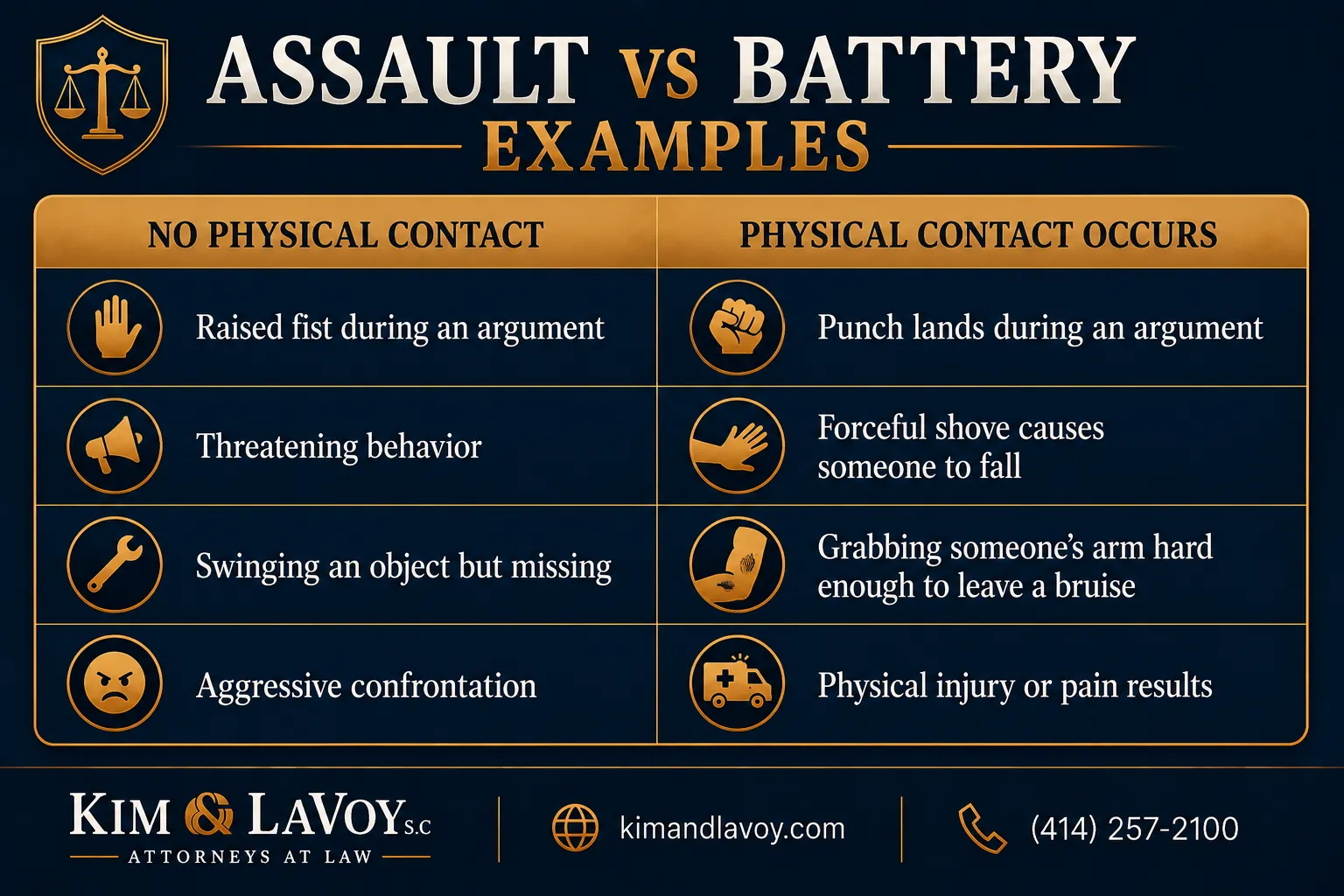
Real situations make the legal definition of assault and battery easier to picture. Some involve threats and fear without contact, while others involve actual physical violence that leaves a mark. A few common scenarios:
- A bar argument ends when one person throws a punch that connects. That is charged as battery, regardless of how badly the other person is hurt.
- Someone raises a fist and threatens to hit another person but never makes contact. That is typically charged as disorderly conduct, not “assault.”
- A parent grabs another parent’s arm hard enough to leave a bruise during a custody exchange. That can result in a battery charge, even without a trip to the emergency room.
- A driver swings a tire iron at another driver but never lands a hit. That can be charged as recklessly endangering safety.
- A coworker shoves another employee during an argument, causing a fall and a wrist injury. Depending on the extent of the injury, that could be charged as battery or substantial battery. In the most extreme cases involving permanent injury, Wisconsin also has a separate mayhem statute.
What Is Battery Law in Wisconsin?
Wisconsin Statute § 940.60 defines three tiers of battery. The tier depends on the harm caused and what the accused person intended. The misdemeanor tier is what most people mean when they search for simple battery or simple assault, even though Wisconsin’s own statute never uses either label.
“Battery” requires bodily harm to another by an act done with intent or without consent. “Substantial battery” requires substantial bodily harm, such as a fracture or a wound that needs stitches. “Aggravated battery” requires great bodily harm, meaning a life-threatening or permanently disfiguring injury.
“I used to train police officers at the police academy, and by the time police officers are talking to people, they’ve already decided in their head that this person has done something wrong.”
Julius Kim spent years as a Milwaukee County Assistant District Attorney, and also trained officers at the police academy. That background gives our firm a clear view of how these cases get built and investigated. It does not matter whether it is a Class A misdemeanor battery charge or a felony aggravated battery charge. Every case moves through the same basic court process, though the stakes rise sharply at the felony level.
Potential Battery Penalties in Wisconsin
Battery penalties range from simple battery up through aggravated battery. The classification and maximum penalty depend on the severity of the injury and what the accused person intended. Wisconsin’s felony and misdemeanor classification system sets the penalty range for every class in the state, including both the fine and jail or prison term.
| Charge | Wisconsin Statute | Classification | Maximum Penalty |
|---|---|---|---|
| Battery | § 940.60(1) | Class A misdemeanor | 9 months in jail, $10,000 fine |
| Substantial battery | § 940.60(2) | Class I felony | 3 years, 6 months in prison, $10,000 fine |
| Aggravated battery (intent to cause bodily harm) | § 940.60(3)(a) | Class H felony | 6 years in prison, $10,000 fine |
| Aggravated battery (intent to cause great bodily harm) | § 940.60(3)(b) | Class E felony | 15 years in prison, $50,000 fine |
| Disorderly conduct (often charged for “assault”-type conduct) | § 947.01 | Class B misdemeanor, or a municipal citation | 90 days in jail, $1,000 fine |
“In Wisconsin, a lot of times things that seem not so big of a deal are treated very seriously.”
Factors That Can Increase Penalties
A battery or disorderly conduct charge rarely remains at its starting point. Several factors can push a case toward a higher classification or a longer sentence:
- A dangerous weapon. A longer prison or jail term applies whenever a weapon is possessed, used, or threatened during the crime. Many people call this a deadly weapon, though Wisconsin Statute § 939.63 uses the term “dangerous weapon.”
- A domestic relationship. This applies when the accused and the victim are current or former partners, live together, or share a child. The court must then add a $100 domestic abuse surcharge as per Wisconsin Statute § 973.055.
- The extent of the injury. Moving from bodily harm to substantial bodily harm to great bodily harm elevates the charge. That is what separates a misdemeanor from a felony.
- A prior record. Past convictions can trigger a repeater enhancement that adds time to whatever sentence the current charge already carries, regardless of the maximum.
- The age of the parties. Cases involving a juvenile defendant or a minor victim can bring additional procedures that come on top of the standard battery penalties.
Common Defenses in Assault or Battery Cases
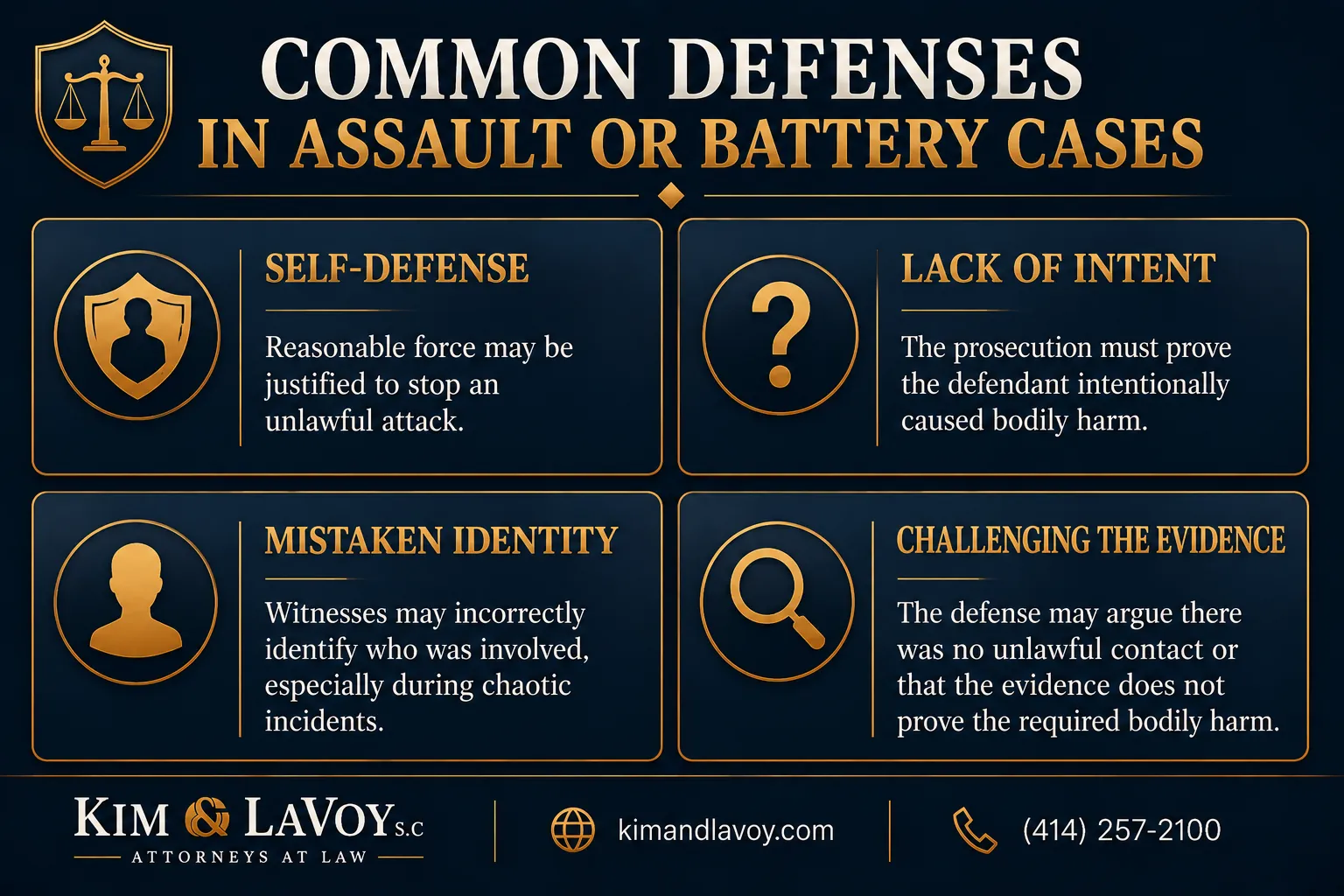
Every case turns on its own facts, but several defenses come up often in battery and disorderly conduct cases:
- Self-defense or defense of others. The Wisconsin Statute § 939.48 states that reasonable force is allowed to stop what a person genuinely believes is an unlawful attack. Our Wisconsin self-defense laws guide covers this further.
- Lack of intent. The state has to prove intent to cause bodily harm, not just that harm occurred, as per Wisconsin Statute § 940.60(1).
- Mistaken identity. Bar fights and other chaotic scenes often involve more than one person. Eyewitness identification is not always reliable in those situations, as a person can be mistakenly identified as a perpetrator.
- Disputing the contact or injury. Sometimes the strongest defense is proving the alleged physical contact never happened, or that it did not amount to a serious injury. Proving it never reached the bodily harm the statute requires.
“When the police are wanting to talk to you about something, talking to them is a mistake. Even if you’re completely innocent about something, what you say to them might get twisted around, or they might take bits and pieces of what you’re confirming for them.”
That advice applies directly to assault and battery allegations, as what you say in the first conversation with an officer often shapes the case. That happens before you ever talk to a lawyer. Reaching out before charges are filed can change the outcome, which is why early representation matters so much.
Facing Assault or Battery Allegations in Wisconsin?
“Talk to someone, talk to an attorney, talk to someone that knows what the next step should be.”
Julius Kim built his career as a Milwaukee County prosecutor, and later joined Kim & LaVoy S.C., a firm that handles nothing but criminal defense. That focus means our attorneys spend every working day inside Wisconsin’s battery, disorderly conduct, and assault-related cases. We are not splitting time across unrelated practice areas.
We serve Milwaukee, Brookfield, Waukesha, Wauwatosa, West Bend, West Allis, and communities throughout Wisconsin. Schedule a consultation with us to talk through your charges and get an honest read on where your case stands.
Frequently Asked Questions About the Differences Between Assault and Battery
What Are the Key Differences Between Assault and Battery Charges in Wisconsin?
Nationally, the key differences between assault and battery charges come down to physical contact. Assault typically covers a threat that causes fear, while battery covers actual harmful contact. Wisconsin’s criminal law statutes skip the assault label entirely for physical attacks or threats. A threat alone is charged as disorderly conduct, and any offensive touch is battery. That distinction shapes both the charge a victim’s case receives and the consequences the accused person faces.
How Much Bodily Harm Does Wisconsin Battery Law Require?
Not much. “Bodily harm” is defined by Wisconsin Statute § 939.00(4) as physical pain, physical harm, illness, or impairment. Causing harm does not have to mean a visible injury. A minor bruise, or even documented pain without a mark, can support a misdemeanor battery charge. Serious bodily injury elevates the offense into substantial or aggravated battery instead.
Is Assault Always Physical?
Not in the way most people think, and Wisconsin does not use the word as a formal charge. States with a standalone assault statute usually require a threat that creates real fear. Some label this as simple assault at the misdemeanor level. That fear also has to be backed by an apparent intent to follow through, even without contact. Wisconsin instead folds that fear-based conduct into disorderly conduct or recklessly endangering safety.
What Is Battery Law?
Battery law in Wisconsin defines three levels: battery, substantial battery, and aggravated battery. Each level depends on the severity of the injury caused and the intentional act behind it. Unlike assault in other states, Wisconsin battery always requires actual physical contact, not just a threat.
Can Assault and Battery Happen Together?
Yes. A heated argument can escalate from a threat into contact within seconds. A single incident can support more than one charge depending on the facts, such as disorderly conduct alongside battery. Assault and battery can also be classified under both criminal law and civil law at the same time. A victim can sue separately from any criminal case, within three years of the incident. [Wis. Stat. § 893.57]
Is Simple Battery a Misdemeanor or a Felony in Wisconsin?
It depends on the harm involved. Simple battery is a Class A misdemeanor, while substantial battery and aggravated battery are felonies. Those felonies range from a Class I felony up to a Class E felony based on the severity of injury caused and the intent of the act. Domestic violence, a weapon, or a victim’s prior protective order can all move a case toward severe penalties. This holds true even when the underlying contact seems minor.
What About Aggravated Assault and Aggravated Battery Charges in Wisconsin?
Wisconsin does not have a charge called aggravated assault. States that use the term often punish it with roughly 1 to 3 years in prison. Wisconsin’s equivalent, aggravated battery, carries far more exposure, from 6 years up to 15 years depending on intent. Using what many call a deadly weapon can add separate prison time on top of either sentence. Anyone comparing out-of-state aggravated assault penalties to Wisconsin aggravated battery charges should not assume the numbers match. Always speak to a Wisconsin lawyer to find out what the penalties are.
Is Simple Assault a Real Charge in Wisconsin?
No, “simple assault” is typically a misdemeanor charge elsewhere, but Wisconsin has no statute that uses the term, just “battery”. Sexual battery is not a Wisconsin legal term either, and sexual offenses are prosecuted separately as sexual assault, which falls under a different chapter of Wisconsin law and is not covered on this page. Contact our office if you need help finding out which charge applies to you. The differences between assault and battery in Wisconsin can change how your entire case is handled.
Legal Disclaimer
The information provided in this article is for general informational purposes only and does not constitute legal advice. Every criminal case is unique, and the facts of your specific situation may result in different outcomes than those described here. Reading this content does not create an attorney-client relationship between you and Kim & LaVoy S.C. or any of its attorneys. Wisconsin law is complex and subject to change. For legal advice tailored to your individual circumstances, please contact Kim & LaVoy S.C. directly to schedule a consultation.