
Wisconsin Misdemeanor Classes: Penalties & Consequences Explained

A misdemeanor charge in Wisconsin can turn an ordinary week upside down, and understanding Wisconsin misdemeanor classes is usually the first thing people want to get clear on. You might be waiting on a court date, staring at a citation, or trying to explain to your family what happens next. None of that is easy to sit with. Wisconsin’s misdemeanor system is not a mystery, and knowing where your charge falls tells you exactly what is at stake.
Wisconsin state law sorts misdemeanor offenses into Class A, Class B, Class C, and a group of unclassified offenses, and each carries its own maximum penalty. A misdemeanor is still a criminal offense, so knowing where your charge falls tells you what is actually at stake, from the maximum fine to whether jail time is on the table.
Julius Kim, founding attorney at Kim & LaVoy S.C., spent years prosecuting misdemeanor offenses and felony cases as a Milwaukee County prosecutor before moving to the defense side. He has also trained police officers at the police academy and understands how these cases get built from the very first traffic stop or citation. That background shapes how the firm approaches every criminal charge.
Key Takeaways
- Wisconsin sorts misdemeanors into Class A, Class B, Class C, and unclassified offenses under Wisconsin Statute § 939.51.
- A Class A misdemeanor carries a fine of up to $10,000, up to nine months in county jail, or both.
- A Class B misdemeanor carries up to $1,000 in fines and up to 90 days in jail, and a Class C misdemeanor carries up to $500 in fines and up to 30 days in jail.
- A Class C misdemeanor carries up to $500 in fines and up to 30 days in jail.
- Prosecutors generally have three years from the date of the offense to file misdemeanor charges under Wisconsin Statute § 939.74.
- A repeat misdemeanor conviction can add up to two years to a sentence under Wisconsin’s habitual criminality law, Wisconsin Statute § 939.62.
- Expungement of a misdemeanor conviction is available only for offenses committed before age 25, and only if a judge orders it at the time of sentencing under Wisconsin Statute § 973.015.
What Are Wisconsin’s Misdemeanor Classes?
Wisconsin divides crimes into two broad categories, felonies and misdemeanors. Under Wisconsin Statute § 939.60, crimes punishable by time in a state prison are felonies, and every other crime is a misdemeanor. That distinction matters because misdemeanor penalty sentences are served in a county jail, not the state prison system. From there, Wisconsin Statute § 939.51 splits most misdemeanor crimes into three classes, Class A, Class B, and Class C, based on how serious the legislature considers the conduct. Some misdemeanor offenses fall outside this system entirely, and any misdemeanor without an assigned letter grade is called an unclassified misdemeanor, which we cover further down.
Understanding which class applies to your charge is not just academic. The penalties for misdemeanor offenses and felony offenses are calculated very differently, and knowing which side of that line you are on determines your maximum exposure, whether a diversion program is realistic, and how the charge could follow you on your criminal record afterward. A criminal defense attorney who knows the Wisconsin legal system can typically identify your misdemeanor class within minutes of reviewing your citation or criminal complaint.
Class A Misdemeanors: The Most Serious Misdemeanor Charge
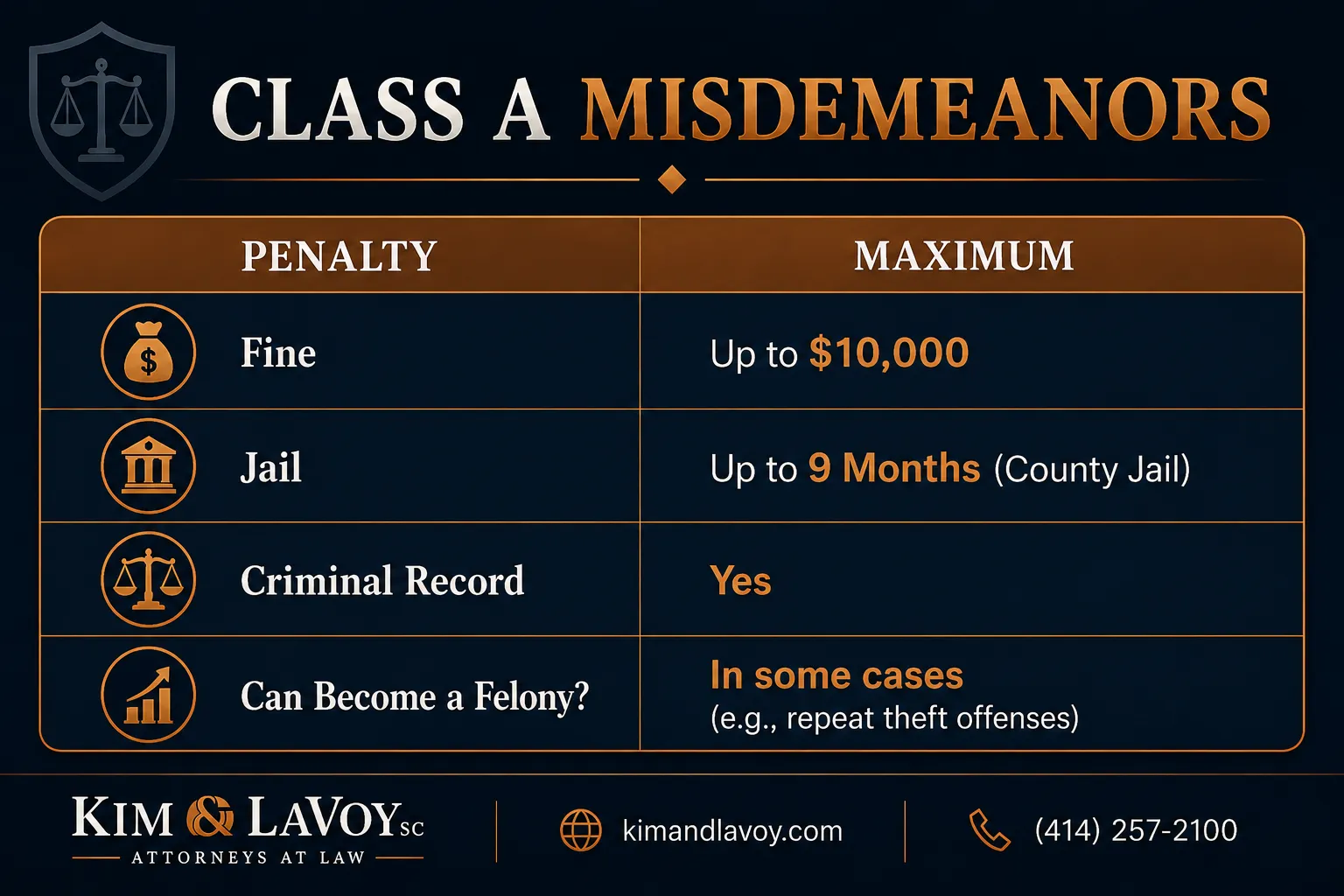
A Class A misdemeanor charge is the most serious level of misdemeanor under Wisconsin law. Under Wisconsin Statute § 939.51, it carries a fine of up to $10,000, imprisonment of up to nine months in county jail, or both.
Common examples include basic battery under Wisconsin Statute § 940.60(1) and theft of property valued at $2,500 or less under Wisconsin Statute § 943.20(3)(a). A strong legal defense matters most at this level, since a Class A misdemeanor conviction can affect your criminal record for years. The burden of proof rests entirely with the prosecution, meaning the state has to prove every element of the charge beyond a reasonable doubt before a conviction can stand. Challenging how evidence was gathered, including the arrest itself, can sometimes lead to key evidence being thrown out.
Repeat theft convictions carry a particular risk. Under Wisconsin Statute § 943.20(3g), a person charged with a Class A misdemeanor theft can instead be charged with and convicted of a Class I felony if they have one or more prior theft convictions. This is one of the clearest examples of how prosecutors can escalate a misdemeanor charge to a felony under Wisconsin law.

“I used to train police officers at the police academy, and by the time police officers are talking to people, they’ve already decided in their head that this person has done something wrong.”
If you are facing a Class A misdemeanor charge, what you say in the hours after an arrest matters. Talking through your situation with a criminal defense attorney before you answer more questions can change how the rest of the case unfolds.
Class B Misdemeanors in Wisconsin
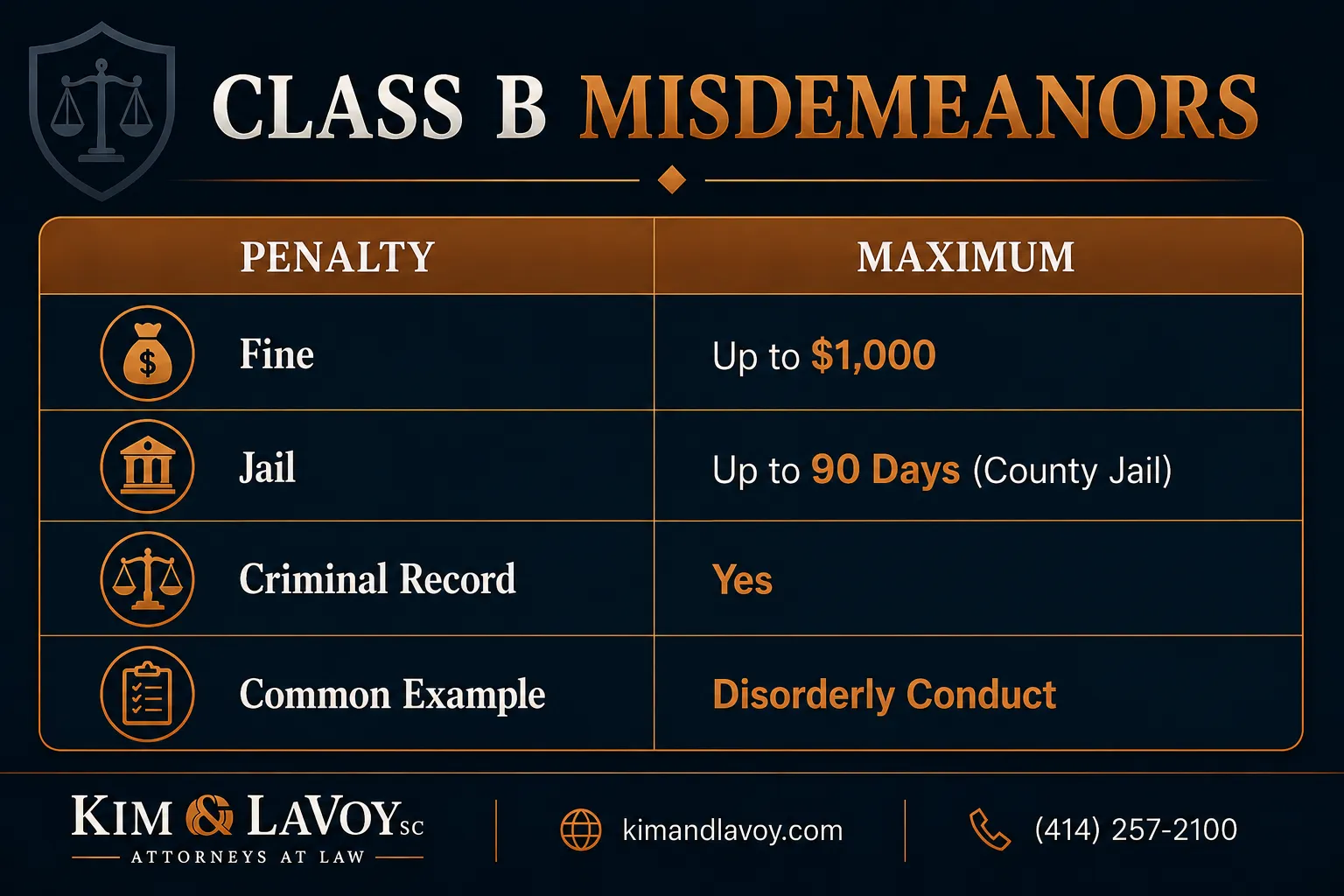
Class B misdemeanors sit in the middle of Wisconsin’s misdemeanor classes, more serious crimes than a Class C charge but a step below a Class A misdemeanor. Under Wisconsin Statute § 939.51, a Class B misdemeanor carries a fine of up to $1,000, imprisonment of up to 90 days in county jail, or both.
Disorderly conduct, charged under Wisconsin Statute § 947.01, is the most common Class B misdemeanor our firm sees, covering violent or abusive conduct that does not rise to the level of bodily harm required for a battery charge. People are frequently surprised by how seriously prosecutors treat conduct that feels minor in the moment, a shouting match, a bar fight, or a heated argument with a neighbor.
“People oftentimes will call us, and they’re really surprised that law enforcement or the various prosecutors’ offices have taken something that they think is seemingly innocuous or something that may have not been that big of a deal.”
Class B misdemeanors still result in a criminal conviction if you are found guilty, and they still show up on a background check even without jail time attached. A disorderly conduct charge connected to a household member can also carry a domestic violence modifier, and community service or counseling conditions are common outcomes in these cases. Our disorderly conduct and battery team regularly works to get these charges reduced, diverted, or dismissed before they ever reach that point.
Class C Misdemeanors and Unclassified Offenses
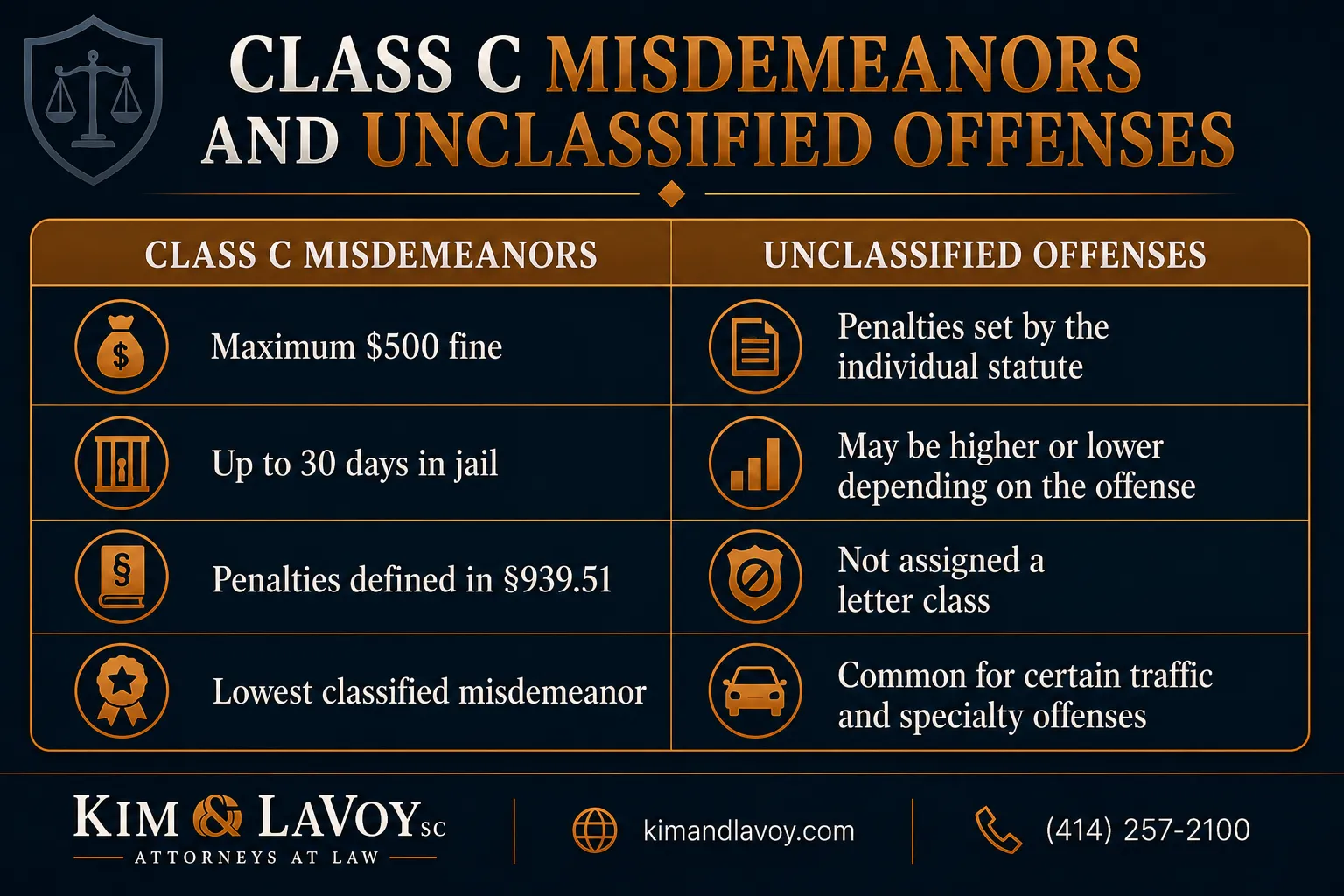
Class C misdemeanors are the least serious classified misdemeanors in Wisconsin. Under Wisconsin Statute § 939.51, a Class C misdemeanor carries a fine of up to $500, imprisonment of up to 30 days in county jail, or both. An example is Wisconsin Statute § 946.40, which makes it a Class C misdemeanor to refuse, without a reasonable excuse, to aid a police officer who has lawfully asked for help.
Outside the criminal code, many misdemeanors, including some criminal traffic offenses, are unclassified. That means the statute defining the offense itself sets its own fine and jail term instead of using the Class A, B, or C system. When a statute does not specify a penalty at all, Wisconsin Statute § 939.61 sets the default to a fine of up to $500, imprisonment of up to 30 days, or both, the same range as a Class C misdemeanor.
“I would much rather get involved in a case sooner rather than later. And the way I equate it is this, is that when we get involved in a case early, then we have some input as to how that table is set for the rest of the case.”
Even Class C misdemeanors and unclassified misdemeanors become part of your record if you are convicted, even though they are less serious crimes than a Class A or Class B charge and carry lighter penalties. It is worth getting a straightforward answer about your options before you decide how to respond to a citation, even one that looks minor on paper.
Aggravating Factors, Repeat Offenses, and Additional Penalties
Certain aggravating factors can increase misdemeanor penalties, including a defendant’s criminal history, whether the offense involved bodily harm, or whether it is connected to domestic violence. Wisconsin’s habitual criminality law, Wisconsin Statute § 939.62, allows a maximum term of imprisonment of one year or less to be increased to as much as two years for a repeat offender.
A person qualifies as a repeat offender if convicted of a felony in the preceding five years, or convicted of a misdemeanor on three separate occasions during that same period. Prior convictions of either kind remain on record for this purpose unless a court has reversed them. These additional penalties are one reason repeat offenders should not treat a new misdemeanor charge the same way they treated the first one. The stakes are higher, and the legal options can be different too.
“No attorney can guarantee the result of any case. There’s just too many variables.”
What we can tell you, based on the circumstances of your case, is where the real risk sits and what a realistic outcome might look like. Most misdemeanors in Wisconsin move through a similar legal process from initial appearance to resolution, and you can read through the steps in a Wisconsin misdemeanor case to see what comes next after a charge is filed.
Defense Strategy: Diversion Programs and Other Options
Not every misdemeanor case has to end in a conviction. Defendants can sometimes participate in treatment alternatives, community service, or other diversion programs instead of jail time, particularly in cases involving substance use. Legal representation is often what makes those options available in the first place.
“We know in terms of who the prosecutor is, how the system works, what programs might be available, and what our clients may be willing to do in terms of getting help or rehabilitation or drug treatment, that we might be able to negotiate a reduction of the case or even a dismissal of the case that they’re not aware of.”
This kind of negotiation is dependent on knowing the local prosecutor’s office and what it is realistically willing to consider, which is part of why our drug offense defense work often starts with a conversation about treatment rather than trial. A charge reduction, deferred prosecution agreement, or dismissal is never guaranteed, but it is worth exploring before you assume jail time is the only outcome.
What a Misdemeanor Conviction Can Mean Long After the Case Ends
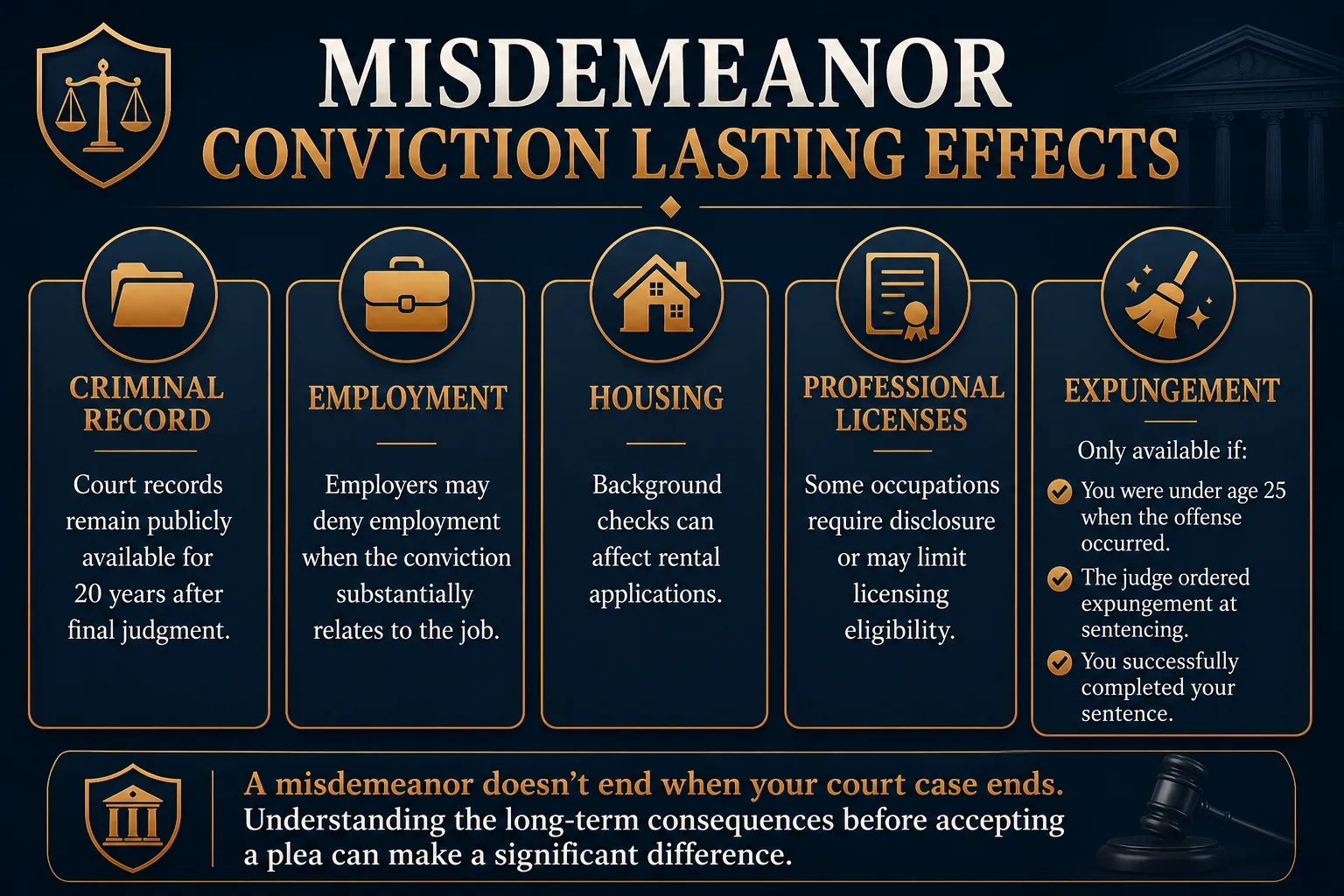
A misdemeanor conviction does not disappear once your case closes. Under Wisconsin Supreme Court Rule SCR 72.01(18) through (20), misdemeanor case files, court records, and minute records are retained and publicly visible on Wisconsin’s online court records system for 20 years after the final judgment, including a Class A misdemeanor conviction.
A conviction can also affect employment. Under Wisconsin Statute § 111.335, it is not illegal discrimination for an employer to decline to hire, or to terminate, someone with a misdemeanor conviction if the circumstances of the offense substantially relate to the job.
Certain professional licenses apply the same standard, and many employers now run background checks as a standard part of hiring. Which is why a misdemeanor conviction can carry serious consequences for employment, housing applications, and licensing in ways people do not expect going in. Expungement offers a narrow way out for some defendants.
Under Wisconsin Statute § 973.015, a court may order a misdemeanor record expunged once the person has successfully completed all sentencing requirements, but only if the person was under age 25 at the time of the offense, and only if the judge orders expungement at the sentencing hearing itself.
Expungement is not automatic, and it cannot be requested after the fact. This is one more reason to get a clear picture of your record and the maximum sentence you are facing before your case is resolved rather than after.
Why Work With a Criminal Defense Attorney
Julius Kim spent years prosecuting crimes as a Milwaukee County prosecutor before founding Kim & LaVoy S.C., and that experience shapes how the firm evaluates every misdemeanor case and the penalties attached to it, including which prosecutors are willing to negotiate and which ones expect to go to trial. Our firm devotes its practice entirely to criminal defense and drunk driving cases, and we serve clients throughout Milwaukee, Brookfield, Waukesha, Wauwatosa, West Bend, and West Allis.
“But I used to be a prosecutor, so I knew the defense attorneys that were good, that were credible, and that were willing to actually take things to trial.”
Getting a criminal defense attorney involved early, even before a criminal offense is formally charged, gives you more room to shape how the case proceeds. We will give you an honest assessment of where your case stands, without promising an outcome that no attorney can guarantee.
Where to Go From Here
A misdemeanor charge is stressful, but it does not have to define the rest of your life. Julius Kim put it plainly when describing how he talks with clients who are worried about what comes next.
“Let’s see if we can try and get you through this process, get you through this case without completely, you know, undoing everything that you’ve worked hard for and see if we can minimize the damage and minimize the impact of the situation on the rest of their life.”
Facing a misdemeanor in Wisconsin means understanding the penalties, the timeline, and your legal options, and that is the first step toward moving through this with a clear head.
Frequently Asked Questions About Wisconsin Misdemeanor Classes
What is the difference between a misdemeanor and a felony in Wisconsin?
Under Wisconsin Statute § 939.60, felony offenses are crimes punishable by time served in a state prison, while a misdemeanor is every other crime. Misdemeanor sentences are served in a county jail rather than state prison, and the maximum penalties for most crimes at the misdemeanor level are lower than for felony offenses. Some misdemeanors, like certain repeat theft offenses, can be charged as a felony instead if the circumstances qualify.
What is the most serious misdemeanor class in Wisconsin?
A Class A misdemeanor in Wisconsin is the most serious misdemeanor class, carrying a fine of up to $10,000, up to nine months in county jail, or both. Battery and theft of property valued at $2,500 or less are common examples of a Class A misdemeanor charge.
Can a misdemeanor charge in Wisconsin turn into a felony?
Yes, in certain situations. Under Wisconsin Statute § 943.20(3g), a person charged with a Class A misdemeanor theft can be charged with and convicted of a Class I felony instead if they have a prior theft conviction. Wisconsin’s habitual criminality law can also increase the maximum sentence for a repeat misdemeanor offender.
How long does a misdemeanor stay on your record in Wisconsin?
Under Wisconsin Supreme Court Rule 72.01, misdemeanor case files and court records are retained and displayed on Wisconsin’s online court records system for 20 years after the final judgment. The underlying conviction record is not automatically erased before then, unless a court orders expungement.
Can I get a misdemeanor expunged in Wisconsin?
Only in specific situations. Under Wisconsin Statute § 973.015, a judge can order expungement only if you were under age 25 at the time of the offense, and the judge must order it at your original sentencing hearing rather than afterward. If expungement was not addressed at sentencing, it is generally too late to request it later.
Do I need a criminal defense attorney for a Class C misdemeanor in Wisconsin?
You are not required to have one, but a Class C misdemeanor still results in a criminal conviction and a court record if you are found guilty. A criminal defense attorney can tell you honestly whether the charge is worth contesting, negotiating down, or resolving through a diversion program before you decide how to respond.
What happens if I get a second misdemeanor charge in Wisconsin?
A second or later misdemeanor charge can carry higher stakes than the first. Under Wisconsin Statute § 939.62, a person convicted of a misdemeanor on three separate occasions within the preceding five years qualifies as a repeater, which can increase the maximum sentence on a new charge. Understanding how Wisconsin misdemeanor classes and repeat offense penalties interact matters most the second time around.
Legal Disclaimer
The information provided in this article is for general informational purposes only and does not constitute legal advice. Every criminal case is unique, and the facts of your specific situation may result in different outcomes than those described here. Reading this content does not create an attorney-client relationship between you and Kim & LaVoy S.C. or any of its attorneys. Wisconsin law is complex and subject to change. For legal advice tailored to your individual circumstances, please contact Kim & LaVoy S.C. directly to schedule a consultation.