
Child Pornography Charges in Wisconsin
Child pornography charges in Wisconsin can turn an ordinary Tuesday into the worst day of your life. Maybe a detective called your phone, or officers showed up with a search warrant for your computer. Whatever brought you here, you’re scared and not sure who to trust. You’re not the first person to feel this way. We have represented parents whose teenagers got in over their heads with a phone camera, professionals who never imagined a search warrant, and first-time offenders who had no idea the consequences were this severe.
Julius Kim spent years as a Milwaukee County Assistant District Attorney and trained police officers at the academy. He knows how prosecutors build these cases and how investigators think before they knock on your door. Our firm gives you an honest assessment of where your case stands, not a sales pitch. These charges exist at the intersection of state law, federal law, and the sexual exploitation of children, which means the stakes and the complexity are both unusually high.
Whether you face a state charge or a federal internet sex crimes investigation, the sooner you talk to a defense team, the more options you have.
Key Takeaways
- Wisconsin charges possession of child pornography as a Class D felony for adults under Wisconsin Statute § 948.12, with a mandatory three-year minimum prison sentence.
- Producing or distributing child pornography falls under Wisconsin Statute § 948.05, a Class C felony with a five-year mandatory minimum prison sentence.
- Federal law defines child pornography under 18 U.S. Code § 2256 as any visual depiction of sexually explicit conduct involving a minor.
- A first-time offender convicted of producing child pornography under 18 U.S. Code § 2251 faces 15 to 30 years in federal custody, according to the Department of Justice.
- In 2025, 46% of individuals sentenced federally for child pornography were sentenced for simple possession, according to the U.S. Sentencing Commission.
- Wisconsin requires most convicted offenders to register with the Wisconsin Department of Corrections Sex Offender Registry for 15 years or life, depending on the offense.
What Counts as Child Pornography in Wisconsin
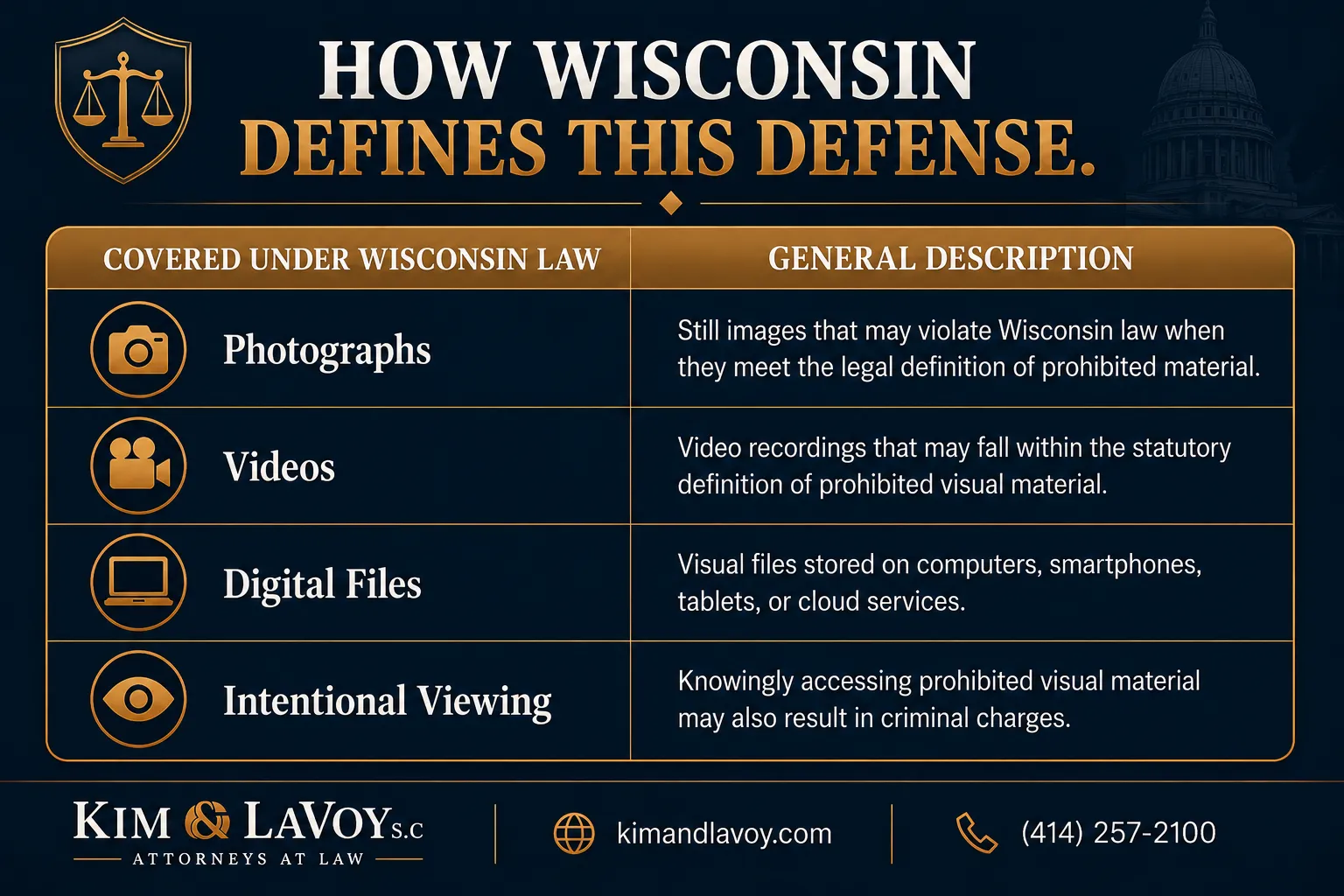
Wisconsin defines this offense under Wisconsin Statute § 948.12 as knowingly possessing, or accessing with intent to view, a photograph, video, or recording of a child engaged in sexually explicit conduct. Federal law is similar, where under 18 U.S. Code § 2256, child pornography is defined as any visual depiction of sexually explicit conduct involving anyone under the age of 18. The images don’t explicitly need to show a sex act, and the Department of Justice confirms that a naked photo of a child can qualify if it is sufficiently sexually suggestive, and Wisconsin prosecutors apply that same standard.

“That’s another thing people don’t realize is that if a minor sends a naked picture of themselves to another minor, they’re both committing felonies.”
What many people call child porn is prosecuted under the same statutes regardless of the label used. The legal definition under 18 U.S. Code § 2256 covers visual depictions in any format, including photographs, film, undeveloped film, undeveloped videotape, and electronically stored data. According to the Department of Justice guidance, federal law also covers computer-generated images indistinguishable from real children, meaning no actual minor needs to be depicted for the images to constitute illegal child pornography. Child pornography laws exist because each child pornography image is a record of the sexual exploitation of children. Law enforcement agencies treat even a single child pornography image as evidence of harm requiring prosecution.
Our internet sex crimes practice area covers the full range of these cases, from a single image to a multi-count indictment.
Wisconsin and Federal Child Pornography Penalties
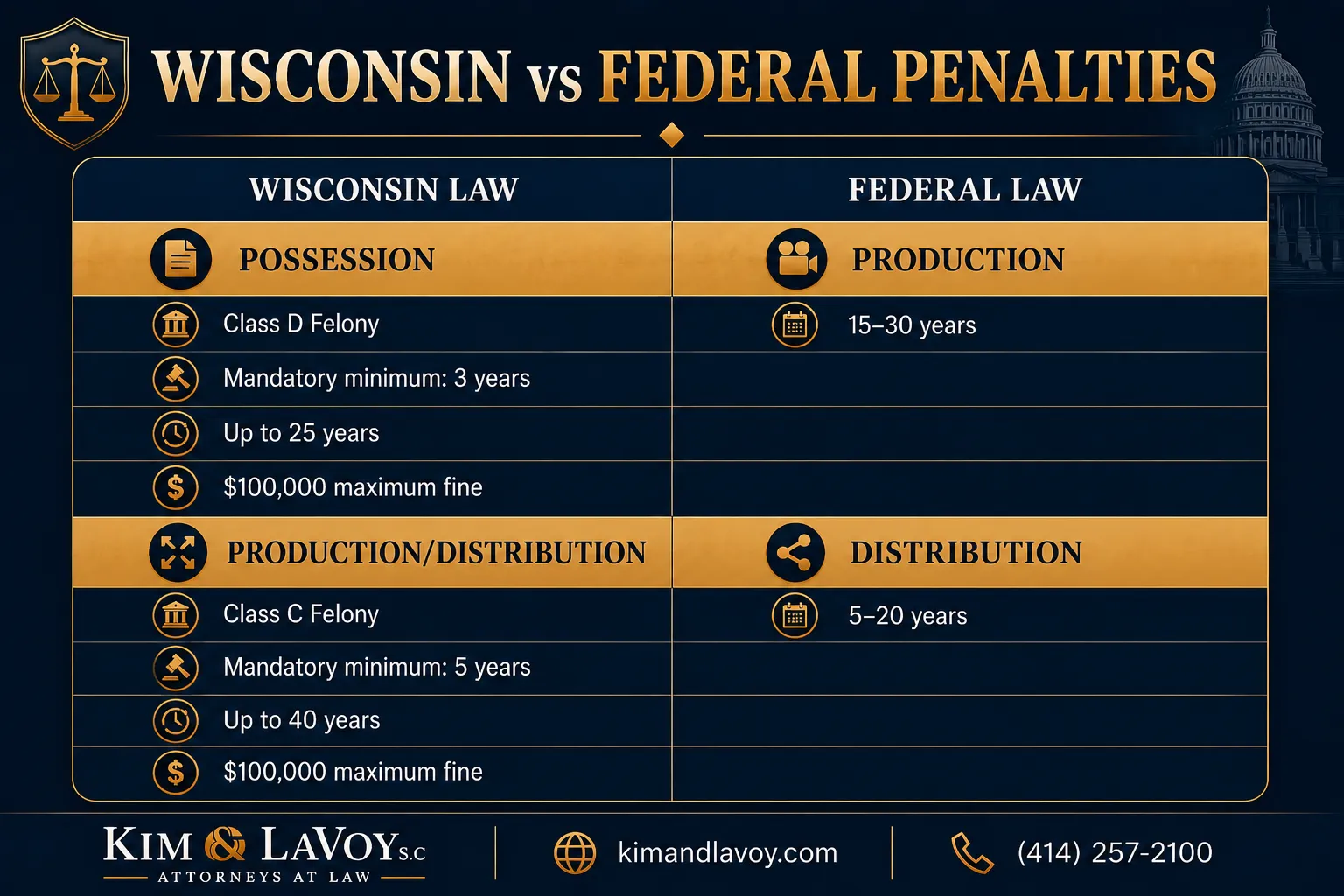
Wisconsin treats simple possession, including any knowing possession of child pornography, as a Class D felony, punishable by up to 25 years imprisonment and a maximum $100,000 fine under Wisconsin Statute § 939.50. Producing or distributing these images is a Class C felony under Wisconsin Statute § 948.05, carrying up to 40 years imprisonment and the same maximum fine.
Both offenses carry mandatory minimum prison sentence requirements under Wisconsin Statute § 939.617: three years for possession, five years for production or distribution. A judge cannot go below that floor except in narrow circumstances tied to the age gap between the offender and the child.
“It carries a mandatory prison sentence of three years, mandatory prison for three years. The judge doesn’t have the ability to give you less than that.”
Federal charges add another layer. Production of child pornography under 18 U.S. Code § 2251 carries a 15- to 30-year prison sentence. Distribution of child pornography under 18 U.S. Code § 2252 carries a 5- to 20-year prison sentence. Federal law prohibits any attempt to transport child pornography across state or international borders. Federal jurisdiction applies whenever child pornography was transported through interstate or foreign commerce, and once the internet is involved, that standard is almost always met, according to the Department of Justice.
Federal sentencing guidelines treat a child pornography conviction as among the most severely prosecuted offenses in the federal court system, and prior convictions raise the statutory minimum significantly, according to the U.S. Sentencing Commission. The Department of Justice publishes a full guide to federal child pornography law. Our federal crimes practice area handles cases like these from investigation through trial.
What Happens After a Conviction
Incarceration isn’t the end of it for a convicted offender. Most people convicted of a child pornography offense in Wisconsin must register with the Wisconsin Department of Corrections Sex Offender Registry for 15 years or life. Sex offender registration applies whether the child pornography offense occurred under state or federal law, under the federal Sex Offender Registration and Notification Act.
Registration and supervision conditions can restrict where offenders may live or work relative to schools, parks, and daycare facilities, though these limits typically come from local ordinances and court-ordered supervision terms rather than a single statewide rule. In child pornography cases involving prior convictions, the registration period and supervision terms tend to run toward the longer end of that range, according to the Wisconsin Department of Corrections.
“They are oftentimes restricted from living in certain locations. They can’t live within a certain perimeter or proximity to certain buildings like schools, for instance, and that really limits people’s lives.”
Wisconsin Statute lets a judge depart from the three-year mandatory minimum, including ordering probation instead, if the offender was not more than 48 months older than the child. [Wis. Stat. § 939.617(2)-(3)] That exception is limited to sentencing, though. It does not exempt someone from registering as a sex offender: Wisconsin law lists a violation of § 948.12 or § 948.05 as a registrable offense regardless of the age gap between the offender and the child. [Wis. Stat. § 301.45]
Why You Should Never Talk to Police Without a Lawyer
If a detective wants to talk to you about a child pornography investigation, stay quiet until your lawyer is in the room. That’s true even if you did nothing wrong.
Your right to remain silent protects you at every stage of an investigation, not only after arrest. Speak to a lawyer before you say anything.
How Kim & Lavoy S.C. Defends Child Pornography Charges
In child pornography cases, every case starts with the same question: what can the state actually prove? We bring in forensic experts to examine devices, timelines, and search warrants for proof problems in the state’s case.
If you know you’re under investigation but haven’t been charged, don’t wait for the knock at your door. Our pre-charging representation team can start working before the state finishes building its case. A child pornography charge doesn’t have to define the rest of your life, and the decisions you make in the first few days matter most.
“It’s always smart and beneficial to get an attorney involved as soon as you can when you’re being investigated for a criminal offense.”
Frequently Asked Questions About Child Pornography Charges
Is possession of child pornography a felony in Wisconsin?
Yes. Possession of child pornography, including what is commonly called “child porn”, is a Class D felony for adults, with a mandatory three-year minimum prison sentence. [Wis. Stat. § 948.12] It becomes a lower-level Class I felony only when the person charged is under the age of 18. [Wis. Stat. § 948.12(3)]
What is the mandatory minimum sentence for child pornography in Wisconsin?
Possession of child pornography carries a three-year mandatory minimum prison sentence. [Wis. Stat. § 939.617] Production and distribution of child pornography each carry a five-year mandatory minimum prison sentence. [Wis. Stat. § 939.617] A judge rarely has discretion to go lower, and first-time offenders should not assume their lack of prior history will waive these minimums.
Is it illegal to distribute child pornography if I only send one image?
Yes. Distribution can occur even by sharing a single image, whether it is emailed, texted, or posted once. [U.S. Department of Justice] Prosecutors can also file a separate count for each image found on a device, so a small number of files can still result in several separate charges.
Does federal law treat distribution of child pornography as more serious than possession?
Yes. At the federal level, individuals convicted of distributing or trafficking child pornography receive longer average sentences than those convicted of simple possession. The average federal sentence for receiving child pornography was 114 months (roughly 9.5 years) in 2025. Most people convicted federally for a child pornography offense have little or no prior criminal history, though a small share do. [U.S. Sentencing Commission]
Can I face both state and federal child pornography charges for the same conduct?
Yes. Federal child pornography charges can apply once visual depictions of child pornography move through interstate or foreign commerce, and an offender can be prosecuted under Wisconsin law alongside federal law, or instead of it. [U.S. Department of Justice] The involvement of the internet almost always satisfies the interstate or foreign commerce element under Title 18 of the United States Code. [18 U.S. Code § 2252A]
Will my case be heard in federal court or state court?
It depends on who investigates and charges the case. A separate federal law specifically prohibits a parent or legal guardian from selling a child or agreeing to transfer custody of a minor for the purpose of producing child pornography, and cases like this move through federal court. [18 U.S. Code § 2251A] Most federal investigations are led by the Federal Bureau of Investigation and other law enforcement agencies, often coordinating with the National Center for Missing & Exploited Children. [FBI Violent Crimes Against Children Program] Even when the materials previously traveled through common carriers rather than crossing state lines directly, federal jurisdiction can still apply, though many Wisconsin cases with no interstate element proceed in state court instead.
Will I have to register as a sex offender if I am convicted?
Most convictions require sex offender registration with the Wisconsin Sex Offender Registry for 15 years or life. [Wis. Stat. § 301.45] Child pornography laws impose these requirements because the sexual exploitation of children documented in these images is treated as an ongoing public safety concern, and a conviction can also lead to lasting social stigma beyond the legal penalties themselves. A defense attorney can advise whether any exception applies in your child pornography case.
Do prosecutors have to prove I knew the images were on my device?
Yes. Wisconsin law requires that a person knowingly possess the material, not simply have it exist somewhere on a device without their awareness. [Wis. Stat. § 948.12] Federal law treats such material the same way, requiring prosecutors to prove intent to knowingly produce, receive, or distribute it, and this knowledge requirement is often where an experienced defense can raise real doubt.
If I deleted the files, can law enforcement still prove a child pornography offense under Wisconsin’s child pornography laws?
Often, yes. Deleted files can often be recovered by law enforcement using forensic recovery tools, even after they have been removed from a device. [FBI Regional Computer Forensics Laboratory Program] Deleting files does not undo a child pornography violation that already occurred, and evidence that files were deleted can sometimes help show someone knew the material was there in the first place.
Legal Disclaimer
The information provided in this article is for general informational purposes only and does not constitute legal advice. Every criminal case is unique, and the facts of your specific situation may result in different outcomes than those described here. Reading this content does not create an attorney-client relationship between you and Kim & LaVoy S.C. or any of its attorneys. Wisconsin law is complex and subject to change. For legal advice tailored to your individual circumstances, please contact Kim & LaVoy S.C. directly to schedule a consultation.