
Class B Misdemeanor Wisconsin: Penalties, Examples, and Your Options

A Class B misdemeanor in Wisconsin carries a maximum penalty of 90 days in jail, a fine of up to $1,000, or both under Wis. Stat. § 939.51(3)(b). A conviction also creates a criminal record.
If you’re facing your first criminal charge or helping someone you love, those consequences can feel overwhelming. This guide explains what a judge can impose, how a conviction affects your record, and what steps to take early.
At Kim & LaVoy S.C., we focus exclusively on criminal defense. Call (414) 257-2100 or contact our criminal defense attorneys online for an honest assessment of where you stand and what comes next.
Key Takeaways
- A Class B misdemeanor carries up to 90 days in jail, a fine of up to $1,000, or both.
- Disorderly conduct qualifies as a Class B misdemeanor.
- A judge can order expungement only at sentencing, and only if you committed the offense before age 25.
- Probation for most Class B misdemeanors can last up to one year.
What Is a Class B Misdemeanor in Wisconsin?
A Class B misdemeanor in Wisconsin is a crime punishable by up to 90 days in jail, a $1,000 fine, or both per Wis. Stat. § 939.51(3)(b). A judge can also order probation, which involves supervision and court-ordered conditions, per Wis. Stat. § 973.09(1)(a).
Wisconsin has three misdemeanor classes. Class A carries the highest standard penalties, Class C carries the lowest, and Class B falls between them:
| Misdemeanor class | Maximum jail time | Maximum fine |
|---|---|---|
| Class A | 9 months | $10,000 |
| Class B | 90 days | $1,000 |
| Class C | 30 days | $500 |
As outlined in Wis. Stat. § 939.51(3), these are the standard maximum penalties for each class. A judge can impose jail time, a fine, or both.
Wisconsin Statute § 939.60 defines a felony as a crime punishable by time in state prison. All other crimes are misdemeanors. Jail time for a standard Class B misdemeanor is generally served in the county jail, per Wis. Stat. § 973.02.
Probation may be an option, per Wis. Stat. § 973.09(1)(a) and § 973.09(4). A judge can place you on probation while either withholding (deferring) a sentence or imposing a sentence up front that is put on hold to see how you do on probation. You must follow the court’s conditions, and probation can include jail time.
For most Class B misdemeanors, the initial probation term can last up to one year. For certain offenses, including misdemeanors involving domestic abuse, it ranges from six months to two years, per Wis. Stat. § 973.09(2)(a).
Some violations, such as certain traffic or local ordinance violations, carry only a forfeiture, a financial penalty for a civil violation. An offense punishable only by a forfeiture is not a crime. [Wis. Stat. § 939.12]
“In Wisconsin, a lot of times things that seem not so big of a deal are treated very seriously.”
-Julius Kim, Kim & LaVoy S.C.
Types of Class B Misdemeanors: Common Examples
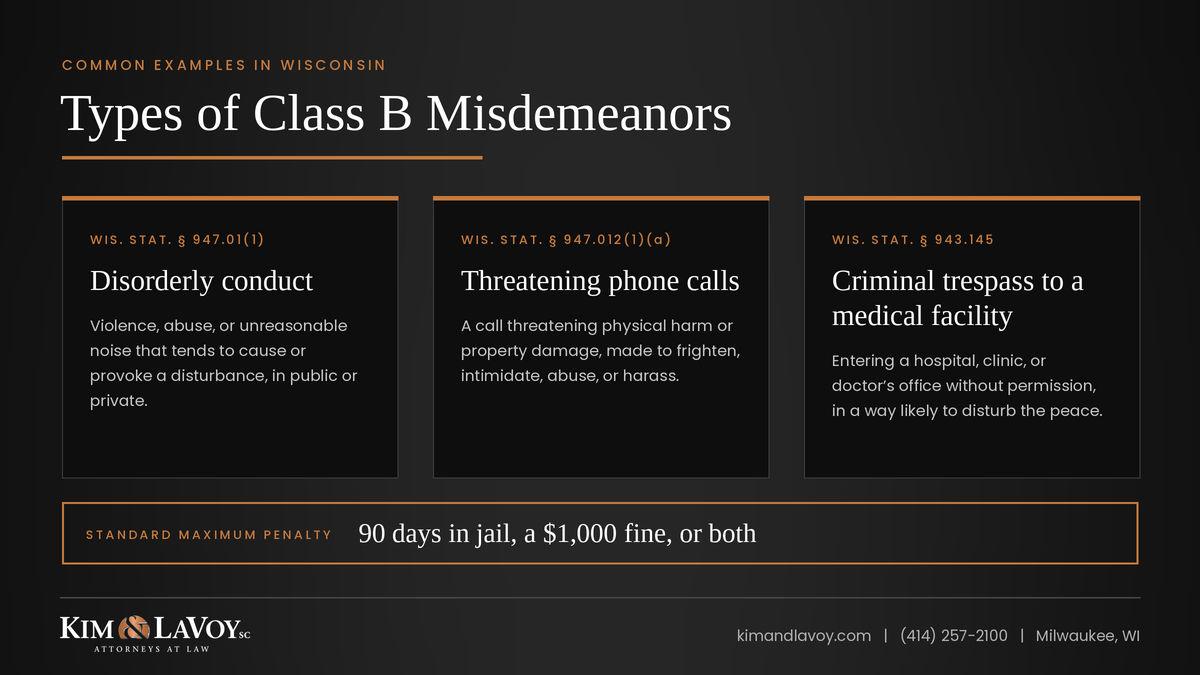
Examples of Class B misdemeanors in Wisconsin include:
- Disorderly conduct: Behavior that is violent, abusive, profane, or unreasonably loud that tends to cause or provoke a disturbance. This behavior can happen in public or private. [Wis. Stat. § 947.01(1)]
- Threatening phone calls: Making a call that threatens physical harm to someone or damage to their property, with the intent to frighten, intimidate, threaten, abuse, or harass. [Wis. Stat. § 947.012(1)(a)]
- Criminal trespass to a medical facility: Intentionally entering a hospital, clinic, or doctor’s office without permission from someone lawfully there, under circumstances likely to disturb the peace. [Wis. Stat. § 943.145]
In Milwaukee, disorderly conduct can also be handled under a city ordinance. That violation carries a forfeiture, meaning a civil financial penalty. If the only penalty for an offense is a forfeiture, it isn’t considered a crime.[Milwaukee Code of Ordinances Chapter 106] [Wis. Stat. § 939.12]
Learn more about disorderly conduct in Wisconsin or how our attorneys defend disorderly conduct charges. If alcohol was involved, read our guide to Wisconsin drinking laws.
“In the past, if the police got involved, many times they’d just tell you to knock it off and go home, but these days, people are getting arrested and they’re getting charged with misdemeanor and sometimes felony offenses for these things.” – Julius Kim, Kim & LaVoy S.C.
Is a Class B Misdemeanor Bad? How It Affects Your Criminal Record
A Class B misdemeanor is a criminal offense, and a conviction will result in you having a criminal record so the consequences can continue after you finish your sentence. [Wisconsin Legislative Council]
A conviction can affect you in several ways:
- Job opportunities: An employer may not hire you if the circumstances of your offense are substantially related to the job’s duties or working conditions. [Wis. Stat. § 111.335]
- Court records: Courts generally must keep misdemeanor case files for at least 20 years after the final judgment. [Wis. SCR 72.01]
- Penalties for future offenses: Misdemeanor convictions on three separate occasions within the five years before a new offense can qualify you as a repeat (habitual) offender. For a new Class B misdemeanor, the maximum sentence can increase to two years. [Wis. Stat. § 939.62(1)(a) and (2)]
Before you plead guilty, a defense attorney can explain your options and how a conviction could affect your future. Read our guide on what to consider before pleading guilty.
Can a Class B Misdemeanor Be Expunged?
Expungement is a legal process that seals your criminal court case file so it is no longer available to the public.
A Class B misdemeanor can qualify for expungement in some cases. The judge must approve it at sentencing, and your court record is expunged only after you successfully complete your sentence. [Wis. Stat. § 973.015]
You generally qualify for consideration if:
- You were under the age of 25 when you committed the offense.
- The offense carries a maximum sentence of six years or less. A standard Class B misdemeanor falls within this limit.
- The judge finds that expungement would benefit you and would not harm society.
Meeting these requirements allows the judge to consider expungement, and approval is discretionary. [Wis. Stat. § 973.015(1m)(a)1.]
Discuss expungement with your lawyer before sentencing. If the judge does not approve it at that hearing, Wisconsin law generally does not allow you to request it afterward. [Wisconsin Legislative Council]
To successfully complete your sentence, you must meet its requirements and have no new convictions during that time. If you are on probation, you must comply with all probation conditions, and your probation must not be revoked. [Wis. Stat. § 973.015(1m)(b)]
Expungement does not overturn your conviction or remove records held by police and other agencies. The case number also remains in the court system. [Wisconsin Legislative Council]
“So there are other options that might be out there that people don’t realize may be available to them to lessen the blow of the situation.” – Julius Kim, Kim & LaVoy S.C.
To find out whether expungement could apply to you, call (414) 257-2100 or contact us online before sentencing.
How We Defend Class B Misdemeanor Charges
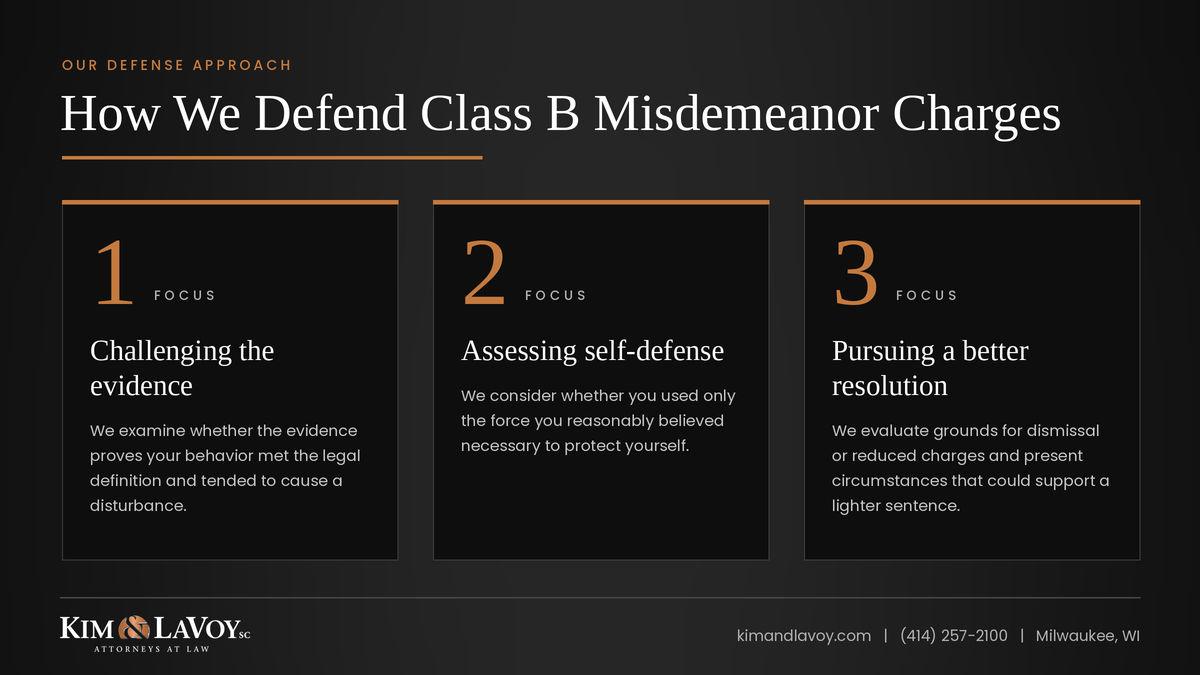
At Kim & LaVoy S.C., we review the police reports and your account to identify weaknesses in the prosecution’s case. Julius Kim’s experience as a former Milwaukee County prosecutor helps us assess the evidence and anticipate the state’s arguments.
Depending on your case, we focus on:
- Challenging the evidence: For disorderly conduct, prosecutors must prove beyond a reasonable doubt that your behavior met the legal definition and tended to cause a disturbance. We examine whether the evidence supports both requirements. [Wisconsin Criminal Jury Instruction 1900]
- Assessing self-defense: We consider whether you used only the force you reasonably believed necessary to protect yourself from an unlawful interference. Learn more about self-defense under Wisconsin law. [Wis. Stat. § 939.48(1)]
- Pursuing a better resolution: We evaluate grounds for dismissal or reduced charges and present circumstances that could support dropping charges or a lighter sentence. For certain domestic abuse charges, deferred prosecution agreements can pause the case while you meet agreed conditions and can lead to dismissal. [Wis. Stat. § 971.37]
We explain the strengths, risks, and consequences of your options so you can make an informed decision before accepting a plea.
Get Legal Help Early for a Class B Misdemeanor
When we get involved early, we can address bail decisions and conditions, review the evidence, and begin discussions with the prosecutor. You’ll get an honest assessment of where you stand and clear guidance on your next steps.
“I would much rather get involved in a case sooner rather than later.”
– Julius Kim, Kim & LaVoy S.C.
We serve clients in Milwaukee, Waukesha, Brookfield, West Bend, Ozaukee County, and throughout Wisconsin. Call (414) 257-2100 or contact us online to discuss your charge and your options.
Frequently Asked Questions About Class B Misdemeanor Wisconsin
Can interfering with a service dog be a criminal offense?
Recklessly interfering with a service dog after being told to stop can be a Class B misdemeanor if you know the animal is a service dog. Certain acts involving intentional interference, injury, or death can lead to Class A misdemeanor or felony charges. A criminal defense attorney can assess what prosecutors must prove about your actions, knowledge, and any warning you received.[Wis. Stat. § 951.18(2s)]
Can a single incident result in criminal charges for both Class B and Class A misdemeanors?
Yes, a single incident can result in multiple misdemeanor charges when the evidence supports each charge. An incident involving a service dog, trespassing at a hospital or medical facility, or property damage may involve different laws and misdemeanor penalties. We assess legal options for each charge, including whether reductions to Class C misdemeanors or other lesser offenses are appropriate.
Can community service reduce jail time or fines?
For most misdemeanors, community service is an option to discuss with your lawyer, and a judge may allow it instead of all or part of a fine, jail, or other punishment. First-time offenders still face potential jail time if convicted, and repeat offenses can affect the sentencing options available to them. We assess available resolutions, including whether a diversion or deferred prosecution agreement in an eligible domestic violence case could help avoid a conviction and fines. [Wis. Stat. § 973.05(3)(a)]
Can a loved one arrange criminal defense help for me?
Yes, a loved one can contact us to help gather paperwork and prepare questions before your initial appearance while you are facing charges. With your permission, we can explain your options and what a misdemeanor record after a criminal conviction could mean for background checks and your life. You remain our client and make decisions about your defense.
Legal Disclaimer
The information provided in this article is for general informational purposes only and does not constitute legal advice. Every criminal case is unique, and the facts of your specific situation may lead to outcomes different from those described here. Reading this content does not create an attorney-client relationship between you and Kim & LaVoy S.C. or any of its attorneys. Wisconsin law is complex and subject to change. For legal advice tailored to your specific circumstances, please contact Kim & LaVoy S.C. directly for a consultation.