
Class B Felony Wisconsin: Penalties, Examples and Defenses
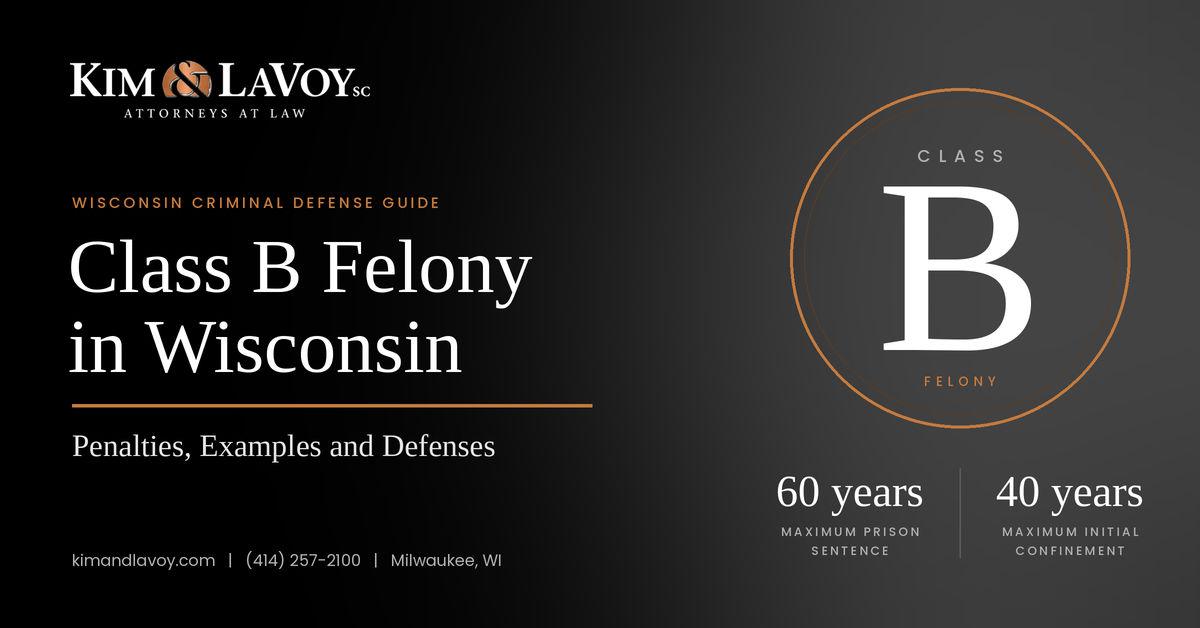
A Class B felony charge in Wisconsin can put decades of your life at stake. It’s the state’s second most serious felony classification, carrying a maximum penalty of 60 years’ imprisonment before any applicable penalty enhancers. [Wis. Stat. § 939.50(3)(b)] Understanding what you could face requires a closer look at the specific offense, the evidence, and the sentencing rules that apply to your case.
You may be worried about your freedom, your family, and whether you have any options. At Kim & LaVoy S.C., our felony defense attorneys can review the allegations, explain the potential consequences, and identify ways to challenge the prosecution’s case. This guide explains Class B felony penalties, common examples, and possible defenses to help you better understand what comes next.
Key Takeaways
- Maximum penalty: You could face up to 60 years in prison. There is no fine for this class. [Wis. Stat. § 939.50(3)(b)]
- How prison time works: A prison sentence in Wisconsin has two parts: up to 40 years in prison, then up to 20 years of supervision in the community. There is no parole for crimes committed on or after Dec. 31, 1999. [Wis. Stat. § 973.01(1), § 973.01(2), § 973.01(6)]
- Common examples: Class B felonies include first-degree reckless homicide (including deaths from drug delivery), second-degree intentional homicide, and certain first-degree sexual assault offenses, including some involving minors. [Wis. Stat. § 940.02, § 940.05, § 940.225(1), § 948.02(1)]
- Probation is possible, but not always: A judge can give you probation unless a law says otherwise. Some Class B crimes require prison time. [Wis. Stat. § 973.09(1)(a), § 939.616]
- Defense options: Your lawyer may challenge the evidence at the preliminary hearing. They may also argue that the facts don’t support a Class B charge, or work out a plea to a lower charge. [Wis. Stat. § 970.03(8), § 940.02, § 939.50(3)]
- No expungement: Wisconsin only lets courts seal records for crimes with a maximum of six years or less. A Class B felony stays on your record. [Wis. Stat. § 973.015(1m)(a)1.]
How Wisconsin Felony Classes Compare
Wisconsin felony classes run from Class A, the most serious, to Class I, the least serious. [Wis. Stat. § 939.50(1)] The nine classes set the maximum sentence for prison, the maximum fine, and the limit on each part of a prison term.
| Class | Maximum Prison Sentence | Maximum Fine | Maximum Initial Confinement | Maximum Extended Supervision |
|---|---|---|---|---|
| Class A Felony | Life imprisonment | None listed | Life sentence rules apply | Life sentence rules apply |
| Class B Felony | 60 years | None listed | 40 years | 20 years |
| Class C Felony | 40 years | $100,000 | 25 years | 15 years |
| Class D Felony | 25 years | $100,000 | 15 years | 10 years |
| Class E Felony | 15 years | $50,000 | 10 years | 5 years |
| Class F Felony | 12 years, 6 months | $25,000 | 7 years, 6 months | 5 years |
| Class G Felony | 10 years | $25,000 | 5 years | 5 years |
| Class H Felony | 6 years | $10,000 | 3 years | 3 years |
| Class I Felony | 3 years, 6 months | $10,000 | 1 year, 6 months | 2 years |
Table sources: [Wis. Stat. § 939.50(3)] [Wis. Stat. § 973.01(2)(b)] [Wis. Stat. § 973.01(2)(d)] [Wis. Stat. § 973.01(3)]
The 60-year ceiling is newer than many people assume. In 1995, Wisconsin had six felony classes, and Class B carried a 40-year maximum [Wis. Stat. 1995 § 939.50(3)(b)]. Some crimes also carry unclassified penalties written into their own statutes. [Wis. Stat. § 973.01(2)(a)]
What Prison Time Looks Like After a Class B Felony Conviction
- A Class B prison sentence has two parts: initial confinement in prison, then extended supervision in the community. [Wis. Stat. § 973.01(2)]
- Confinement must be at least one year and can’t exceed 40 years. [Wis. Stat. § 973.01(2)(b)]
- Extended supervision may not exceed 20 years and must be at least 25% of the confinement term. [Wis. Stat. § 973.01(2)(d)]
- Wisconsin allows no good-time reduction and no parole, so you serve the full confinement term unless a narrow statutory exception applies. [Wis. Stat. § 973.01(4), § 973.01(6)]
- Violating extended supervision can send you back to the Wisconsin state prison system for up to the time remaining on your sentence. [Wis. Stat. § 302.113(9)(am)]
- Class B sentences also can’t be shortened through a sentence adjustment petition. [Wis. Stat. § 973.195(1r)(a)]
- For excluded crimes, including crimes listed in Wisconsin Statute § 940 and child sexual assault under Wisconsin Statute § 948.02, judges can’t approve the Earned Release Program or the Challenge Incarceration Program. [Wis. Stat. § 973.01(3g), § 973.01(3m)]
Is There a Minimum Sentence for a Wisconsin Class B Felony?
For most Class B felonies, no. A judge can order probation unless a statute prohibits it, and the automatic bar covers only crimes punishable by life imprisonment. [Wis. Stat. § 973.09(1)]
If the judge imposes prison, the confinement must be at least one year. [Wis. Stat. § 973.01(2)(b)]
Some Class B offenses carry mandatory prison terms:
- At least 25 years of confinement: Sexual intercourse with a child under 12, or with a child under 16 by use or threat of force or violence, and the matching repeated-acts charge. [Wis. Stat. § 939.616(1r)]
- At least five years of confinement: Sexual contact with a child under 16 by use or threat of force or violence by an actor 18 or older, and the matching repeated-acts charge. [Wis. Stat. § 939.616(2)]
- At least five years of confinement, with no probation: For serious violent crimes like first-degree reckless homicide by someone with a prior serious or violent conviction. [Wis. Stat. § 939.619]
- At least three years and six months of confinement, with no probation: First- or Second degree sexual assault by someone with a prior conviction for either. [Wis. Stat. § 939.618(2)(a)]
The child sex offense minimums don’t apply to offenders under 18 at the time or to persistent repeaters, who face lifetime confinement. [Wis. Stat. § 939.616(3)]
Penalty Enhancers That Raise the Maximum
Penalty enhancers can push a Class B sentence past 60 years:
- Repeater: Up to six more years if an offense is committed after a felony conviction in the prior five years, or up to two more years if an offense is committed after misdemeanor convictions on three separate occasions in that period. Time spent in confinement while serving a sentence is excluded from the five years. [Wis. Stat. § 939.62(1)(c), § 939.62(2)]
- Dangerous weapon: Up to five more years for committing the crime while possessing, using, or threatening to use a dangerous weapon (unless the weapon is already an element of the charge). [Wis. Stat. § 939.63(1)(b), § 939.63(2)]
- Domestic abuse repeater: Up to two more years for a domestic abuse offense committed within 72 hours of a domestic abuse arrest. The same applies after qualifying domestic abuse convictions on two or more separate occasions in the prior 10 years. [Wis. Stat. § 939.621]
- Repeat serious offenses: Life without parole or extended supervision for a repeat first-degree sexual assault, or for a persistent repeater with two prior serious felony convictions. [Wis. Stat. § 939.618(2)(b), § 939.62(2m)]
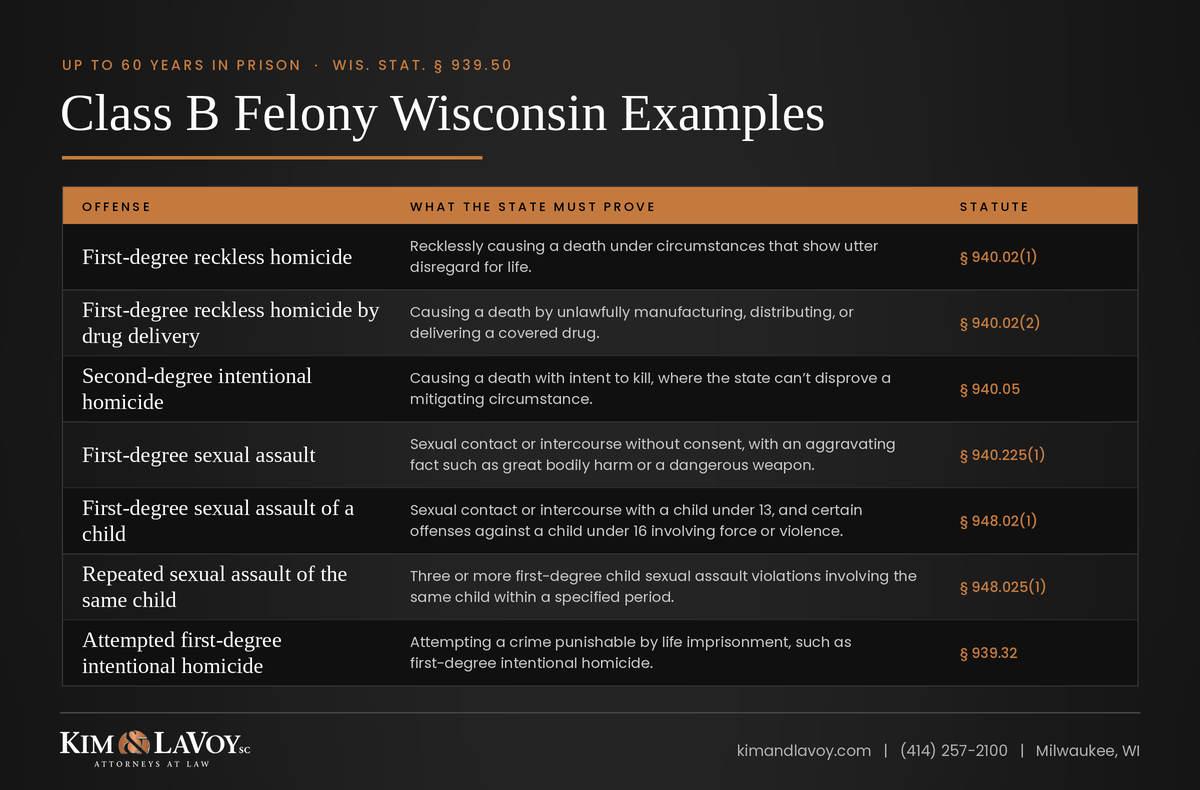
Class B Felony Wisconsin Examples
| Offense | What the State Must Prove | Statute |
|---|---|---|
| First-degree reckless homicide | Recklessly causing the death of another person, or of an unborn child, under circumstances that show utter disregard for life. Criminal recklessness means creating an unreasonable and substantial risk of death or great bodily harm to another human being while aware of that risk. | [§ 940.02(1)] [§ 940.02(1m)] [§ 939.24(1)] |
| First-degree reckless homicide by drug delivery | Causing another person’s death by unlawfully manufacturing, distributing, or delivering a covered drug, or by administering or helping administer it without lawful authority. Covered drugs are Schedule I or II controlled substances, their analogs, ketamine, and flunitrazepam, and the person must use the drug and die from it. | [§ 940.02(2)] |
| Second-degree intentional homicide | Causing the death of another person or an unborn child with intent to kill that person or another. It applies instead of first-degree intentional homicide when the state can’t disprove adequate provocation, unnecessary defensive force, prevention of a felony, or coercion or necessity. Charging this offense concedes that point. | [§ 940.05(1)] [§ 940.05(2)] [§ 940.05(2g)] [§ 940.01(2)] |
| First-degree sexual assault | Sexual contact or intercourse without consent that causes pregnancy or great bodily harm. It also covers assault by use or threat of a dangerous weapon, or an article used or fashioned so the victim reasonably believes it is one. Assault with help from others by use or threat of force or violence also qualifies. It also covers any second-degree sexual assault against a person 60 or older, and a mistake about age is no defense. | [§ 940.225(1)] [WI JI-Criminal 1204 Example] |
| First-degree sexual assault of a child | Sexual intercourse with a child under 12, or with a child under 16 by use or threat of force or violence. It also covers sexual contact with a child under 16 by use or threat of force or violence when the actor is 18 or older. Any sexual contact or intercourse with a child under 13 also qualifies. | [§ 948.02(1)] |
| Repeated sexual assault of the same child | Three or more first-degree child sexual assault violations involving the same child within a specified period. | [§ 948.025(1)] |
| Attempted first-degree intentional homicide | Attempting any crime punishable by life imprisonment, such as first-degree intentional homicide. Attempt means intending the crime and taking acts that unequivocally show you would have committed it except for another person or some other outside factor. | [§ 939.32(1)(a)] [§ 939.32(3)] [§ 940.01(1)] |
Armed robbery, second-degree sexual assault, and intentionally causing great bodily harm to a child are serious charges, but each is a Class C felony, not Class B. [Wis. Stat. § 943.32(2)] [Wis. Stat. § 940.225(2)] [Wis. Stat. § 948.03(2)(a)]
Our guide to the degrees of sexual assault in Wisconsin explains each degree.
Collateral Consequences of a Felony Conviction
- Voting rights: You can’t vote until you finish every part of a felony sentence, including extended supervision or probation, unless you’re pardoned. [Wis. Stat. § 6.03(1)(b)] [Wis. Stat. § 304.078(1)(a)] [Wis. Stat. § 304.078(3)] Then you can register, certifying that you’re no longer under supervision. [Wisconsin Elections Commission]
- Possessing firearms: Possessing a gun after a felony conviction in Wisconsin, or one elsewhere that would be a Wisconsin felony, is a separate Class G felony. [Wis. Stat. § 941.29(1m)(a)] [Wis. Stat. § 941.29(1m)(b)] Federal law also bars possession after a conviction punishable by more than one year. [ATF, Identify Prohibited Persons]
- Permanent criminal record: A Class B conviction can’t be expunged because its maximum exceeds six years. [Wis. Stat. § 973.015(1m)(a)1.]
- Jobs and professional licenses: Employers and licensing agencies may refuse to hire or license you, or terminate your job or license, if the offense is substantially related to the job or licensed activity. [Wis. Stat. § 111.335(3)(a)1.] Licensing agencies must explain a denial in writing and let you present evidence of rehabilitation, except for exempt offenses, which include every chapter 940 crime and child sexual assault under §§ 948.02 and 948.025. [Wis. Stat. § 111.335(4)(c)] [Wis. Stat. § 111.335(1m)(b)1.]
Defenses to Class B Felony Charges
The state must prove beyond a reasonable doubt every fact that is necessary to the crime. [In re Winship, 397 U.S. 358 (1970)] One line of defense is proving that an element from the Class B offense has not been proven.
Challenging Probable Cause at the Preliminary Hearing
- Anyone charged with a felony is entitled to a preliminary hearing unless they waive it. [Wis. Stat. § 970.02(1)(c)]
- It must start within 10 days of the initial appearance if you’re in custody with bail above $500, or 20 days if you’re released, unless the court extends it for cause. [Wis. Stat. § 970.03(2)]
- The court must dismiss counts without probable cause and must amend the complaint if only a misdemeanor probably occurred. [Wis. Stat. § 970.03(8)] [Wis. Stat. § 970.03(10)]
Contesting the Element That Makes It Class B
- The only difference between first and second-degree reckless homicide is “utter disregard for human life.” [Wis. Stat. § 940.02, annotation (State v. Johnson, 2021 WI 61)]
- Second-degree reckless homicide is a Class D felony with a 25-year maximum. [Wis. Stat. § 940.06(1)] [Wis. Stat. § 939.50(3)(d)]
- Self-defense allows force you reasonably believe is necessary to stop what you reasonably believe is an unlawful interference with your person, and deadly force to prevent imminent death or great bodily harm. [Wis. Stat. § 939.48(1)]
- Provocation can limit that privilege, as our guide to Wisconsin self-defense laws explains. [Wis. Stat. § 939.48(2)]
- In sexual assault cases, consent means words or overt actions by a person competent to give informed consent, showing a freely given agreement. [Wis. Stat. § 940.225(4)] People who are unconscious, physically unable to communicate unwillingness, or impaired by a mental illness or defect are presumed unable to consent, though that can be rebutted. [Wis. Stat. § 940.225(4)]
- Without proof of an aggravating fact like great bodily harm or a weapon, the facts may support only second degree (Class C) or third degree (Class G) sexual assault. [Wis. Stat. § 940.225(2)] [Wis. Stat. § 940.225(3)] Our sex offense defense attorneys closely examine those facts.
Plea Negotiations and Mitigating Factors
- A plea to a Class C or Class D charge cuts the maximum prison sentence by 20 years or more. [Wis. Stat. § 939.50(3)]
- “The quality of that plea negotiation is going to be impacted by the respect of the attorneys. And better attorneys are able to get better deals,” says Julius Kim.
- At sentencing, the judge must weigh the gravity of the offense, your character, and the public’s need for protection. [Wis. Stat. § 973.01, annotation (State v. Steele, 2001 WI App 160)]
- “There might be mitigating circumstances, and there could be ways that we could make the situation better that people don’t realize are possible,” says Julius Kim.
Facing a Class B Felony Case? Let Our Criminal Defense Attorneys Help
When your freedom and future are at stake, get legal advice before deciding what to do next. At Kim & LaVoy S.C., our experienced criminal defense attorneys help you understand what you’re facing, what options you have, and how to respond.
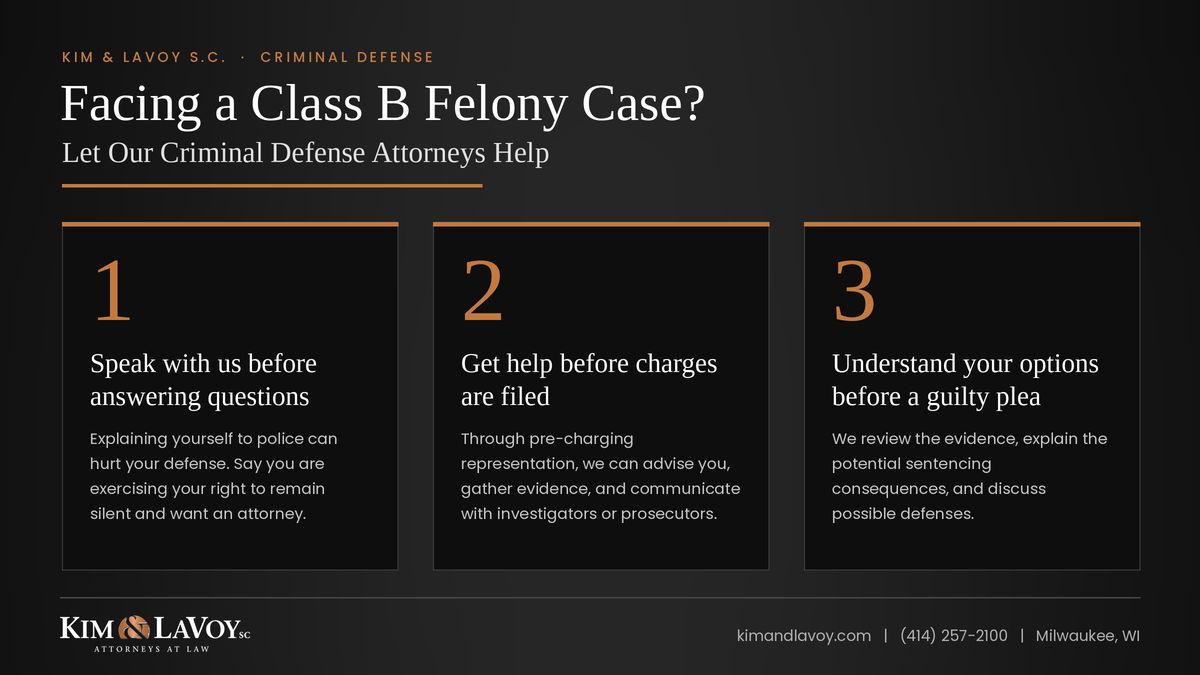
Speak with an experienced attorney before answering questions about the allegations
Trying to explain yourself to police can create problems for your defense. You have the right not to be a witness against yourself. [U.S. Const. amend. V] Clearly state that you’re exercising your right to remain silent and want an attorney, while continuing to follow lawful orders. [Berghuis v. Thompkins, 560 U.S. 370 (2010)]
You don’t have to wait until charges are filed to ask for help
Through pre-charging representation, we can advise you, gather evidence, and communicate with investigators or prosecutors on your behalf. Our managing partner’s experience as a former Milwaukee County prosecutor gives us insight into how charging decisions are made.
Before considering a guilty plea, explore your options
We’ll review the evidence, explain the potential sentencing consequences, and discuss possible defenses so you can make an informed decision about whether to plead guilty.
Let Us Help You Understand Your Options When It Comes To Facing Felony Charges
If you’re under investigation or facing Class B felony charges, contact Kim & LaVoy S.C. for a case evaluation. Tell us what has happened so far, and we’ll help you understand your next steps and begin working to protect your rights.
Frequently Asked Questions About Class B Felony Wisconsin Criminal Charges
Can you get probation for Class B felonies?
Yes, in some cases. Judges can order probation unless a statute prohibits it or the crime is punishable by life imprisonment. [Wis. Stat. § 973.09(1)] Class B offenses with mandatory minimums, like certain child sexual assault charges, require prison. [Wis. Stat. § 939.616]
Do you lose voting rights with a felony in Wisconsin?
Yes, but not permanently. Your right to vote returns when you finish your full sentence, including extended supervision or probation. [Wis. Stat. § 304.078(1)(a)] [Wis. Stat. § 304.078(3)] You can then register, certifying that you’re no longer under supervision. [Wisconsin Elections Commission]
How is a Class B felony different from a Class C felony?
Class B carries up to 60 years with no fine listed, while Class C carries up to 40 years, a $100,000 fine, or both. [Wis. Stat. § 939.50(3)] Class B allows 40 years of initial confinement, compared with 25 for Class C. [Wis. Stat. § 973.01(2)(b)]
What are Class I felonies?
Class I felonies are the lowest Wisconsin felony class, with up to three years and six months in prison, a $10,000 fine, or both. [Wis. Stat. § 939.50(3)(i)] Initial confinement can’t exceed one year and six months. [Wis. Stat. § 973.01(2)(b)]
Can a Class B felony charge be reduced?
Yes. For example, at the preliminary hearing, the judge must dismiss any count that lacks probable cause. If the evidence shows only a misdemeanor probably happened, the judge must amend the complaint to reflect that [Wis. Stat. § 970.03(8)] [Wis. Stat. § 970.03(10)] Charges can also be reduced through plea negotiations, and a jury can convict on a less serious homicide than the one charged. [Wis. Stat. § 939.66(2)]
Legal Disclaimer
The information provided on this page is for general informational purposes only and does not constitute legal advice. Every criminal case is unique, and the facts of your specific situation may lead to outcomes different from those described here. Reading this content does not create an attorney-client relationship between you and Kim & LaVoy S.C. or any of its attorneys. Wisconsin law is complex and subject to change. For legal advice tailored to your individual circumstances, please contact Kim & LaVoy S.C. directly to discuss your case.