
Class C Misdemeanor Wisconsin: Understand Your Charge and Your Options
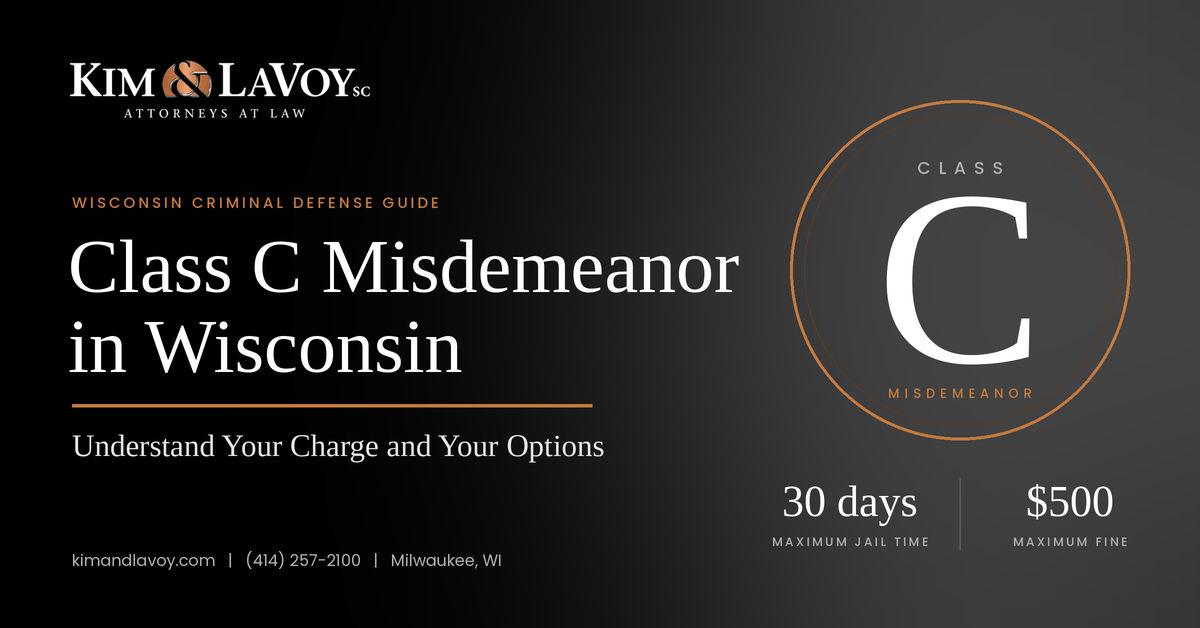
A Class C misdemeanor in Wisconsin carries a maximum penalty of 30 days in jail, a $500 fine, or both. It is Wisconsin’s lowest misdemeanor class, but a conviction still creates a criminal record. [Wis. Stat. § 939.51] [Wisconsin Legislative Council]
The maximum penalty alone doesn’t tell you how your case will end. The exact charge, what the state can prove, and the quality of your legal representation all matter.
At Kim & LaVoy S.C., we focus exclusively on criminal defense. We help you understand those details before you decide how to respond. Call (414) 257-2100 or contact our defense team online to discuss your case.
Key Takeaways
- Maximum penalty: A Class C misdemeanor can mean up to 30 days in jail, a $500 fine, or both. It’s Wisconsin’s lowest misdemeanor class. [Wis. Stat. § 939.51(3)(c)]
- Common examples: Class C charges include failing to aid a victim, blocking a fire hydrant, contributing to truancy, and unsafe firearm storage. [Wis. Stat. § 940.34, § 941.12(3), § 948.45, § 948.55]
- Jail isn’t automatic: A judge may order a fine or probation instead. For most Class C charges, probation can last up to one year. [Wis. Stat. § 973.09(1)(a), § 973.09(2)(a)]
- A conviction still creates a record: It can affect jobs and show up in public court records. It can also lead to tougher penalties for future charges. [Wis. Stat. § 111.335, Wis. SCR 72.01, Wis. Stat. § 939.62]
- Expungement may be possible: If you were under 25 at the time of the offense, the judge may approve expungement at sentencing. You usually can’t ask for it later. [Wis. Stat. § 973.015(1m)(a)1.]
- Exceptions can matter: Some Class C laws have built-in exceptions that may affect whether the charge holds up. [Wis. Stat. § 940.34(2)(d), § 948.55(4)]
What Does a Class C Misdemeanor Mean in Wisconsin?
Class C is the misdemeanor category with the lowest maximum penalties. Wisconsin has three misdemeanor classes:
| Misdemeanor class | Maximum jail time | Maximum fine |
|---|---|---|
| Class A | 9 months | $10,000 |
| Class B | 90 days | $1,000 |
| Class C | 30 days | $500 |
A judge can impose jail time, a fine, or both. These are the limits on what punishment can be imposed and qualifying prior convictions can increase the maximum sentence. [Wis. Stat. § 939.51(3), § 939.62]
Wisconsin defines a felony as a crime punishable by time in state prison. All other crimes are misdemeanors. A violation punishable only by a forfeiture, a financial penalty for a civil violation, is not a crime. [Wis. Stat. § 939.60, § 939.12]
Check the exact charge on your paperwork.
Look for the offense name and statute number on your citation or criminal complaint. The misdemeanor class tells you the penalty range, and the statute tells you what conduct the state is alleging agaisnt you. [Wis. Stat. § 939.51]
For example, disorderly conduct is generally a Class B misdemeanor, while criminal trespass to a dwelling is a Class A misdemeanor. Ordinary trespass to land is generally a civil violation carrying a Class B forfeiture of up to $1,000. A “Class B forfeiture” is different from a Class B misdemeanor. [Wis. Stat. § 947.01, § 943.13, § 943.14, § 939.52]
Our guides to disorderly conduct in Wisconsin and Class A misdemeanors explain those charges.
Which Offenses Are Class C Misdemeanors?
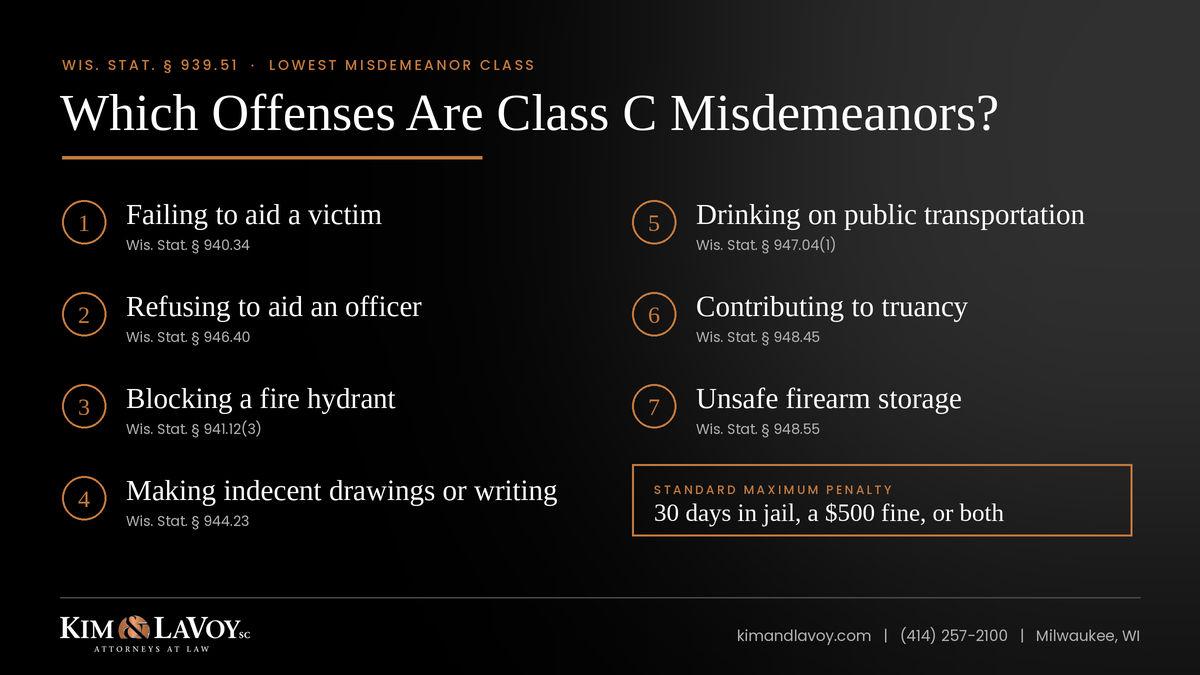
Wisconsin classifies offenses such as failing to aid a victim, blocking a fire hydrant, and contributing to truancy as Class C misdemeanors. Each charge requires specific facts:
- Failing to aid a victim: Knowing that a crime is being committed where a victim faces bodily harm, but failing to call law enforcement, summon other help, or assist the victim. [Wis. Stat. § 940.34(1)(a) and (2)(a)]
- Refusing to aid an officer: Refusing or failing to help someone you know is a peace officer after an authorized command without a reasonable excuse. [Wis. Stat. § 946.40]
- Blocking a fire hydrant: Piling or dumping material that blocks access, without municipal permission. Each day the obstruction continues is a separate offense. [Wis. Stat. § 941.12(3)]
- Making indecent drawings or writing: Making lewd, obscene, or indecent drawings or writing in public or in a public place. [Wis. Stat. § 944.23]
- Drinking on public transportation: Publicly drinking or sharing alcohol as a passenger on a common carrier, such as a bus or train, under circumstances that tend to provoke a disturbance. Exceptions apply where alcohol sales or consumption are specifically allowed by law. [Wis. Stat. § 947.04(1)]
- Contributing to truancy: Knowingly encouraging or contributing to a student’s unexcused school absences, when you’re 17 or older, and the student is 17 or younger. A specific statutory exception may apply. [Wis. Stat. § 948.45]
- Unsafe firearm storage: Recklessly leaving or storing a loaded firearm within a child’s reach or easy access, when the child is under 14. The Class C charge applies if the child obtains it without lawful permission, possesses or displays it in public, or violates the dangerous-weapons rules under Wis. Stat. § 941.20. [Wis. Stat. § 948.55(1) and (3)]
Other examples include vagrancy and certain violations of laws or lawful rules at State Fair Park and specified state or county institutions. [Wis. Stat. § 946.73, § 947.02]
Why a legal exception can matter
Failing to help doesn’t automatically establish a crime. The failing-to-aid law includes exceptions if helping would put you in danger, interfere with duties you owe others, or duplicate help already being provided or summoned. [Wis. Stat. § 940.34(2)(d)]
Firearm storage charges also have exceptions, including secure storage, a trigger lock, or a reasonable belief that no child was likely to be present. These details can affect whether the charge holds up. [Wis. Stat. § 948.55(4)]
Does a Class C Misdemeanor Mean You Will Go to Jail?
Jail is possible, but a Class C conviction doesn’t automatically mean a jail sentence. The maximum is 30 days, generally served in the county jail. A judge may also impose a fine or place you on probation. [Wis. Stat. § 939.51(3)(c), § 973.02, § 973.09(1)(a)]
With probation, the judge may withhold a sentence or impose one and put it on hold. You must follow the court’s conditions, and note that probation can include jail time. [Wis. Stat. § 973.09(1)(a), § 973.09(4)]
For most Class C misdemeanors, the initial probation term is up to one year. Certain offenses, including domestic abuse misdemeanors, offenses committed while possessing a firearm, and Chapter 948 offenses against children, allow six months to two years. Multiple convictions can increase the maximum term. [Wis. Stat. § 973.09(2)(a)]
The $500 fine limit is not a cap on your total court bill. Court costs and surcharges can add to what you owe. Ask your attorney to explain the full financial obligations of any proposed resolution. [Wis. Stat. § 814]
What Can Follow You After the Case Ends?
A Class C misdemeanor conviction creates a criminal record, even if you receive no jail time. Finishing your sentence won’t automatically remove that record. [Wis. Stat. § 973.015]
- Employment: While Wisconsin generally protects applicants from conviction-record based discrimination, an employer may still refuse to hire you if the circumstances of the offense substantially relate to the job. [Wis. Stat. § 111.321, § 111.335]
- Public records: Courts generally must keep misdemeanor case files for at least 20 years after final judgment. Case summaries can also appear on the public Wisconsin Circuit Court Access website. [Wis. SCR 72.01] [Wisconsin Circuit Court Access]
- Future charges: A qualifying felony conviction or misdemeanor convictions on three separate occasions within five years before a new offense can trigger repeat-offender rules. The five-year period excludes time spent confined while serving a criminal sentence. These rules can increase the maximum sentence for a Class C misdemeanor to two years. [Wis. Stat. § 939.62]
Before accepting a plea, discuss both the sentence and the record consequences. Our guide on what to consider before pleading guilty explains why that decision deserves a closer look.
“Sometimes people will come in here with the idea that, again, based upon conversations that they’ve had with other people, that it’s not that big of a deal when it is really a big deal.”
– Julius Kim, Kim & LaVoy S.C.
Can a Class C Misdemeanor Be Expunged?
Expungement is a legal process that seals your criminal court case file so it is no longer available to the public. [Wis. SCR 72.06]
Some Class C misdemeanors qualify. The judge generally must approve expungement at sentencing, and it takes effect after you successfully complete your sentence. [Wis. Stat. § 973.015]
You generally qualify for consideration if:
- You were under 25 when you committed the offense.
- The offense carries a maximum sentence of six years or less, which includes Class C misdemeanors.
- The judge finds that expungement would benefit you and would not harm society.
Approval is discretionary. Wisconsin law generally doesn’t allow you to request expungement after sentencing, so raise it with your lawyer before the hearing. [Wis. Stat. § 973.015(1m)(a)1.] [State v. Matasek, 2014 WI 27]
Successful completion means meeting every sentence condition and having no new convictions during that time. If you’re on probation, it mustn’t be revoked. Expungement doesn’t overturn the conviction or remove records held by police and other agencies. The case number also remains in the court system. [Wis. Stat. § 973.015(1m)(b)] [Wisconsin Legislative Council] [Wis. SCR 72.06]
What to Do After Receiving a Class C Charge
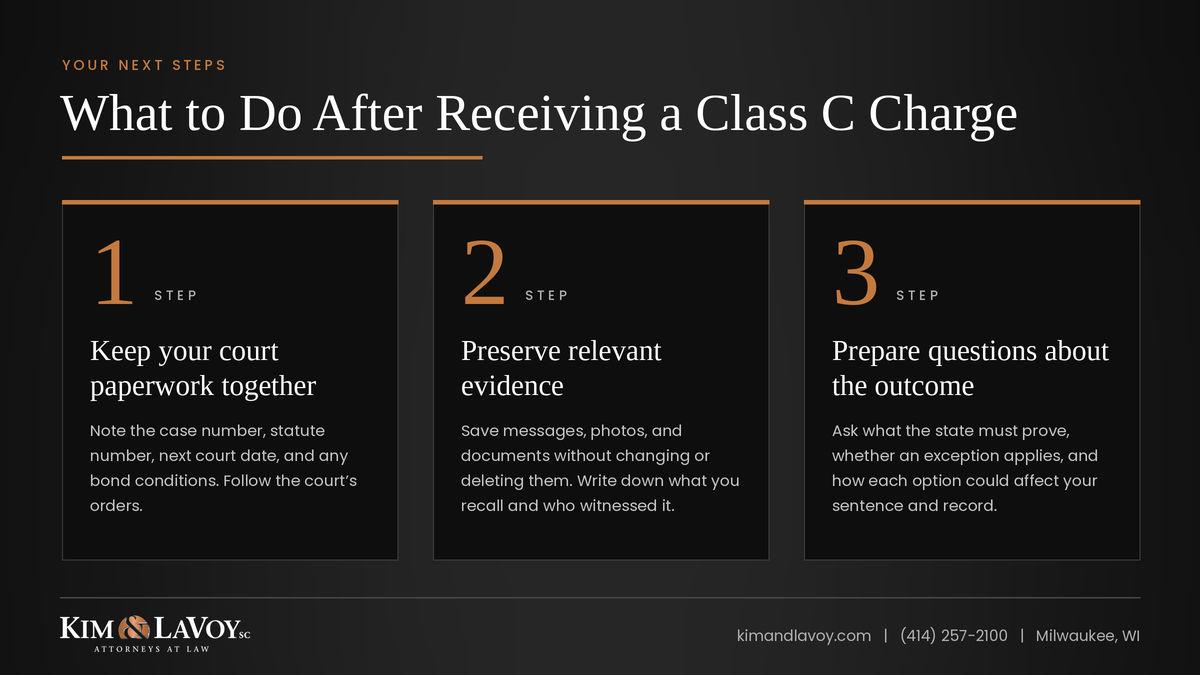
Start by organizing the information your attorney will need:
- Keep your court paperwork together: Note the case number, statute number, next court date, and any bond conditions. Follow the court’s orders.
- Preserve relevant evidence: Save messages, photos, and documents without changing or deleting them. Write down your recollection and the names of anyone who witnessed what happened.
- Prepare questions about the outcome: Ask what the state must prove, whether an exception applies, and how each option could affect your sentence and record.
These steps give your lawyer a clearer starting point. Our guide to the steps in a misdemeanor case in Wisconsin explains what happens next.
How Kim & LaVoy Defense Attorneys Can Help You Evaluate Your Options
We review the police reports, your account, and the available evidence against the requirements of the charge. Also, Julius Kim’s experience as a former Milwaukee County Assistant District Attorney helps us anticipate how prosecutors may evaluate your case.
That review helps us answer the questions that matter to you:
- Can the state prove the charge? We examine each legal requirement and any applicable exceptions.
- Is there a basis to seek dismissal or a reduction of charges? We look for proof problems and legal challenges.
- If the case moves toward sentencing, what can help? We identify mitigating circumstances and discuss probation, expungement eligibility, and other available options.
You get an honest assessment of the case and an explanation of the consequences by an experienced defense lawyer before making a decision to hire a lawyer or not. Learn more about what a defense attorney does.
“What I can guarantee people is that if they hire us, we’re going to do everything we possibly can to look and see if there are any legal issues, challenges, proof problems with the case.”
– Julius Kim, Kim & LaVoy S.C.
Talk Through Your Charge Before Deciding What to Do
Before you decide whether to contest the charge or accept a plea, understand what each option means for your sentence and record. We can walk you through the evidence, possible defenses, and available resolutions. At Kim & LaVoy S.C., we serve clients in Milwaukee, Waukesha, Brookfield, West Bend, Ozaukee County, and throughout Wisconsin. Call (414) 257-2100 or contact us online to discuss your next step.
Frequently Asked Questions About Charges for Class C Misdemeanor, Wisconsin
Can I face criminal charges without being arrested?
Yes. A misdemeanor case can begin with a summons requiring you to appear in court. We can review the paperwork and help you prepare for your initial appearance. [Wis. Stat. § 968.04(2)]
What happens if I miss a court date for my Class C misdemeanor charges?
The court can issue an arrest warrant. Intentionally violating a bond condition, such as missing a court date, can also lead to a bail-jumping charge. Contact your attorney promptly to address the missed appearance. [Wis. Stat. § 968.09, § 946.49]
Are public intoxication, theft, and harassment Class C offenses?
Public intoxication alone is not a crime in Wisconsin, while separate laws govern theft and harassment. These allegations don’t fall into a single class or category of criminal offenses, so don’t assume the least serious category applies. Check the cited statute to determine whether you face a civil forfeiture, a Class A, B, or C misdemeanor, or a felony. [Wis. Stat. § 51.45, § 943.20, § 947.013]
Is possession of up to two ounces of marijuana a Class C misdemeanor?
No. Wisconsin doesn’t use an “up to two ounces” cutoff to classify marijuana possession as Class C. A first state marijuana possession conviction generally carries potential penalties of up to six months in jail, a $1,000 fine, or both. Adult drug paraphernalia possession under section 961.573(1) has its own specified punishment of up to 30 days in jail, a $500 fine, or both. [Wis. Stat. § 961.41(3g)(e), § 961.573(1)]
Are traffic violations treated like misdemeanor charges?
Many traffic violations are civil matters, and a civil forfeiture doesn’t create a criminal conviction. Certain traffic violations, including repeat OWI offenses, are crimes that can carry mandatory jail time. If you’re facing charges for what seems like a minor traffic issue, review the specific statute and the possible long-term consequences with an attorney. [Wis. Stat. § 346.65(2), § 939.12]
Can a dismissed charge still appear in background checks?
A dismissed charge is not a criminal conviction, but related arrest or court records may still appear in background checks. If you’re convicted, you may face a permanent criminal record with long-term consequences for your work and life. We can explain what remains visible and whether your legal options include requesting removal of eligible arrest information. [Wis. Stat. § 165.84(1).] [Wis. SCR 72]
Can the person who accused me have the case dismissed?
The person who accused you doesn’t legally control whether the case is dismissed. Only the prosecutor makes that decision. Even for a minor charge, we review potential defenses and whether alternative resolutions are available. Our legal representation focuses on explaining your options and pursuing the best possible outcomes the evidence and law allow. [Wis. Stat. § 978.05(1)]
Legal Disclaimer
The information provided in this article is for general informational purposes only and does not constitute legal advice. Every criminal case is unique, and the facts of your specific situation may lead to outcomes different from those described here. Reading this content does not create an attorney-client relationship between you and Kim & LaVoy S.C. or any of its attorneys. Wisconsin law is complex and subject to change. For legal advice tailored to your specific circumstances, please get in touch with Kim & LaVoy S.C. directly for a consultation.