
Class A Felony in Wisconsin: Penalties and Legal Process for Class A and all Felony Offenses
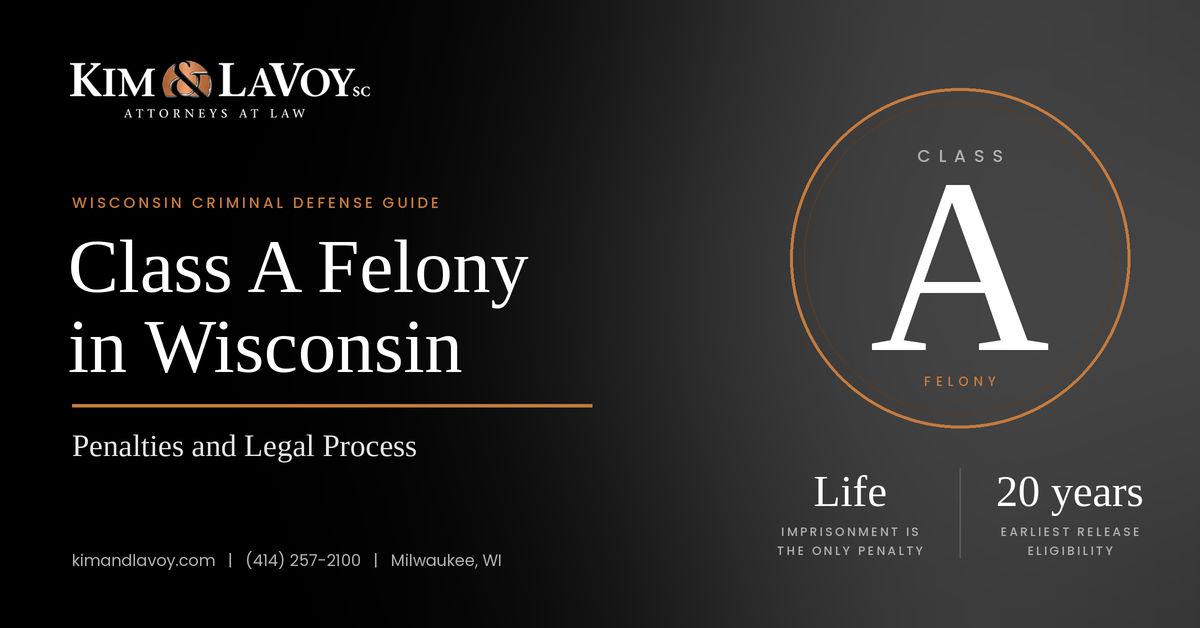
A Class A felony in Wisconsin is the most serious classification of crime in the state, and its only penalty is life imprisonment. [Wis. Stat. § 939.50] If you or someone you love is facing felony charges at this level, the sentencing question isn’t whether the sentence is life. It’s whether, and when, the judge allows a path to release. [Wis. Stat. § 973.014]
This guide explains which crimes constitute Class A felonies, how sentencing works, and what to do next.
Key Takeaways
- Wisconsin has nine felony classifications, A through I, and a Class A felony carries life imprisonment. [Wis. Stat. § 939.50]
- Probation isn’t available for a crime punishable by life imprisonment. [Wis. Stat. § 973.09]
- The judge decides whether the person can seek release to extended supervision after 20 years, at a later date, or never. [Wis. Stat. § 973.014]
- Four mitigating circumstances reduce first-degree intentional homicide to a Class B felony. [Wis. Stat. § 940.01]
- A Class A felony conviction can’t be expunged and bars firearm possession unless a narrow exception applies. [Wis. Stat. § 973.015, § 941.29]
How Wisconsin Classifies Felonies
- Any crime punishable by imprisonment in the Wisconsin state prisons is a felony. [Wis. Stat. § 939.60]
- A felony belongs to one of the nine classes only when the statute defining it says so. [Wis. Stat. § 939.50]
- An unclassified felony has its penalty written into its own statute, as felony murder does. [Wis. Stat. § 940.03]
- Most felonies receive a bifurcated sentence, meaning prison confinement followed by extended supervision in the community. [Wis. Stat. § 973.01(2)]
- A felony punishable by life imprisonment is excluded from standard bifurcated sentencing and is instead sentenced under Wis. Stat. § 973.014(1g).
Wisconsin Felony Classes Compared
This table shows each class’s maximum penalty and the most prison time a judge can order before extended supervision begins. [Wis. Stat. § 939.50(3)] [Wis. Stat. § 973.01(2)(b)]
| Felony class | Maximum prison sentence | Maximum fine | Maximum initial confinement in prison |
|---|---|---|---|
| Class A | Life imprisonment | None listed | Set under § 973.014(1g) |
| Class B | 60 years | None listed | 40 years |
| Class C | 40 years | $100,000 | 25 years |
| Class D | 25 years | $100,000 | 15 years |
| Class E | 15 years | $50,000 | 10 years |
| Class F | 12 years, 6 months | $25,000 | 7 years, 6 months |
| Class G | 10 years | $25,000 | 5 years |
| Class H | 6 years | $10,000 | 3 years |
| Class I | 3 years, 6 months | $10,000 | 1 year, 6 months |
Examples of Class A Felonies in Wisconsin
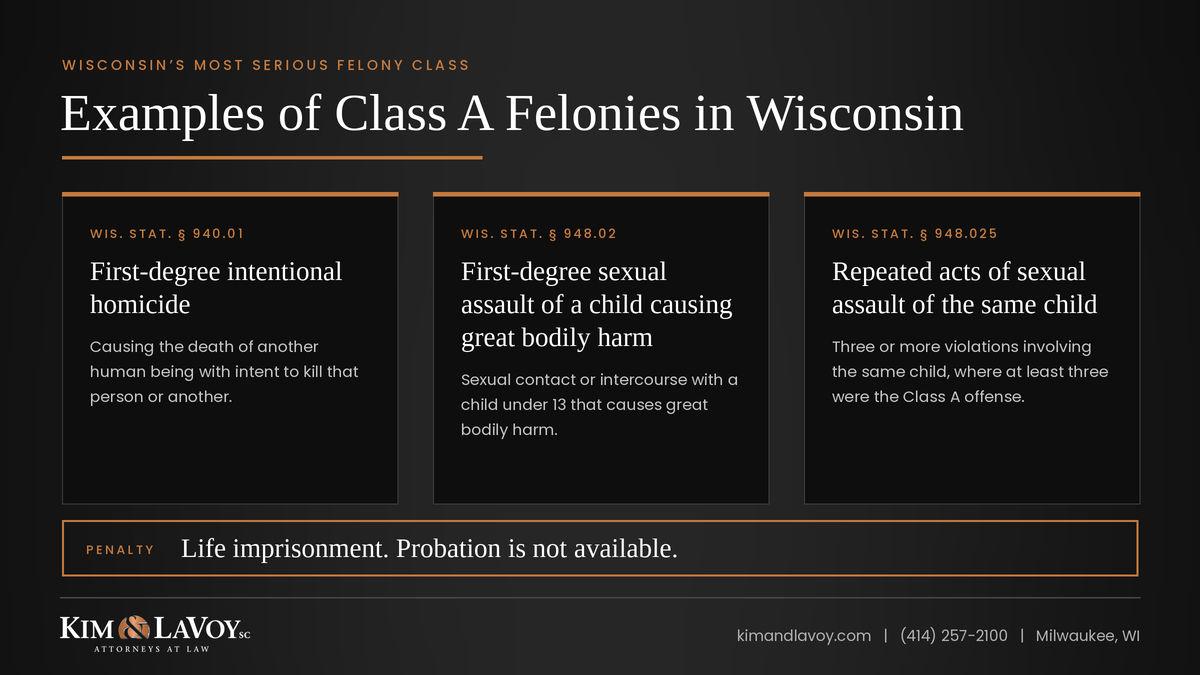
First-Degree Intentional Homicide
- First-degree intentional homicide means causing the death of another human being with intent to kill that person or another. [Wis. Stat. § 940.01(1)(a)]
- It also covers causing the death of an unborn child with intent to kill that unborn child, the woman pregnant with that child, or another. [Wis. Stat. § 940.01]
- In the homicide statutes, a “human being” is one who has been born alive. [Wis. Stat. § 939.22]
- “With intent to” covers a person whose purpose is to cause the result, and a person aware their conduct is practically certain to cause it. [Wis. Stat. § 939.23] That’s why the state can argue intent even when someone says they never meant for anyone to die.
Four affirmative defenses, called mitigating circumstances, reduce the charge to second-degree intentional homicide, a Class B felony. [Wis. Stat. § 940.01(2), § 940.05]
- Adequate provocation: The death was caused under the influence of adequate provocation as Wisconsin law defines it. [Wis. Stat. § 940.01(2)(a), § 939.44]
- Unnecessary defensive force: The person believed they or another faced imminent danger of death or great bodily harm and that the force was necessary, but either belief was unreasonable. [Wis. Stat. § 940.01(2)(b)]
- Prevention of a felony: The person unreasonably believed the force was necessary to prevent or end a felony. [Wis. Stat. § 940.01(2)(c)]
- Coercion or necessity: The death was caused in the exercise of a privilege under Wis. Stat. § 939.45(1). [Wis. Stat. § 940.01(2)(d)].
Once the trial evidence places one of these defenses at issue, the state must prove beyond a reasonable doubt that it didn’t exist. [Wis. Stat. § 940.01(3)]
Our guide to Wisconsin self-defense laws explains how courts judge reasonableness.
First-Degree Sexual Assault of a Child Causing Great Bodily Harm
- It’s a Class A felony to have sexual contact or sexual intercourse with a person who has not attained the age of 13 years and cause great bodily harm to that person. [Wis. Stat. § 948.02(1)(am)] Both terms carry detailed statutory definitions in Wisconsin Statute § 948.01(5-6).
- Great bodily harm is bodily injury that creates a substantial risk of death or causes serious permanent disfigurement. It also includes a permanent or protracted loss or impairment of the function of any bodily member or organ, or other serious bodily injury. [Wis. Stat. § 939.22(14)]
- The other offenses under Wisconsin Statute § 948.02(1) are Class B felonies, so that one element separates a life sentence from a 60-year maximum. [Wis. Stat. § 939.50] Learn more about our sex offense defense.
Repeated Acts of Sexual Assault of the Same Child
- Committing three or more violations of first- or second-degree sexual assault involving the same child within a specified period is a separate crime. It’s a Class A felony only if at least three violations were the Class A offense defined in Wisconsin Statute § 948.02(1)(am). Otherwise, it’s a Class B or Class C felony. [Wis. Stat. § 948.025]
- For charges involving adults, see our guide to the degrees of sexual assault in Wisconsin.
- An attempt to commit a crime punishable by life imprisonment is a Class B felony, not a Class A felony. [Wis. Stat. § 939.32(1)(a)]
Wisconsin Class A Felony Sentencing
The court can’t order probation for a crime punishable by life imprisonment, per Wisconsin Statute § 973.09(1)(c). For a crime committed on or after Dec. 31, 1999, the judge must choose one of three options instead. [Wis. Stat. § 973.014(1g)(a)1.-3.]
- The person is eligible for release to extended supervision after serving 20 years.
- The person is eligible on a later date set by the court, which can’t be earlier than 20 years.
- The person is not eligible for release to extended supervision.
Parole isn’t available under this sentence. [Wis. Stat. § 973.014(2)]
Eligibility Isn’t Release
Reaching the eligibility date only allows the person to petition the sentencing court. The district attorney responds in writing, and victims can make a statement. [Wis. Stat. § 302.114(5)]
The court can’t grant release unless the person proves, by clear and convincing evidence, that they aren’t a danger to the public. [Wis. Stat. § 302.114(5)(cm)]
If extended supervision is later revoked due to a violation, the court must order at least five more years in prison before the person is eligible again. [Wis. Stat. § 302.114(9)(am)]
Penalty Enhancers and Habitual Criminality
Under the persistent repeater law, a person convicted of a “serious felony” on two or more separate prior occasions receives life imprisonment without the possibility of parole or extended supervision for a new serious felony. [Wis. Stat. § 939.62, 973.014]
Collateral Consequences of a Felony Conviction
- Firearms: Possessing a firearm after a Wisconsin felony conviction is a Class G felony, with limited exceptions such as certain pardons. [Wis. Stat. § 941.29(1m)]
- Voting: A person convicted of a felony can’t vote until they receive a pardon or complete the full term of imprisonment, including extended supervision or probation. [Wis. Stat. § 6.03(1)(b)]
- Expungement: Wisconsin’s expungement statute applies only to offenses committed before age 25 that carry a maximum sentence of 6 years or less. [Wis. Stat. § 973.015(1m)(a)1.]
- Residence approval: A person on extended supervision for a serious sex offense must live in a residence approved by the Department of Corrections. [Wis. Stat. § 302.116(1)]
What Happens After Felony Charges in Wisconsin
Wisconsin Statute § 970 describes the criminal procedure for a felony charge. At the initial appearance, the judge provides a copy of the complaint, explains the penalties for the felony charged, and addresses bail.
Anyone charged with a felony is entitled to a preliminary hearing unless they waive it. At that hearing, the court decides whether there’s probable cause to believe the person committed a felony. If it finds probable cause, the case is bound over for trial and can continue. If it doesn’t, the court must discharge the person.
Defense Strategies in a Class A Felony Case
Depending on the facts, a criminal defense attorney may ask questions like these about the felony charges.
- Can the state prove intent as Wisconsin law defines it?
- Does a mitigating circumstance reduce a homicide charge to a Class B felony?
- Does the evidence support a finding of great bodily harm in a first-degree sexual assault case?
- Did law enforcement violate your rights when gathering evidence or taking statements?
Raising these issues only helps if the prosecutor believes the defense will follow through.
“If we find these legal challenges or issues and bring them up to the prosecutor, unless the prosecutor knows and believes that you are actually capable and willing to litigate these things, that’s not going to make a difference to that prosecutor,” says Julius Kim, Managing Partner at Kim & LaVoy S.C.
Next Steps If You’re Under Investigation or Charged
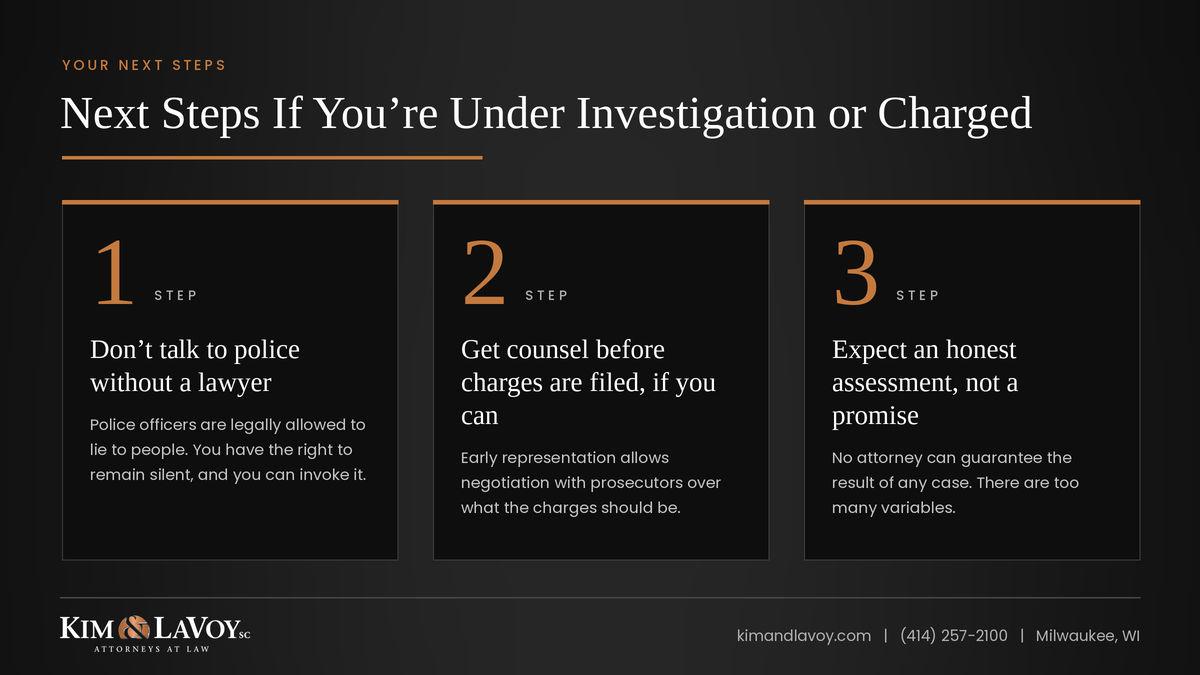
Don’t talk to police without a lawyer
“One thing that people don’t realize also is that police officers are legally allowed to lie to people,” says Julius Kim, Managing Partner at Kim & LaVoy S.C. Our guide to the right to remain silent explains how to invoke it.
Get counsel before charges are filed, if you can
“We can also try to negotiate with prosecutors as to what the different types of charges should be in a particular case,” says Julius Kim, Managing Partner at Kim & LaVoy S.C. Prosecutors can charge second-degree intentional homicide from the start, which concedes they can’t disprove a mitigating circumstance. [Wis. Stat. § 940.05(1)(b)] Learn more about pre-charging representation.
Expect an honest assessment, not a promise
“No attorney can guarantee the result of any case. There are just too many variables,” says Julius Kim, Managing Partner at Kim & LaVoy S.C.
Talk to a Class A Felony Lawyer in Wisconsin
The earliest decisions in a Wisconsin Class A felony case can shape the charge itself. A criminal conviction at this level carries a life sentence, and the actual sentence depends on whether the judge allows a path to extended supervision. Because Wisconsin’s expungement statute only applies to certain low-level, non-violent offenses committed while under the age of 25, the conviction also leaves a permanent criminal record. [Wis. Stat. § 973.015]
Those long-term consequences are why the choice of counsel matters from the start. An experienced criminal defense attorney can test whether the state can prove intent, raise any mitigating circumstance, and challenge how evidence was gathered. [Wis. Stat. § 940.01] Where the facts support it, plea negotiations can address the charge itself, such as resolving a homicide case as second-degree intentional homicide, a Class B felony. [Wis. Stat. § 940.05]
“When we get involved in a case early, then we have some input as to how that table is set for the rest of the case,” says Julius Kim, Managing Partner at Kim & LaVoy S.C. Julius is a former Milwaukee County prosecutor, and our experienced criminal defense team brings that perspective to cases in Wisconsin courts throughout the state.
Get a Straight Answer About Your Class A Felony Case
If you or a family member is facing a Wisconsin Class A felony charge or investigation, an experienced attorney can explain where your case stands and what your options are. Call Kim & LaVoy S.C. at (414) 257-2100 or contact us for a case evaluation. We’ll give you a straight answer about where you stand and pursue the most favorable outcome the facts allow.
Frequently Asked Questions About Class A Felonies in Wisconsin
What is a Class A felony in Wisconsin?
It’s the highest of Wisconsin’s nine felony classes, and its penalty is life imprisonment. Examples include first-degree intentional homicide and first-degree sexual assault of a child under 13 that causes great bodily harm.
Can a Class A felony mean life without any chance of release?
Yes. The judge may find the person ineligible for release to extended supervision. A persistent repeater also receives life without the possibility of parole or extended supervision.
How is a Class A felony different from a Class E felony or Class I felony?
A Class E felony carries up to 15 years in prison and a $50,000 fine. A Class I felony carries a sentence of up to 3.5 years and a $10,000 fine. Both receive a bifurcated sentence with set limits as to the amount of up front prison time, while a Class A felony carries a life sentence.
What should I do if I’m charged with a felony in Wisconsin?
Don’t discuss the case with police, and speak with a criminal defense attorney as early as you can. Bring any paperwork you received from police or the court to that first conversation.
Legal Disclaimer
The information provided in this article is for general informational purposes only and does not constitute legal advice. Every criminal case is unique, and the facts of your specific situation may lead to outcomes different from those described here. Reading this content does not create an attorney-client relationship between you and Kim & LaVoy S.C. or any of its attorneys. Wisconsin law is complex and subject to change. For legal advice tailored to your specific circumstances, please contact Kim & LaVoy S.C. directly to schedule a consultation.